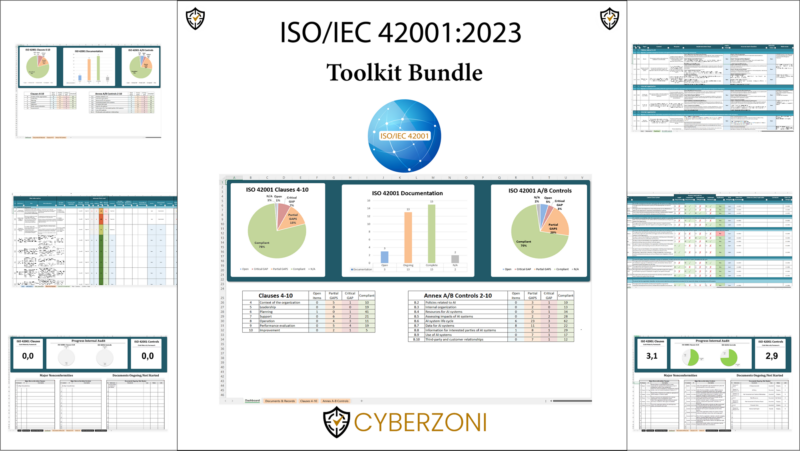
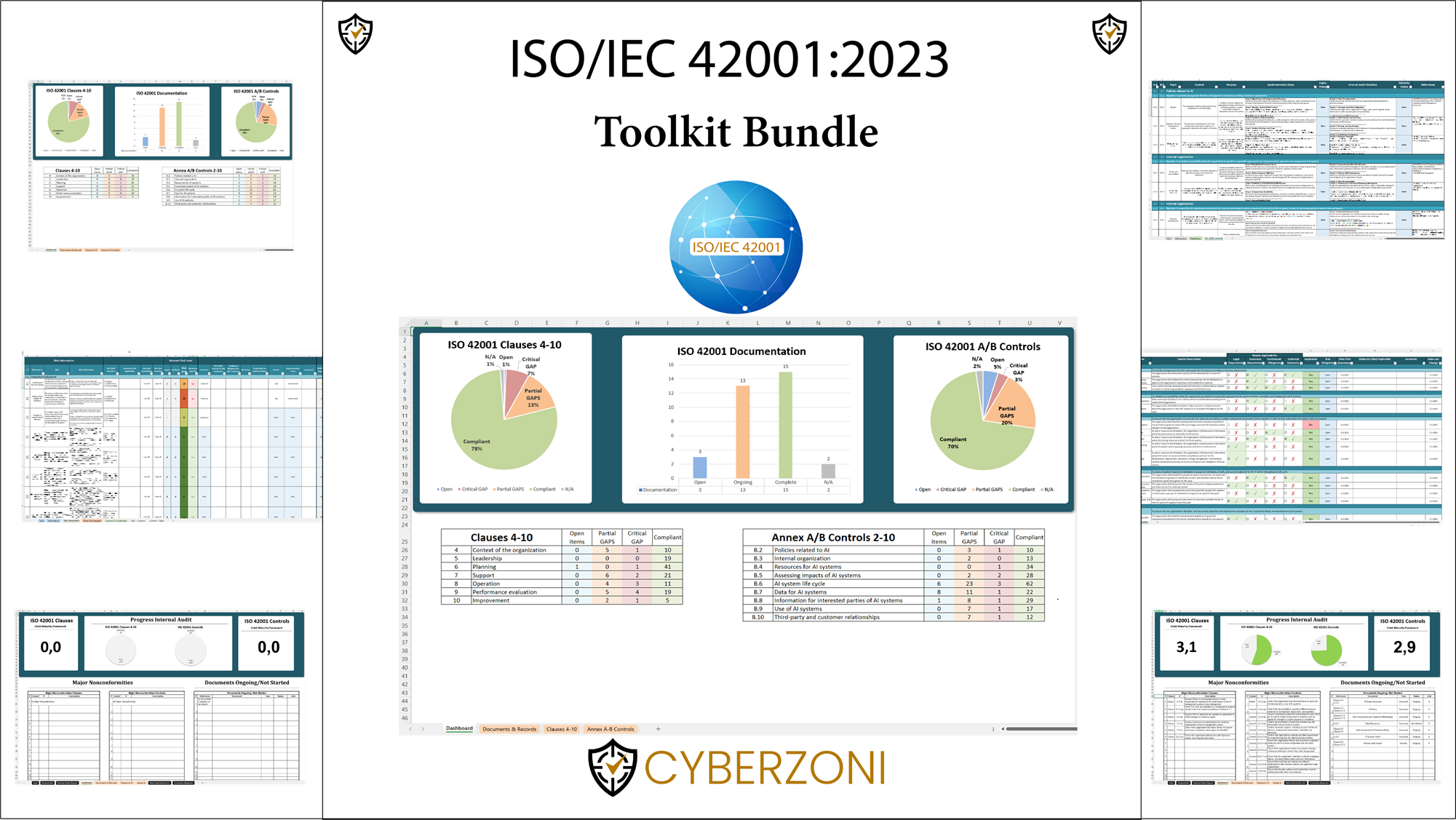
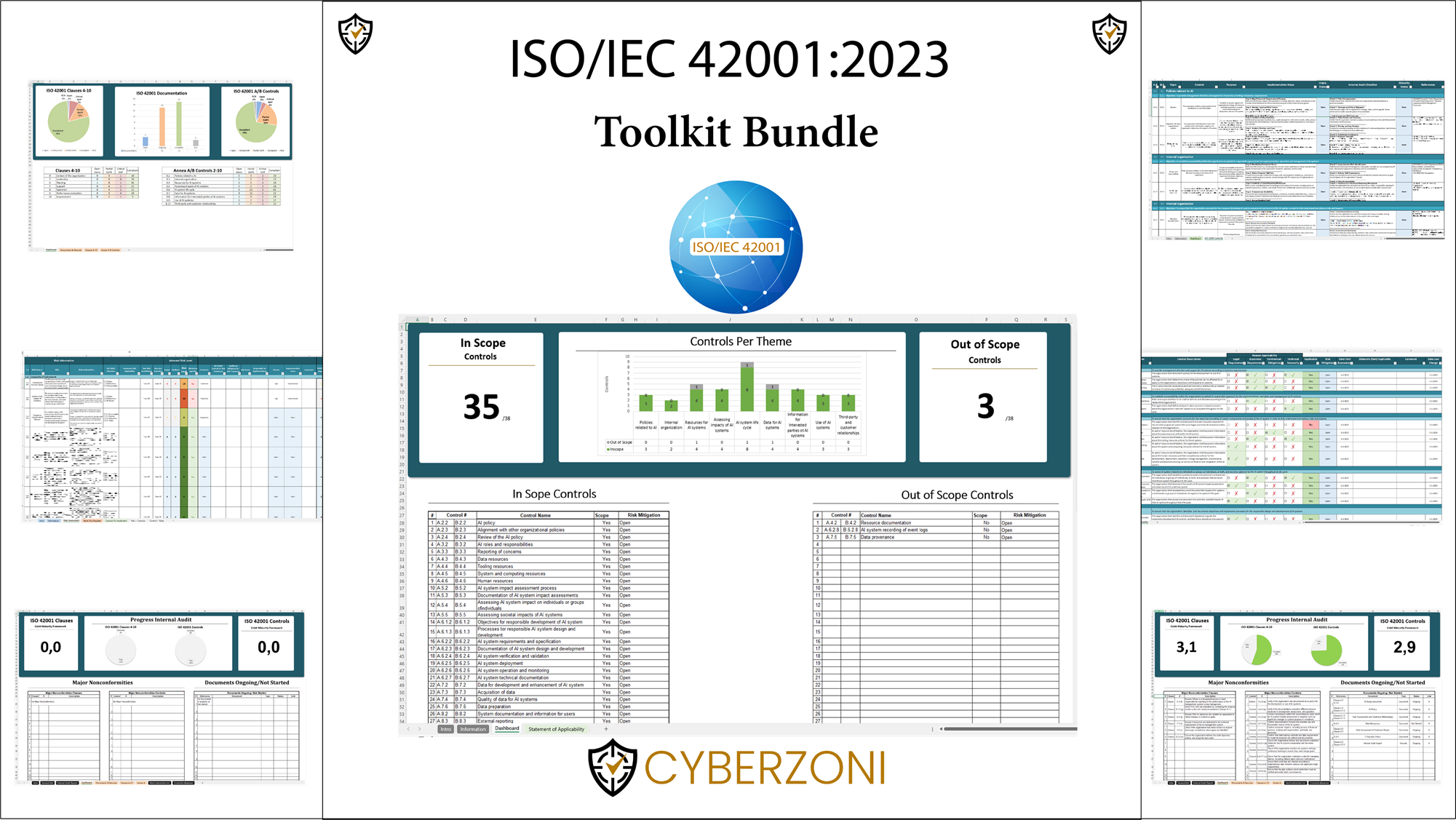
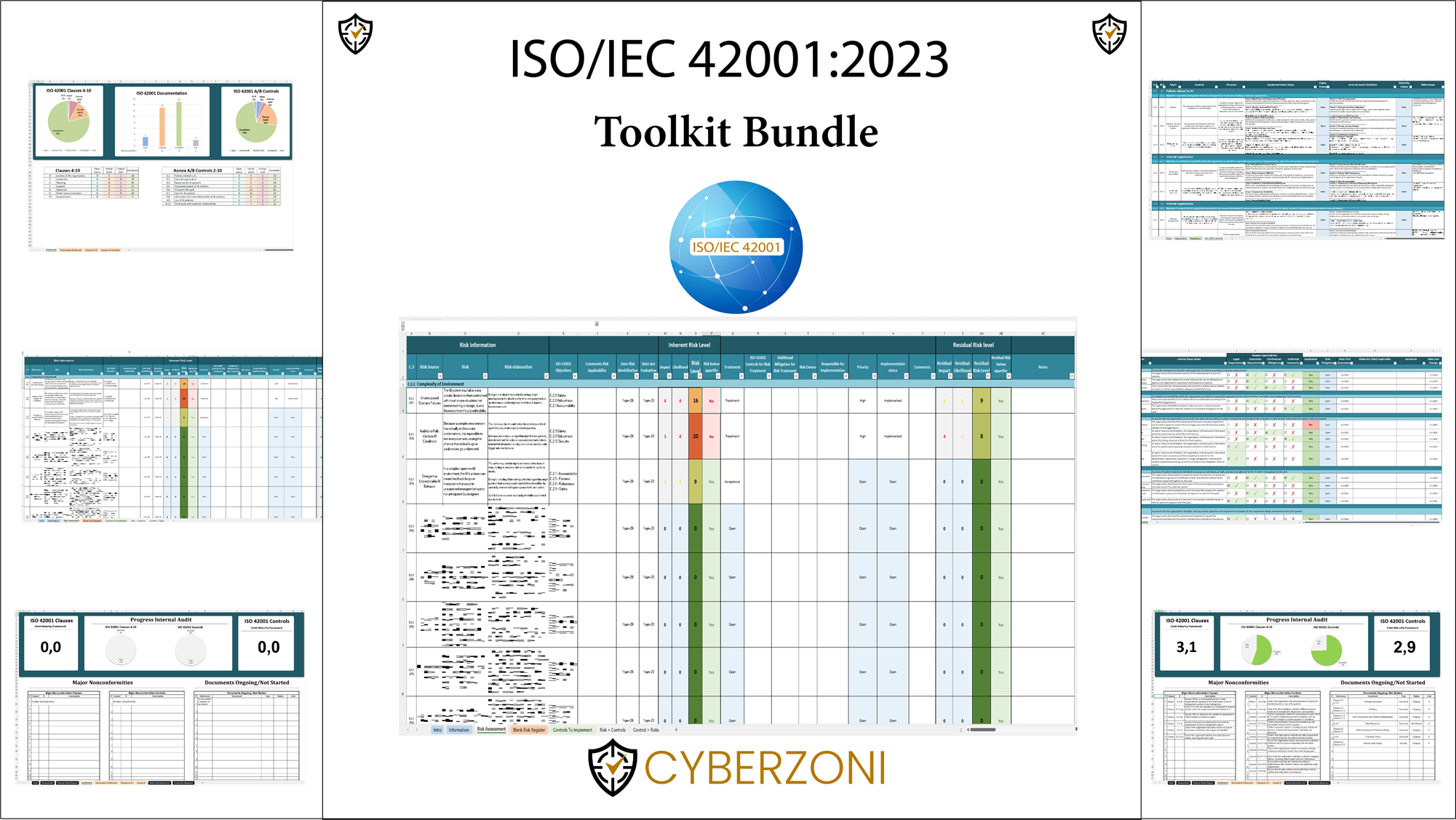
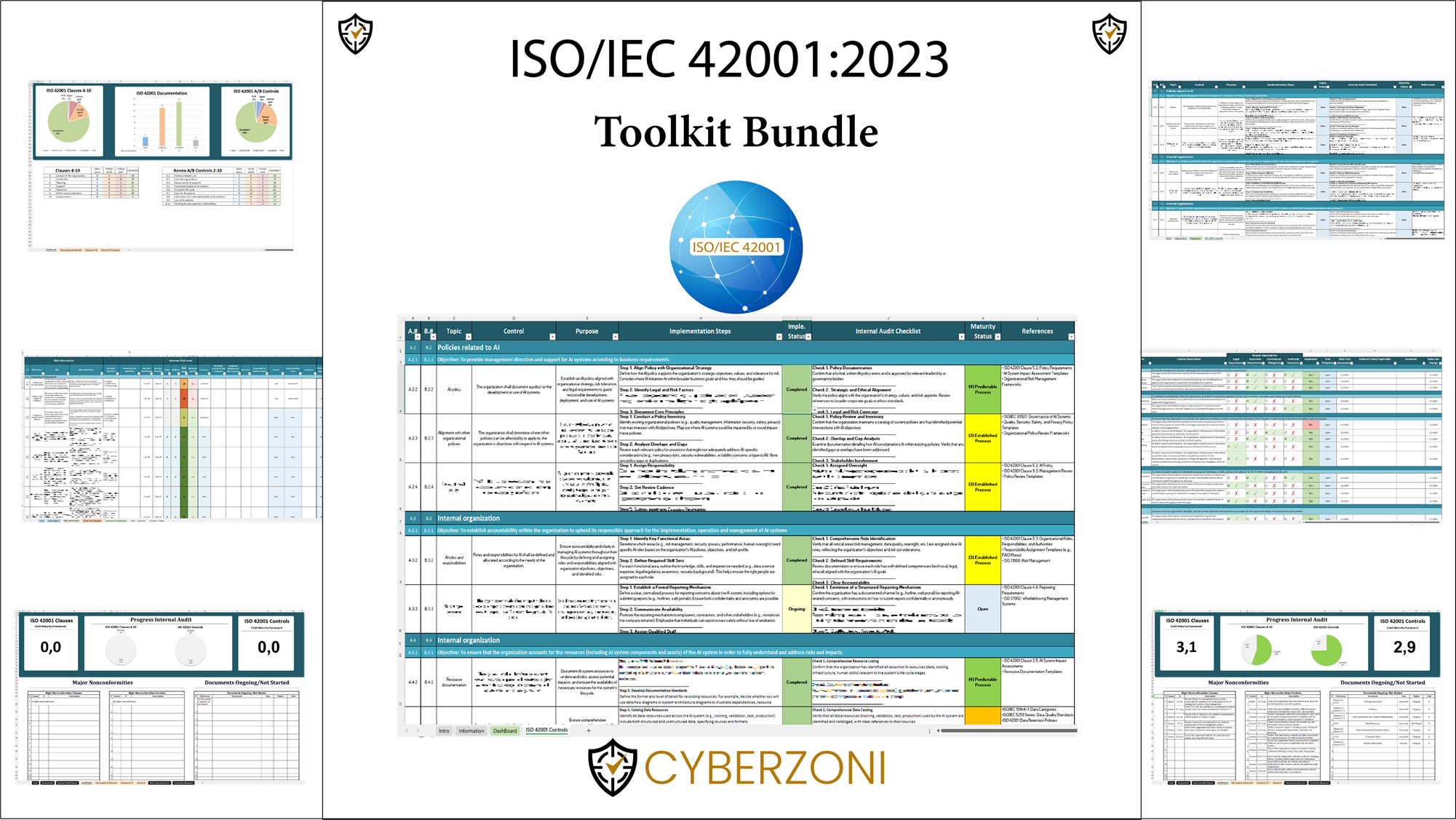
ISO 42001 Toolkit Bundle

Configure your own ISO/IEC 42001 toolkit based on your organization’s needs.
Structure AI governance, responsibilities, risks, controls and audit preparation.
AIMS Templates, Policies, Procedures, Records
Build a practical documentation foundation for your AIMS.
Editable Word and Excel templates with instant download.

Original price was: € 955,00.Current price is: € 878,60.

Image Product Quantity
Secure checkout Protected WooCommerce checkout
Built from Experience Based on real business situations
CyberZoni support Questions can be handled by the CyberZoni team
Need a custom version? Contact us for custom templates and support
Secure checkout Protected purchase flow
Practical templates Built for real compliance work
ISO-focused Designed around standards and controls
Support available Contact CyberZoni for help

Core AIMS Implementation Templates for AI Governance

Build, document and improve your Artificial Intelligence Management System with this practical ISO 42001 Toolkit. Designed for organizations that develop, provide, procure or use AI systems, this toolkit gives you the core templates needed to start implementing an ISO/IEC 42001-aligned AI Management System, often referred to as an AIMS.

ISO/IEC 42001:2023 specifies requirements for establishing, implementing, maintaining and continually improving an Artificial Intelligence Management System. It is designed for organizations providing or using AI-based products or services and supports responsible development and use of AI systems.

This ISO 42001 documentation toolkit helps you move from scattered AI policies, informal risk discussions and undocumented AI use cases to a structured, evidence-based AIMS. It includes ready-to-customize templates for AI policy, AIMS scope, risk assessment, AI system impact assessment, Statement of Applicability, lifecycle governance, internal audit and more.

An AI management system helps organizations define responsibilities, assess AI-related risks, address transparency and accountability, manage data quality and monitor AI systems across their lifecycle. This ISO 42001 Toolkit is built around those practical implementation needs.


What This ISO 42001 Toolkit Helps You Accomplish

This ISO 42001 Toolkit is designed to help your organization create the core documented foundation for an AI Management System.

  • Define the scope of your AIMS, including which AI systems, teams, processes, business units, locations and third-party relationships are included.
  • Create a clear AI policy that sets the direction for responsible AI development, procurement, deployment and use.
  • Identify internal and external issues affecting AI governance through PESTLE analysis and legal obligation tracking.
  • Assign AI governance roles and responsibilities using a RACI matrix so leadership, compliance, IT, legal, product, security, data, procurement and operations teams know what they own.
  • Assess AI risks and opportunities, including risks related to bias, safety, privacy, security, transparency, misuse, supplier reliance, model performance and operational impact.
  • Perform AI system impact assessments for individuals, groups and wider societal impacts.
  • Build a Statement of Applicability for ISO 42001 Annex A controls, documenting which controls apply, why they apply, implementation status and supporting evidence.
  • Document your AI system lifecycle process from design and development through deployment, monitoring, change management and retirement.
  • Prepare for internal audits by reviewing ISO 42001 clauses, selected controls, evidence and implementation gaps.
  • The result is a practical AIMS implementation toolkit that reduces the time required to create ISO 42001 documentation from scratch and gives your team a structured starting point for implementation, audit preparation and continual improvement.

What’s Included in the ISO 42001 Toolkit?

ISO/IEC 42001 is structured around management system clauses 4–10 and Annex A control areas. Annex A contains AI-specific controls grouped across areas including AI policy, internal organization, resources, impact assessment, AI system lifecycle, data, interested-party information, use of AI systems and third-party relationships.

The following documents are included in this ISO 42001 Toolkit:

Included Document What It Is Used For Main ISO 42001 Clause and/or Control Mapping
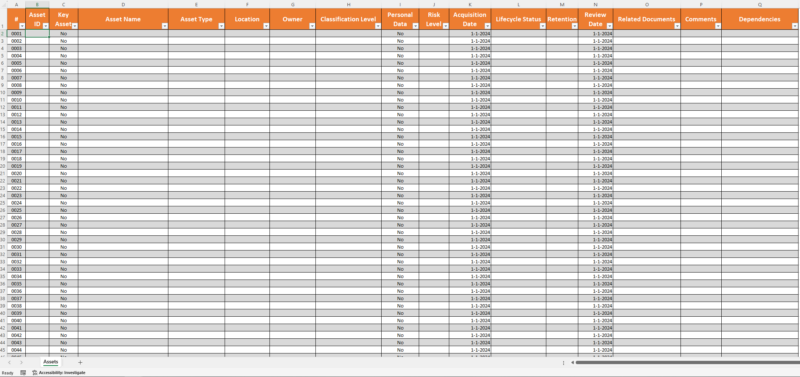
ISO 42001 Checklist – GAP Analysis Used to compare your current AI governance practices against ISO 42001 requirements. It helps identify missing policies, weak controls, undocumented processes, incomplete evidence and priority implementation actions. Supports Clauses 4–10 and Annex A controls A.2–A.10. Especially useful for implementation planning, audit readiness, Clause 6.1.1 actions to address risks and opportunities, and Clause 9.2 internal audit preparation.
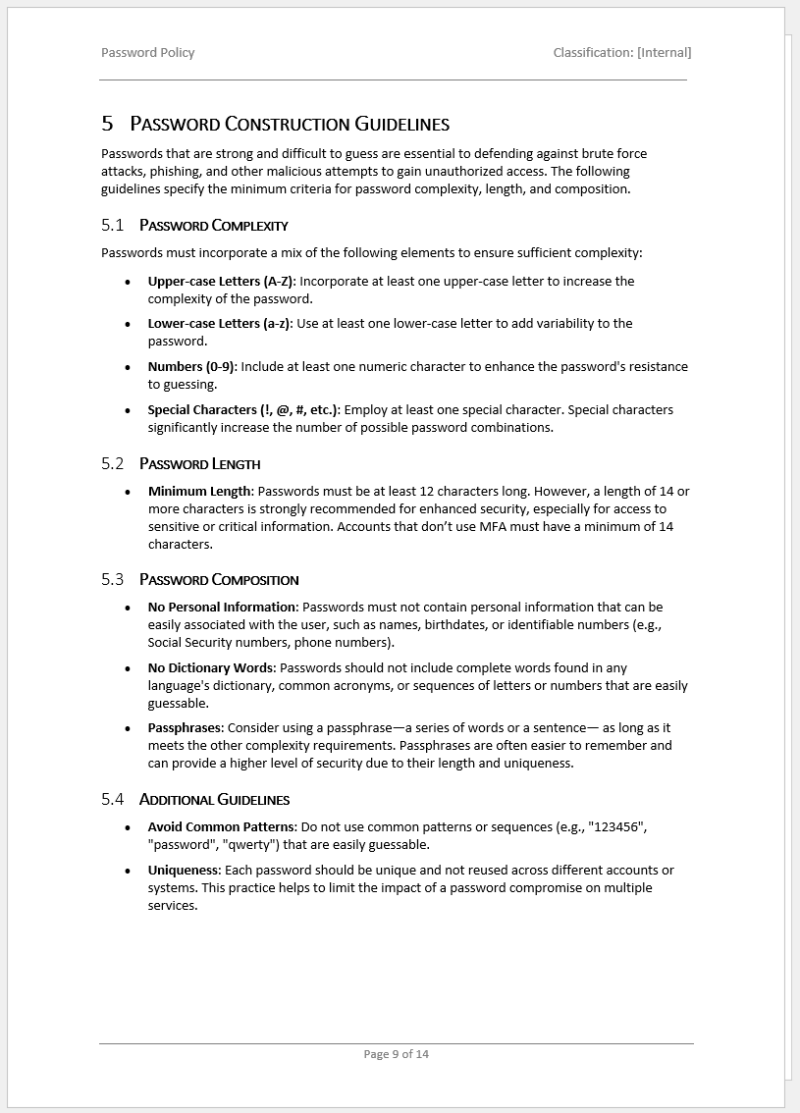
ISO 42001 AI Policy Template Provides the top-level AI governance policy for your organization. It defines responsible AI principles, leadership commitment, accountability, acceptable AI use, risk-based governance, compliance expectations and policy review requirements. Directly supports Clause 5.2 AI policy. Also supports Clause 5.1 leadership, Clause 5.3 roles, responsibilities and authorities, Clause 7.3 awareness, Clause 7.4 communication, and Annex A controls A.2.2 AI policy, A.2.3 alignment with other organizational policies, A.2.4 review of AI policy, and A.3.2 AI roles and responsibilities.
ISO 42001 AIMS Scope Document Template Used to define the boundaries of your Artificial Intelligence Management System. It helps document included AI systems, business units, departments, locations, users, suppliers, lifecycle roles and exclusions. Directly supports Clause 4.3 determining the scope of the AI management system. Also supports Clause 4.1 organizational context, Clause 4.2 interested parties, Clause 4.4 AI management system, and helps determine which Annex A controls are applicable in the SoA.
ISO 42001 RACI Matrix Template Used to assign responsibility, accountability, consultation and information flows for AIMS implementation and ongoing AI governance. It helps avoid accountability gaps across AI policy, risk assessment, impact assessment, lifecycle controls, data governance, supplier management and internal audit. Supports Clause 5.3 roles, responsibilities and authorities, Clause 7.1 resources, Clause 7.2 competence, Clause 7.4 communication, Clause 8.1 operational planning and control, and Annex A controls A.3.2 AI roles and responsibilities, A.4.6 human resources, A.6.1.3 responsible design and development processes, and A.10.2 allocation of responsibilities.
Legal Register Template Used to record applicable legal, regulatory, contractual and stakeholder requirements relating to AI. This may include privacy laws, sector rules, AI regulations, customer obligations, contractual commitments, data protection requirements and incident notification obligations. Supports Clause 4.1 context, Clause 4.2 needs and expectations of interested parties, Clause 6.1.1 risks and opportunities, Clause 6.1.2 AI risk assessment, Clause 8.1 operational planning and control, and Clause 9.1 monitoring and evaluation. Also supports Annex A controls A.2.3 policy alignment, A.8.4 communication of incidents, A.8.5 information for interested parties, A.10.3 suppliers, and A.10.4 customers.
PESTLE Analysis Template Used to assess political, economic, social, technological, legal and environmental factors affecting your AI governance program. It supports context analysis and helps identify AI-related risks, opportunities and external pressures. Supports Clause 4.1 understanding the organization and its context, Clause 4.2 interested parties, Clause 6.1.1 actions to address risks and opportunities, Clause 6.2 AI objectives, and impact-related controls such as A.5.4 impacts on individuals or groups and A.5.5 societal impacts of AI systems.
ISO 42001 Risk Assessment Template Used to identify, assess, evaluate and treat AI-related risks and opportunities. It helps document risk criteria, inherent risk, existing controls, treatment actions, residual risk, risk owners and control links. Directly supports Clause 6.1.1, Clause 6.1.2 AI risk assessment, Clause 6.1.3 AI risk treatment, Clause 8.2 AI risk assessment, and Clause 8.3 AI risk treatment. It also informs Annex A control selection across A.2–A.10, especially controls relating to resources, impact, lifecycle, data, interested parties, responsible use and suppliers.
AI System Life Cycle Process Template Used to define how AI systems are planned, designed, developed, tested, validated, deployed, monitored, changed and retired. It creates a repeatable process for lifecycle governance and operational control. Supports Clause 8.1 operational planning and control, Clause 6.3 planning of changes, Clause 8.2 risk assessment, Clause 8.3 risk treatment, Clause 8.4 impact assessment, Clause 9.1 monitoring, and Annex A controls A.6.1.2, A.6.1.3, and A.6.2.2–A.6.2.8 covering AI system requirements, design documentation, verification and validation, deployment, operation, technical documentation and event logging.
AI System Impact Assessment Template Used to assess the potential effects of an AI system on individuals, groups, customers, users, employees, vulnerable groups, society and the environment. It helps document intended use, foreseeable misuse, affected parties, impact severity, mitigations, oversight and residual concerns. Directly supports Clause 6.1.4 AI system impact assessment and Clause 8.4 AI system impact assessment. Also supports Clause 6.1.1, Clause 6.1.2, Clause 9.1, Clause 10.2, and Annex A controls A.5.2 AI system impact assessment process, A.5.3 documentation of impact assessments, A.5.4 impacts on individuals or groups, and A.5.5 societal impacts.
ISO 42001 SoA Template Used to create your Statement of Applicability. It documents which Annex A controls are applicable, why they are included or excluded, implementation status, control owner, evidence and treatment links. Directly supports Clause 6.1.3 AI risk treatment, where the Statement of Applicability is a key documented output. It maps to all selected Annex A controls from A.2.2 through A.10.4 and supports Clause 8.3 AI risk treatment.
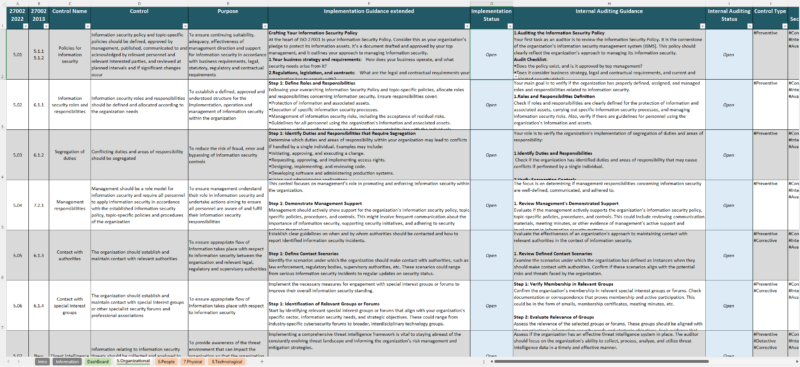
ISO 42001 Controls List – Implementation Guidance Provides a practical control reference for implementing ISO 42001 Annex A controls. It helps teams understand control intent, assign owners, identify evidence and link controls to policies, processes and records. Supports Annex A control areas A.2–A.10, including AI policy, roles, resources, impact assessment, lifecycle, data, interested-party information, responsible use and third-party relationships. Also supports Clause 6.1.3, Clause 8.1, and Clause 9.2 audit preparation.
ISO 42001 Internal Audit Checklist Used to check whether your AIMS conforms to ISO 42001 requirements, your own policies and selected controls. It helps internal auditors record findings, evidence, nonconformities, improvement actions and audit conclusions. Directly supports Clause 9.2 internal audit. Also supports Clause 9.1 performance evaluation, Clause 9.3 management review, Clause 10.2 nonconformity and corrective action, and audit review of Clauses 4–10 plus selected Annex A controls from your SoA.

Why Buy This ISO 42001 Toolkit?

Save Time Creating ISO 42001 Documentation

Implementing ISO 42001 from scratch can be time-consuming. Many teams know they need AI governance, but they struggle to translate the standard into practical documents. This ISO 42001 Toolkit gives you a structured set of templates so you do not have to start with a blank page.

Instead of spending weeks drafting your AI policy, scope document, risk assessment framework, impact assessment process and Statement of Applicability, you can start with templates that are already organized around AIMS implementation.

Build a Practical AI Management System

This is not just a collection of generic AI documents. The toolkit is focused on the core documents needed to establish and operate an Artificial Intelligence Management System.

It helps you connect policy, scope, roles, legal requirements, risk assessment, impact assessment, lifecycle controls, control applicability and internal audit into one coherent AIMS implementation structure.

Improve ISO 42001 Audit Readiness

Auditors and assessors expect to see documented information, clear responsibilities, evidence of risk-based decisions and control implementation. This ISO 42001 documentation toolkit helps you organize that evidence.

The GAP Analysis, Statement of Applicability, Risk Assessment Template, AI System Impact Assessment Template and Internal Audit Checklist are especially useful for preparing for internal reviews, supplier assessments, customer questionnaires and ISO 42001 certification readiness.

Strengthen Responsible AI Governance

ISO 42001 is not only about documentation. It is about governing AI systems responsibly. This toolkit helps organizations define accountability, assess AI risks, document impacts, manage third-party dependencies, monitor lifecycle controls and communicate relevant information to stakeholders.

ISO describes ISO/IEC 42001 as supporting responsible AI use, AI governance, risk management, transparency and reliability.

Support Cross-Functional AI Compliance

AI governance is not owned by one department. Legal, compliance, IT, cybersecurity, product, data science, procurement, HR, operations and executive leadership may all have responsibilities.

The included RACI Matrix, AI Policy, Legal Register, Risk Assessment and Lifecycle Process templates help create a shared operating model so each team understands its role in AI governance.

Reduce Consultant Dependency

Many organizations rely heavily on consultants because they do not have a documented starting point. This ISO 42001 Toolkit gives internal teams the structure needed to begin implementation independently or work more efficiently with consultants, auditors and certification bodies.

Create Reusable AI Governance Evidence

The templates can be used repeatedly across AI systems, departments and projects. For example, the AI System Impact Assessment Template can be applied to each AI use case, while the Risk Assessment Template can be updated as new AI systems, suppliers, risks or regulations emerge.


Who Should Use This ISO 42001 Toolkit?

  • Organizations developing AI systems, machine learning models, AI-enabled software or automated decision systems.
  • SaaS companies and technology providers that need to demonstrate responsible AI governance to customers, investors or procurement teams.
  • Businesses using third-party AI tools, generative AI platforms, predictive analytics, AI chatbots, recommendation engines or automated decision-making systems.
  • Compliance managers, risk managers, quality managers, information security teams and internal auditors implementing an AI Management System.
  • Consultants helping clients prepare ISO 42001 documentation and AI governance frameworks.
  • Organizations already certified to ISO 27001, ISO 9001 or other ISO management system standards that want to extend their governance framework to AI.
  • Public sector bodies, healthcare providers, financial services firms, manufacturers, education providers and other organizations where AI risk, accountability, transparency and trust are important.
  • ISO states that ISO/IEC 42001 applies to organizations of any size involved in developing, providing or using AI-based products or services, across industries and sectors.

How to Use the ISO 42001 Toolkit

A practical implementation sequence is:

Step 1: Understand Your Context
Start with the PESTLE Analysis Template and Legal Register Template to identify external and internal issues, interested-party expectations, legal obligations and business drivers for AI governance.

Step 2: Define Your AIMS Scope
Use the ISO 42001 AIMS Scope Document Template to define what your AI Management System covers. This should include relevant AI systems, departments, locations, lifecycle responsibilities, suppliers and customer-facing services.

Step 3: Set Policy and Governance Responsibilities
Use the ISO 42001 AI Policy Template to define your AI governance commitments. Then use the RACI Matrix Template to assign responsibilities across leadership, compliance, IT, data, product, procurement and operational teams.

Step 4: Perform the GAP Analysis
Use the ISO 42001 Checklist – GAP Analysis to compare your current position against the expected AIMS requirements and identify missing documents, controls, evidence and implementation actions.

Step 5: Assess AI Risks and Impacts
Use the ISO 42001 Risk Assessment Template to assess AI-related risks and opportunities. Use the AI System Impact Assessment Template to assess impacts on people, groups, customers, users and society.

Step 6: Select and Document Controls
Use the ISO 42001 SoA Template and ISO 42001 Controls List – Implementation Guidance to determine which Annex A controls apply, justify exclusions, assign control owners and document implementation evidence.

Step 7: Operationalize the AI Lifecycle
Use the AI System Life Cycle Process Template to define lifecycle controls for AI requirements, design, development, testing, deployment, monitoring, logging, change management and retirement.

Step 8: Audit and Improve
Use the ISO 42001 Internal Audit Checklist to test whether your AIMS is implemented, maintained and effective. Feed audit findings into corrective actions, management review and continual improvement.


Key Benefits of This ISO 42001 Documentation Toolkit

  • Faster AIMS implementation with ready-to-customize ISO 42001 templates.
  • Clearer AI governance roles, responsibilities and accountability.
  • Better visibility of AI legal, regulatory and contractual obligations.
  • Structured AI risk assessment and AI system impact assessment.
  • Practical support for ISO 42001 Annex A control selection and Statement of Applicability creation.
  • Improved internal audit readiness and evidence organization.
  • Reusable documentation for multiple AI systems and use cases.
  • A stronger foundation for responsible AI, trustworthy AI and AI compliance.
  • A practical bridge between AI governance strategy and operational implementation.

Frequently Asked Questions

What is an ISO 42001 Toolkit?

An ISO 42001 Toolkit is a set of templates, checklists and implementation documents designed to help an organization establish and document an Artificial Intelligence Management System. This toolkit focuses on the core AIMS documents needed for ISO 42001 implementation, including AI policy, AIMS scope, risk assessment, impact assessment, SoA, lifecycle process and internal audit checklist.

Does this ISO 42001 Toolkit guarantee certification?

No toolkit can guarantee ISO 42001 certification. Certification depends on how well your organization implements the AIMS, maintains evidence, operates controls, performs audits, addresses nonconformities and meets the requirements assessed by your certification body. ISO also notes that ISO does not certify organizations; certification is performed by independent certification bodies.

Is this ISO 42001 Toolkit only for companies that build AI systems?

No. The toolkit is useful for organizations that develop AI systems and for organizations that use, procure, deploy or manage AI systems from third parties. It is relevant for AI providers, AI users, SaaS companies, internal enterprise AI teams, public sector organizations and regulated businesses using AI in operations or decision-making.

Does the toolkit include the official ISO/IEC 42001 standard?

No. This ISO 42001 Toolkit does not replace the official ISO/IEC 42001:2023 standard. It provides implementation templates and supporting documentation. Organizations should purchase and refer to the official standard when implementing or preparing for certification.

Are the templates customizable?

Yes. The templates are intended to be customized to your organization’s AI systems, risks, processes, terminology, legal obligations, control decisions and governance structure.

Do I need every document in the toolkit?

Most organizations implementing an AIMS will need the majority of these documents or equivalent records. However, the final documentation set depends on your AIMS scope, AI risk profile, selected Annex A controls, legal obligations and certification objectives.

Is this a complete ISO 42001 implementation?

This toolkit provides the core documents for AIMS implementation. A complete implementation also requires actual operation of the management system, evidence collection, training or competence records, management review, monitoring results, corrective actions and continual improvement activities.

What is the Statement of Applicability used for?

The Statement of Applicability, or SoA, is used to document which ISO 42001 Annex A controls apply to your organization, why they apply, whether any controls are excluded, how controls are implemented and what evidence supports them. It connects risk assessment, risk treatment and control implementation.

What is the difference between AI risk assessment and AI system impact assessment?

The AI risk assessment focuses on risks and opportunities related to AI systems and the organization’s objectives. The AI system impact assessment focuses on how an AI system may affect individuals, groups, customers, users, society or other interested parties. Both are important for ISO 42001 implementation.

Can this ISO 42001 Toolkit help with AI Act or other AI regulatory requirements?

This toolkit can help create structured AI governance evidence, risk assessment records, impact assessment records, control ownership and lifecycle documentation. However, legal compliance depends on your jurisdiction, sector, AI system type and regulatory obligations. The Legal Register Template helps you identify and track those obligations, but it is not legal advice.


Summary

The ISO 42001 Toolkit gives your organization the core documentation needed to start building an Artificial Intelligence Management System with confidence. Whether you are preparing for ISO 42001 implementation, strengthening responsible AI governance, responding to customer AI compliance questionnaires or preparing for an internal audit, this toolkit provides a structured and practical foundation.

Instead of trying to interpret ISO 42001 requirements from scratch, you get a focused set of AIMS implementation templates covering scope, policy, responsibilities, legal requirements, context analysis, risk assessment, impact assessment, control applicability, lifecycle governance and internal audit.

Use this ISO 42001 implementation toolkit to save time, reduce documentation gaps, improve audit readiness and build a more transparent, accountable and risk-based AI governance program.


Questions or Custom Toolkit Requests

Have questions about the ISO 42001 Toolkit or need help choosing the right ISO 42001 templates for your organization?

Our team is happy to help.

Whether you need clarification about what is included, how the documents support AIMS implementation, or how the toolkit can be used for ISO/IEC 42001 readiness, you can contact us at any time.

We also offer customized toolkit bundles for organizations that would like specific templates included or excluded based on their AI governance needs.

Looking for an individual ISO 42001 document, AI policy, risk assessment template, impact assessment form, Statement of Applicability, or another specific policy or procedure?

Reach out to us with your requirements, and we will be glad to discuss the best option for your organization.

Contact

Product specifications

Standard

ISO/IEC 42001:2023, ISO/IEC 42005:2025

Framework

AIMS

File Type

Microsoft Excel (.xlsx), Microsoft Word (.docx)

Macros

No

Delivery

Digital Download

Format

Editable

Language

English

Need help choosing?

Not sure whether this is the right document, tool, or toolkit for your organization? Contact CyberZoni before purchase.

Ask a question

Need a custom compliance document or security support?

CyberZoni can support ISO, AI governance, cybersecurity, and ISMS implementation needs beyond ready-made templates.

iso 42001 toolkit 2ISO 42001 Toolkit Bundle
Original price was: € 955,00.Current price is: € 878,60.Add to cart