ISO 42001 Templates

The Core Documents You Need for an AI Management System.

ISO 42001 templates help organizations implement an AI Management System with more structure, consistency, and audit readiness. Explore the core templates used for AI risk assessment, controls, internal audits, and documented ISO 42001 compliance.
Iso 42001 Templates

ISO 42001 Templates: The Core Documents You Need for an AI Management System

Artificial intelligence is moving fast, but governance, accountability, and evidence still matter. That is exactly why ISO 42001 is getting so much attention. It is the first international management system standard focused specifically on AI, and it gives organizations a structured way to establish, implement, maintain, and continually improve an Artificial Intelligence Management System, or AIMS.

That sounds clear enough in theory, but in practice many organizations hit the same obstacle: documentation. Teams know they need policies, registers, assessments, and audit evidence, but they often do not always know what those documents should look like or how they should fit together. This is where ISO 42001 templates become useful. They give you a structured starting point for building the documents, records, and trackers needed to support implementation and audit readiness.

ISO 42001 overview

What are ISO 42001 templates?

ISO 42001 templates are practical document formats used to implement the standard in a consistent and repeatable way. The standard itself does not require one fixed template set, but it does require documented information in several areas, especially across Clauses 4 through 10 and the AI-related controls in Annex A.

In practice, implementation usually means creating working documents such as an AIMS scope statement, AI policy, AI risk methodology, Statement of Applicability, treatment plan, impact assessment, internal audit checklist, and corrective action records.

Why templates matter for ISO 42001 implementation

The biggest value of templates is not convenience alone. A well-designed template helps your organization work through the standard in the right order. ISO describes ISO/IEC 42001 as a management system standard built around structured governance and continual improvement, while audit guidance emphasizes defining scope, identifying AI roles, documenting risks, and collecting evidence that shows how the AIMS actually operates. Templates make those activities easier to standardize across teams, systems, and business units.

Templates are especially useful when multiple people are involved in AI governance. Legal may care about obligations and transparency, technical teams may focus on lifecycle controls and validation, management may want risk visibility, and auditors will want traceable evidence. A template-based approach reduces ad hoc documentation and helps everyone work from the same structure.

The most important ISO 42001 templates

AIMS Scope Template

Your scope is one of the first documents you should define. A scope template should capture which AI systems, services, teams, processes, and locations are covered by your AIMS. It should also explain the boundaries of the system and why those boundaries were chosen.

An AI policy sets the direction for the management system. It should describe your organization’s approach to responsible AI, governance, accountability, oversight, and continual improvement.

A clear AI policy gives management, employees, and auditors a shared reference point for how AI is governed within the organization.

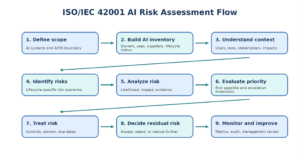
Risk assessment is one of the core parts of ISO 42001. A risk assessment template should help identify AI-related risks and opportunities, assign ownership, score likelihood and impact, and determine treatment actions.

This is also where many organizations begin translating AI governance from theory into something practical and auditable.

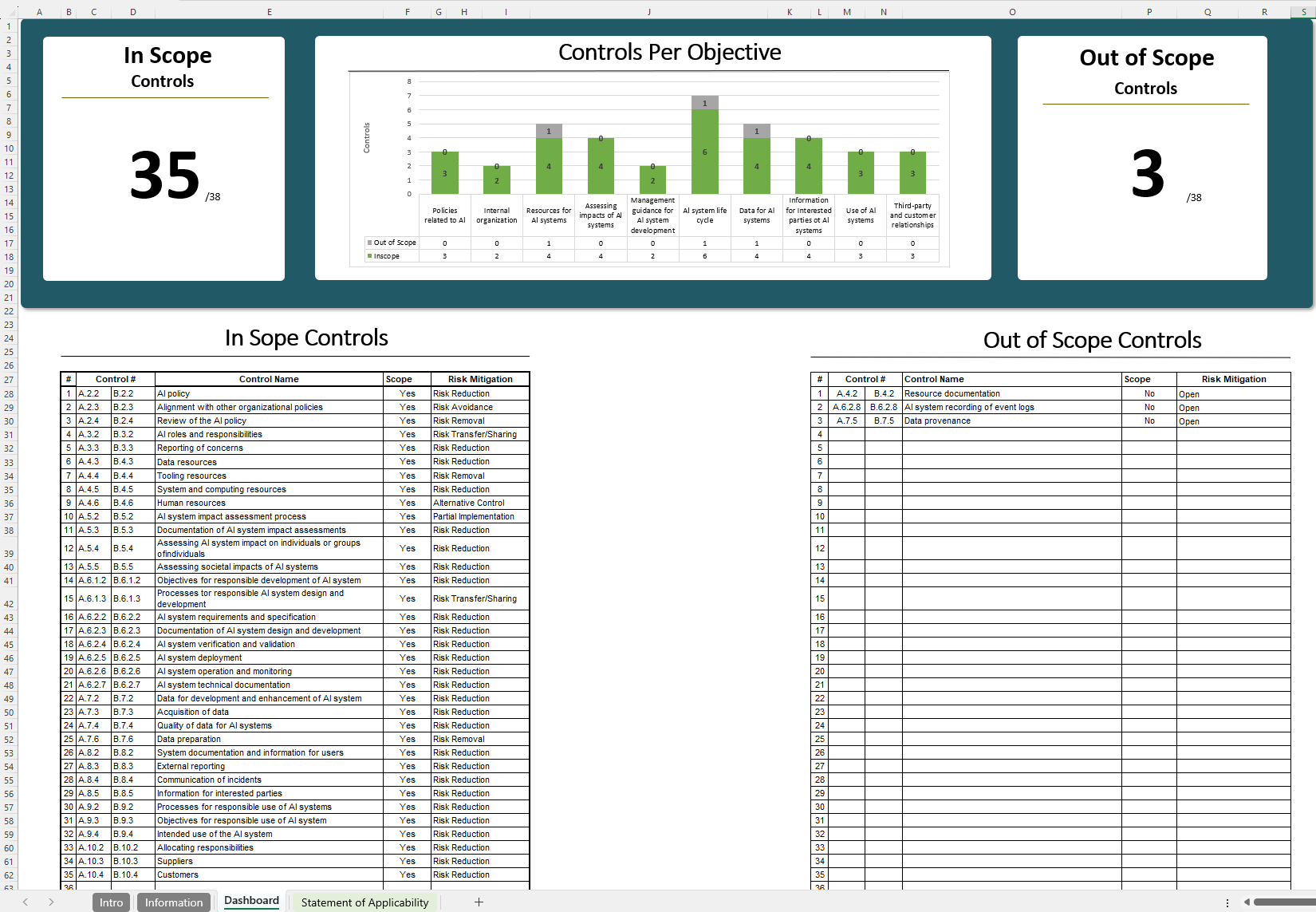
The Statement of Applicability, or SoA, is one of the most important templates in an ISO 42001 Toolkit. It helps determine which Annex A controls are applicable, why they are applicable, and how they are implemented.

A useful SoA template should include each control, applicability, justification, implementation status, related evidence, and responsible owner.

After risks are assessed, they need to be treated. A treatment plan template helps define what action will be taken, who is responsible, when it should be completed, and how completion will be verified.

This document helps connect risk decisions to actual implementation work.

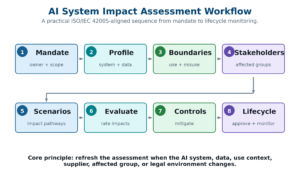
Impact assessment is one of the areas that makes ISO 42001 particularly relevant for AI governance. An impact assessment template helps evaluate how an AI system may affect individuals, groups, or society.

A good template should cover intended purpose, affected stakeholders, potential harms, safeguards, severity, residual risk, and any required escalation or approval.

Because Annex A contains multiple AI-related controls, many organizations benefit from using a controls tracker. This template can help monitor implementation status, control ownership, linked evidence, review dates, and dependencies.

Used properly, it becomes the operational bridge between your SoA and your day-to-day implementation work.

Internal audits are a required part of the management system. An internal audit checklist helps review whether clauses, controls, and supporting records are in place and working effectively.

It also helps identify weaknesses before an external audit or certification review.

Management review is often overlooked, but it is an important sign that the AIMS is being actively governed. A management review template should capture meeting inputs, decisions, actions, deadlines, and follow-up responsibilities.

This helps demonstrate that leadership is reviewing the performance of the AIMS and driving improvement.

No management system is perfect. A corrective action template helps document nonconformities, root causes, actions taken, verification of effectiveness, and closure.

This is essential for continual improvement and for showing that issues are not just identified, but actually addressed.

What makes a good ISO 42001 template?

Not every template is worth using. A good ISO 42001 template should be easy to edit, clearly mapped to the relevant clause or control, and structured so that it produces evidence rather than just text. Since auditors will look at scope, governance, risk management, impacts, controls, and records, the best templates make those links visible instead of burying them in narrative documents.

In practice, the most useful templates usually include:

  • clause or control references
  • ownership fields
  • status tracking
  • review dates
  • evidence references
  • links between risks, controls, and actions

That kind of structure helps turn ISO 42001 from a documentation exercise into a manageable implementation workflow.

Are ISO 42001 templates enough on their own?

No. Templates help you move faster, but they are not a substitute for real AI governance. The organization still needs to define its AI roles, decide what is in scope, assess actual risks, evaluate impacts, assign accountability, and maintain evidence that reflects real operations. Even Microsoft’s ISO 42001 materials make this point indirectly: a supplier’s or platform provider’s certification can support your own compliance effort, but your organization still has to be assessed on its own implementation and controls.

That is why the best way to use templates is as a structured foundation. They should help your team think clearly, document consistently, and show auditors how your AI management system works in practice.

Final thoughts

ISO 42001 templates are valuable because they turn a complex AI governance standard into an implementation path that teams can actually follow. If you are building an AI management system, the most important templates are usually the scope document, AI policy, risk assessment, Statement of Applicability, treatment plan, impact assessment, control tracker, internal audit checklist, management review record, and corrective action log. Together, these documents help translate ISO 42001 from high-level requirements into day-to-day governance and audit-ready evidence.

Scroll to Top