ISO 42001 Certification
Quality, Security, Traceability, Transparency, and Reliability of AI Applications.
%%{init: {
  'theme': 'base',
  'themeVariables': {
    'primaryColor': '#f7f3e8',
    'primaryTextColor': '#222222',
    'primaryBorderColor': '#9f8a4c',
    'lineColor': '#7d6a33',
    'fontSize': '18px'
  },
  'flowchart': {
    'nodeSpacing': 40,
    'rankSpacing': 55,
    'curve': 'basis'
  }
}}%%
flowchart LR
    Prep[Gap Analysis &
 Prepare AIMS] --> IntAudit[Internal Audit &
 Readiness Review]
    IntAudit --> Stage1[Stage 1 Audit
 Documentation Review]
    Stage1 --> Stage1Find{Findings?}
    Stage1Find -- No major findings --> Stage2[Stage 2 Audit
 On-site Review]
    Stage1Find -- Yes --> Stage1Fix[Remediate]
    Stage1Fix --> Stage2
    Stage2 --> Stage2Find{Findings?}
    Stage2Find -- No major findings --> Cert[Certification
 Issued]
    Stage2Find -- Yes --> Stage2Fix[Correct
 Nonconformities]
    Stage2Fix --> Cert
    Cert --> Surv1[Surveillance
Year 1]
    Surv1 --> Surv2[Surveillance
Year 2]
    Surv2 --> Recert[Recertification
Year 3]
Certification Bodies and Accreditation
ISO itself does not conduct certification. Accredited certification bodies (CBs) perform ISO 42001 audits under ISO/IEC 17021-1, supplemented by ISO/IEC 42006 (which adds AI-specific requirements for CBs). CBs must be accredited by national accreditation bodies (e.g. ANSI-ANAB in the U.S., UKAS in the U.K.). The first ISO 42001-accredited CB was BSI (accredited by UKAS and ANAB), and Schellman has been accredited under ANSI-ANAB.
Accreditation references
ISO/IEC 42006:2024 specifies how ISO/IEC 17021 applies to AIMS certification, and ISO/IEC 42005:2023 provides guidance on AI impact assessments that auditors will review. In practice, a certifying CB will have assessment criteria derived from ISO 42001 clauses, plus ISO/IEC 42006 rules.
Certification Process and Requirements
The ISO 42001 certification audit follows the standard 2-stage model: Stage 1 (readiness review) and Stage 2 (on-site audit), followed by issuance of a 3-year certificate and annual surveillance audits. A detailed “roadmap” is:
- Preparation (Pre-Audit): Before engaging a CB, organizations establish their AIMS: define scope, governance structure, policies, and implement controls. This typically involves an internal gap analysis against ISO 42001 clauses and Annex A, developing an AI inventory, writing an AI policy, setting objectives, conducting AI risk and impact assessments, and documenting processes/controls. Many organizations perform at least one internal audit of the AIMS to verify readiness (ISO 42001 actually “requires that you perform an internal audit… including prior to the first Stage 1 audit”).
- Stage 1 Audit (Documentation Review): The CB reviews key AIMS documentation to confirm readiness. Auditors will examine the scope statement, AI governance framework, policies, risk assessment approach, Statement of Applicability (Annex A controls mapped to risks), and other foundational docs. The goal is to ensure all required processes are defined. The Stage 1 audit typically lasts a few days and includes interviews of key personnel. Auditors issue any areas of concern (AOCs) or minor findings, which the organization must address before Stage 2.
- Stage 2 Audit (Operational Effectiveness): This on-site audit verifies that the AIMS is implemented and effective. Auditors will observe processes and review records to check Clause 8 (operation) items: they will look for evidence that AI risks are actively managed, controls are working, internal audits and management reviews have been conducted, and continual improvement is happening. Typical evidence includes AI risk registers, AI model test logs, incident reports, training records, internal audit reports, and management review minutes. Stage 2 often spans several days (longer for broader scopes). At its conclusion the CB lists any nonconformities or observations. All major nonconformities must be resolved (with corrective actions) to obtain certification; minor findings are fixed in agreed time frames.
- Certification & Surveillance: Upon successful completion of Stage 1 and Stage 2 (and closure of findings), the CB issues the ISO 42001 certificate (valid 3 years). Annual surveillance audits (typically in Years 1 and 2) then verify continued compliance. These are shorter reviews focusing on any changes, key AIMS updates, and demonstration of monitoring/controls. A recertification audit is performed at the end of the third year to renew certification for another 3-year cycle.
- Surveillance & Nonconformities: During surveillance, auditors check that the organization has addressed prior audit findings and maintained the AIMS. Common findings in ISO 42001 audits include: missing or outdated AI risk registers, undefined or overly broad AIMS scope, incomplete documentation, lack of performance reviews (e.g. model monitoring), and unclear roles/responsibilities. (For example, RSI notes that “missing or outdated AI Risk Register” and “undefined AIMS Scope” are frequent gaps.) Organizations should correct any nonconformities promptly.
Implementation and Preparation
Implementation typically follows the roadmap outlined at the top of this article.
In essence, the organization should: (1) define the AIMS scope and governance, (2) perform gap analysis against ISO 42001, (3) develop missing policies/procedures (AI policy, risk process, etc.), (4) conduct AI risk and impact assessments, (5) implement controls (data checks, logging, etc.), (6) train staff, (7) conduct internal audits and management reviews, and (8) address any issues.
Each step builds toward readiness for the certification audit. This requires a dedicated project team (often including a project lead, AI/technical expert, compliance lead, and executive sponsor) and involvement of AI engineers, IT security, legal and business stakeholders.
In most cases we suggest assigning a Project Lead (50–80% of one person’s time), an AI/Tech SME (20–40%), and an executive sponsor (5–10%).
Certification Timeline
Actual timelines vary. For a greenfield organization with no prior AI management, a full implementation plus certification can take on the order of 6–12 months. Organizations with existing management systems (e.g. ISO 27001) may accelerate (potentially 3–6 months) by reusing frameworks.
gantt
    title ISO 42001 Certification Timeline (Example)
    dateFormat  YYYY-MM
    axisFormat  %b-%Y
    todayMarker off
    section Implementation
    Gap Analysis & Planning      :         2026-01, 1M
    AI Policy & Scope Definition :         2026-02, 1M
    Risk/Impact Assessments      :         2026-03, 2M
    Controls Implementation      :         2026-05, 2M
    Internal Audit & Review      :         2026-07, 1M
    section Certification
    Stage 1 (Document Review)    :         2026-08, 1M
    Stage 2 (On-site Audit)      :         2026-09, 1M
    Certificate Issued           :milestone, 2026-11, 0M
Resources and Competencies
Implementing ISO 42001 requires knowledge of AI technologies, data governance, risk management and compliance. Teams should include AI/data scientists, IT/security staff, and compliance/legal experts. A project champion at senior level helps secure resources. Training (e.g. ISO 42001 Lead Implementer/Auditor courses) is often needed; accredited providers include PECB, BSI, DNV, and TÜV SÜD.
Certification Checklist
ISO 42001 Certification Check lists typical core items organizations should have in place before a CB audit:
| Check | Certification Check | Description / Evidence Required |
| ✓/✗ | Executive sponsorship approved | Top management sponsor and resource commitment for the AIMS project. |
| ✓/✗ | AIMS scope documented | Written scope of AI Management System (which AI systems/functions are in/out of scope). |
| ✓/✗ | AI inventory completed | Inventory of all AI systems/models in scope, with owners identified. |
| ✓/✗ | Risk and impact assessments done | Completed AI risk assessments and AI impact assessments (per Clause 6) for scoped systems. |
| ✓/✗ | AI governance policy and objectives | Formal AI policy document and measurable objectives, approved by management. |
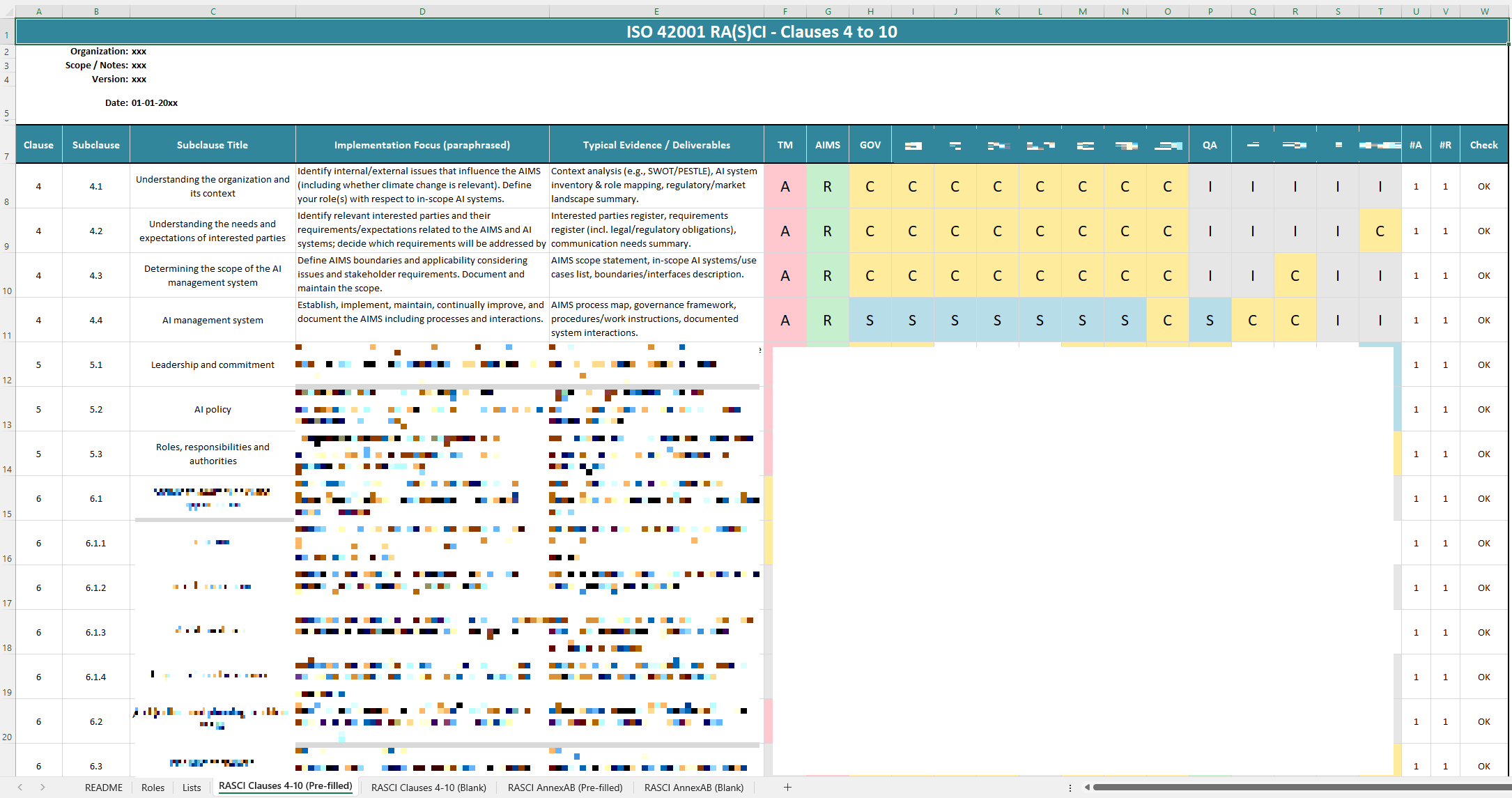
| ✓/✗ | Roles & responsibilities defined | RACI chart or description of AIMS roles (data science lead, compliance officer, etc.). |
| ✓/✗ | Statement of Applicability (SoA) | SoA mapping ISO 42001 Annex A controls to the organization’s AI risks. |
| ✓/✗ | Controls implemented | Evidence that required AI controls are in place (e.g. data quality checks, bias mitigation, monitoring). |
| ✓/✗ | Staff training conducted | Records of AIMS and AI governance training for relevant personnel. |
| ✓/✗ | Internal audit completed | Internal audit report of AIMS with findings addressed; readiness review performed. |
| ✓/✗ | Management review completed | Management review minutes/document showing AIMS performance and decisions. |
| ✓/✗ | Documentation assembled | All key documents (AI policy, risk register, procedures, audit reports, etc.) organized and accessible. |
Certification Costs
Certification costs vary depending on organization size, AI complexity, and the chosen implementation approach. Based on our experience in the field and industry reports, estimated Year 1 budgets are roughly as follows:
Org Size | Employees | Year 1 Cost Range (EURO) | Notes |
Small enterprise | 50–200 | ~€85.000–€150.000 | Startup or SME with a few AI projects; may use consultants to fill gaps. |
Mid-market | 200–500 | ~€180.000–€520.000 | Multiple departments and AI systems; broader audit scope. |
Large enterprise | 500+ | ~€450.000–€850.000 | Multi-site, complex AI deployments; multi-day audits and extensive controls. |
These figures include consulting/training, toolset costs and CB audit fees (small firms often spend a few tens of thousands, while very large organizations may reach hundreds of thousands).
Key cost factors are the number of AI models, geographic scope (multiple sites require more audit days), existing compliance maturity (using ISO 27001/9001 can reduce effort), and the extent of external support used.
We analyzed that Stage 2 audit alone for a large enterprise can exceed €30–50k in fees. After initial certification, ongoing costs are lower: budget for annual surveillance audits (~1–2 days of CB audit per year) and maintaining an AI governance team.
pie
    title Example Year-1 Cost Breakdown
    "Implementation (consultants, staff time)" : 50
    "Certification Audit & Fees"            : 15
    "Tools & Software"                     : 10
    "Staff Training & Awareness"           :  10
    "Internal Resources (salaries)"        : 15
Resources and Guidance
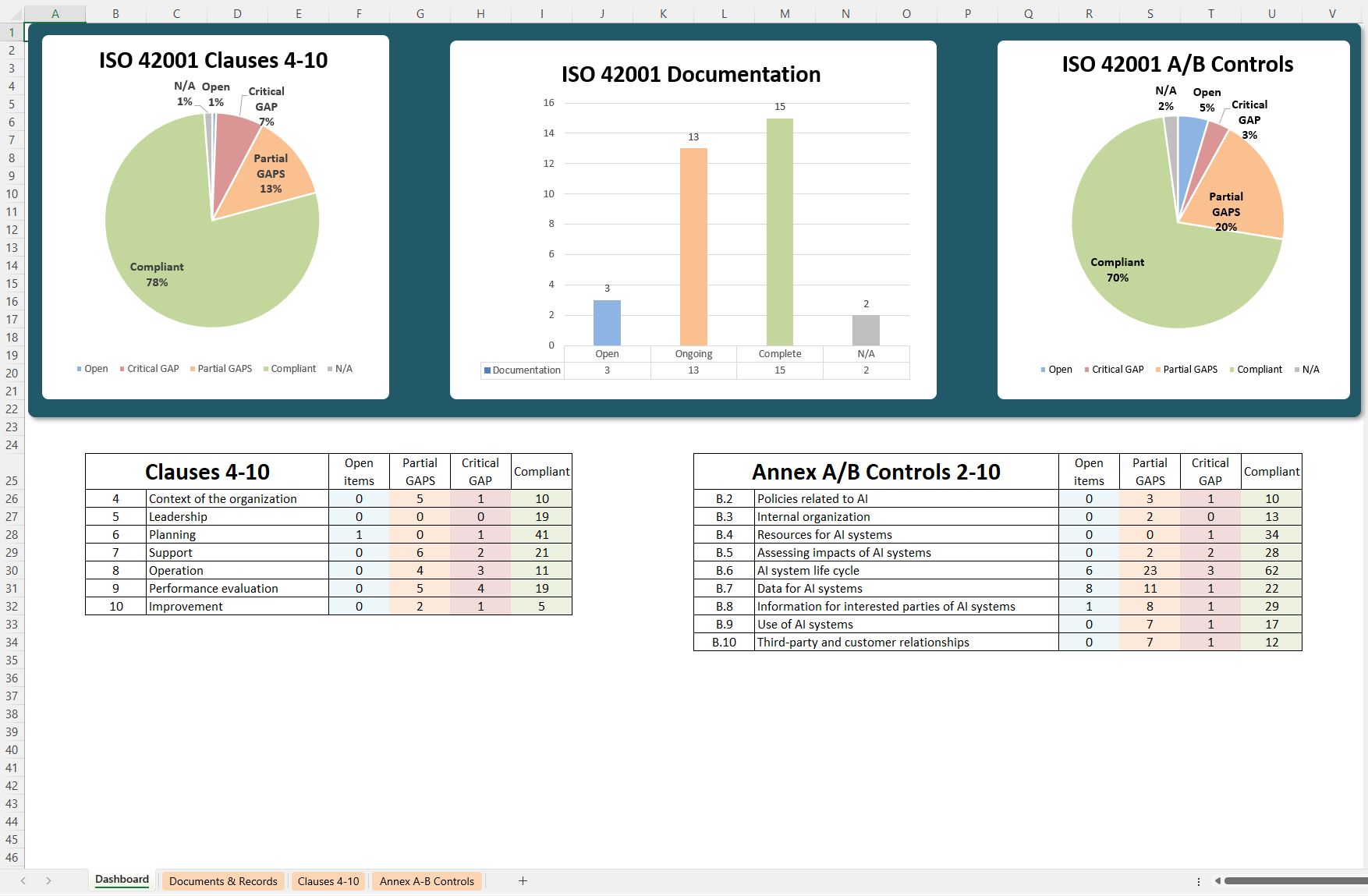
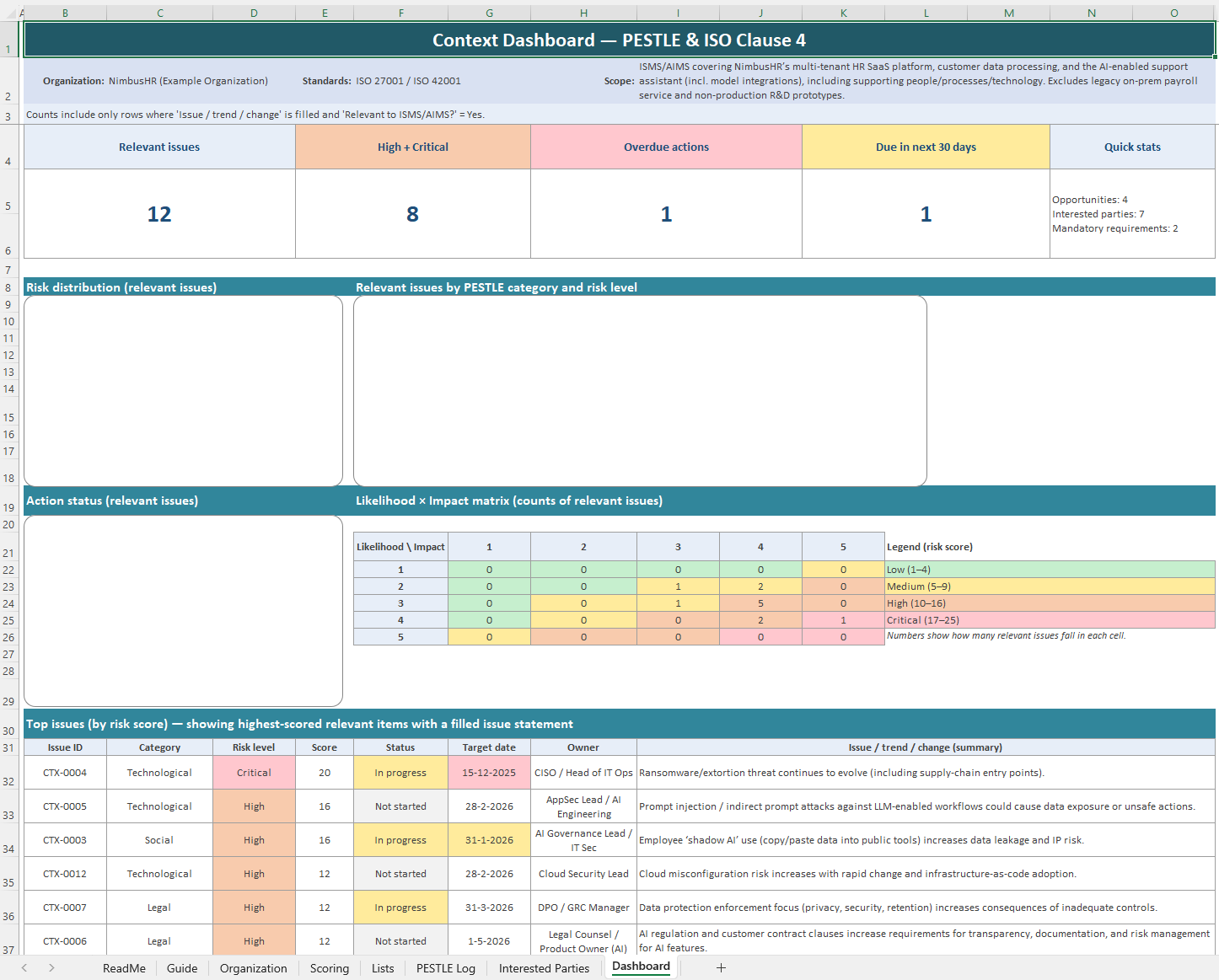
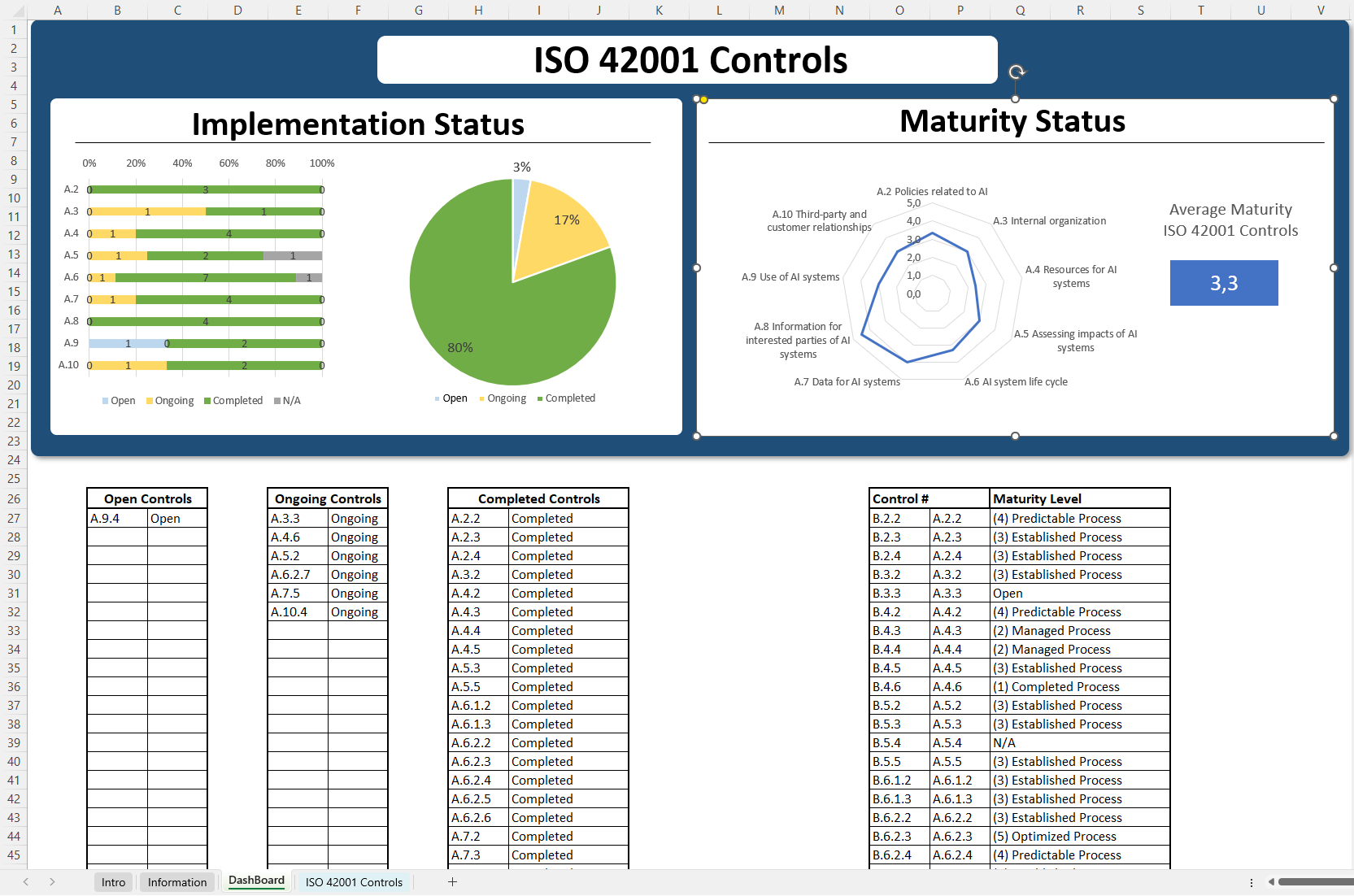
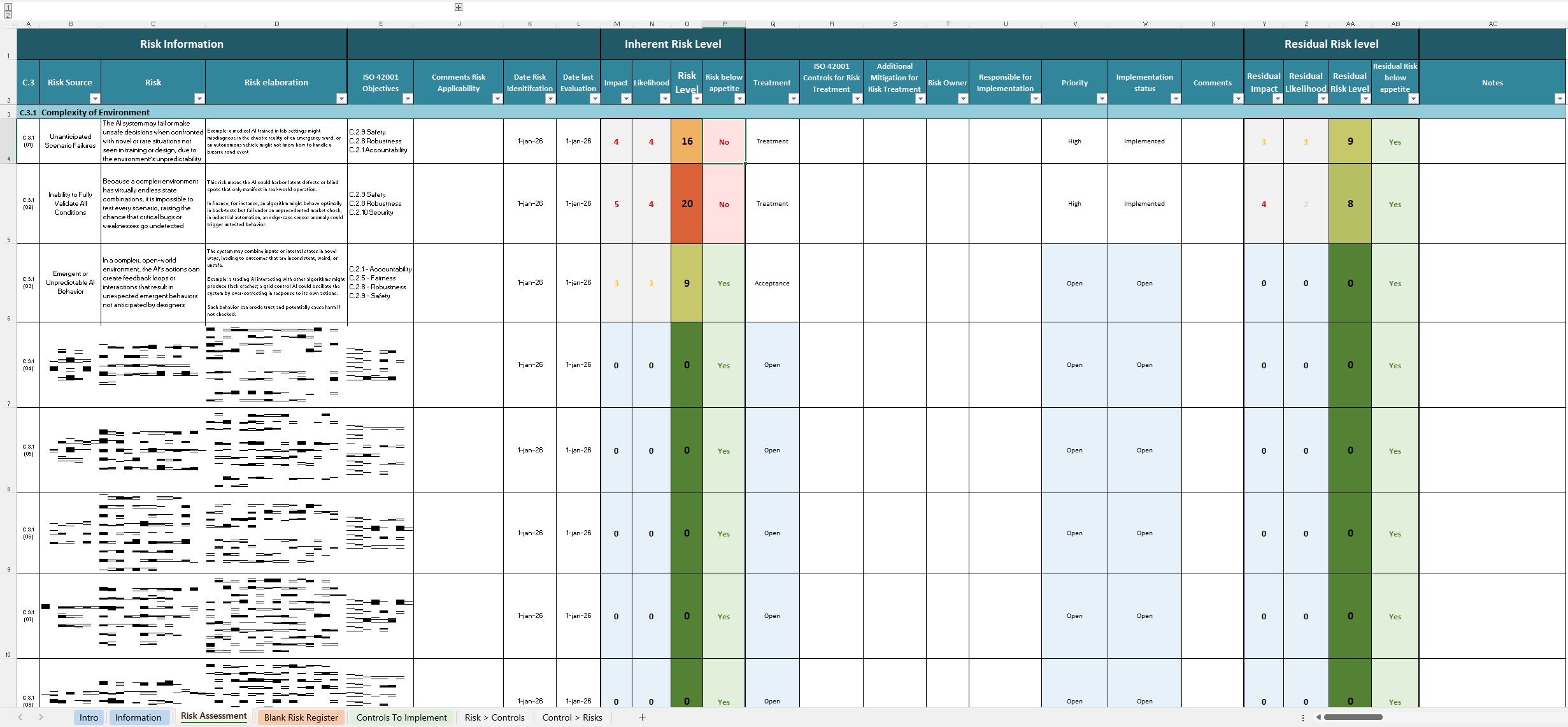
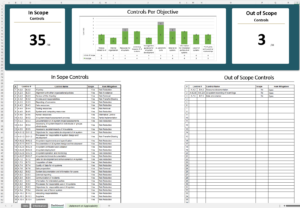
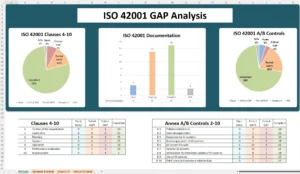
CyberZoni offers practical ISO 42001 tools to support implementation and certification preparation, including the ISO 42001 Toolkit with an AI Risk Assessment Template, Statement of Applicability Template, Controls List – Implementation Guidance, GAP Analysis Checklist, and Internal Audit Checklist. Supporting tools such as RACI / RA(S)CI templates can also help define AIMS roles and responsibilities.