
ISO 42001/42005 AI System Impact Assessment Procedure Template
The AI System Impact Assessment Procedure Template is a professionally structured Word document designed to help organizations define, document, and implement a consistent process for performing AI system impact assessments. It is built for organizations working with ISO/IEC 42005, ISO/IEC 42001, and responsible AI governance requirements.
This procedure template helps you move from high-level standard requirements to a practical internal procedure that can be used by governance teams, compliance teams, risk managers, AI project owners, consultants, and auditors. It explains when an AI system impact assessment should be performed, who should be involved, how impacts should be identified and assessed, how decisions should be approved, and how results should be recorded, reported, monitored, and reviewed.
If your organization is implementing an AI management system or preparing for ISO/IEC 42001 alignment, this AI system impact assessment procedure template provides a clear and reusable foundation for managing AI impact assessments in a structured, auditable, and repeatable way.
Included in this procedure template
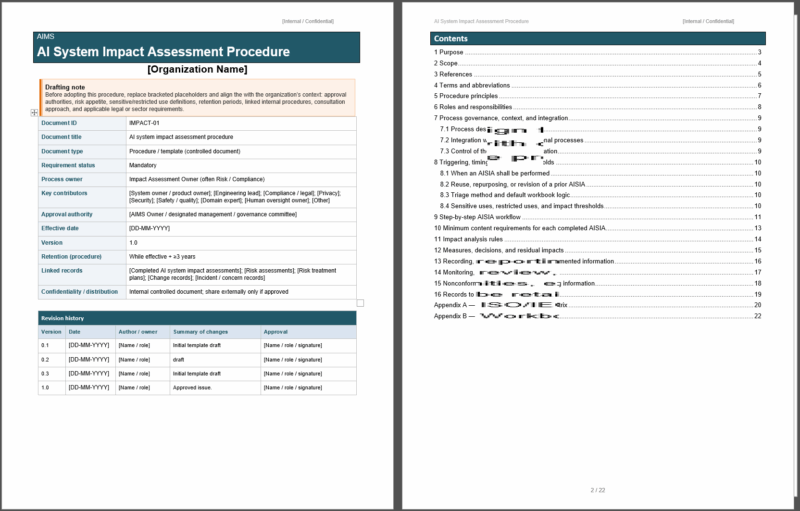
The template includes a complete AI system impact assessment procedure with structured sections that can be adapted to your organization.
Typical sections include:
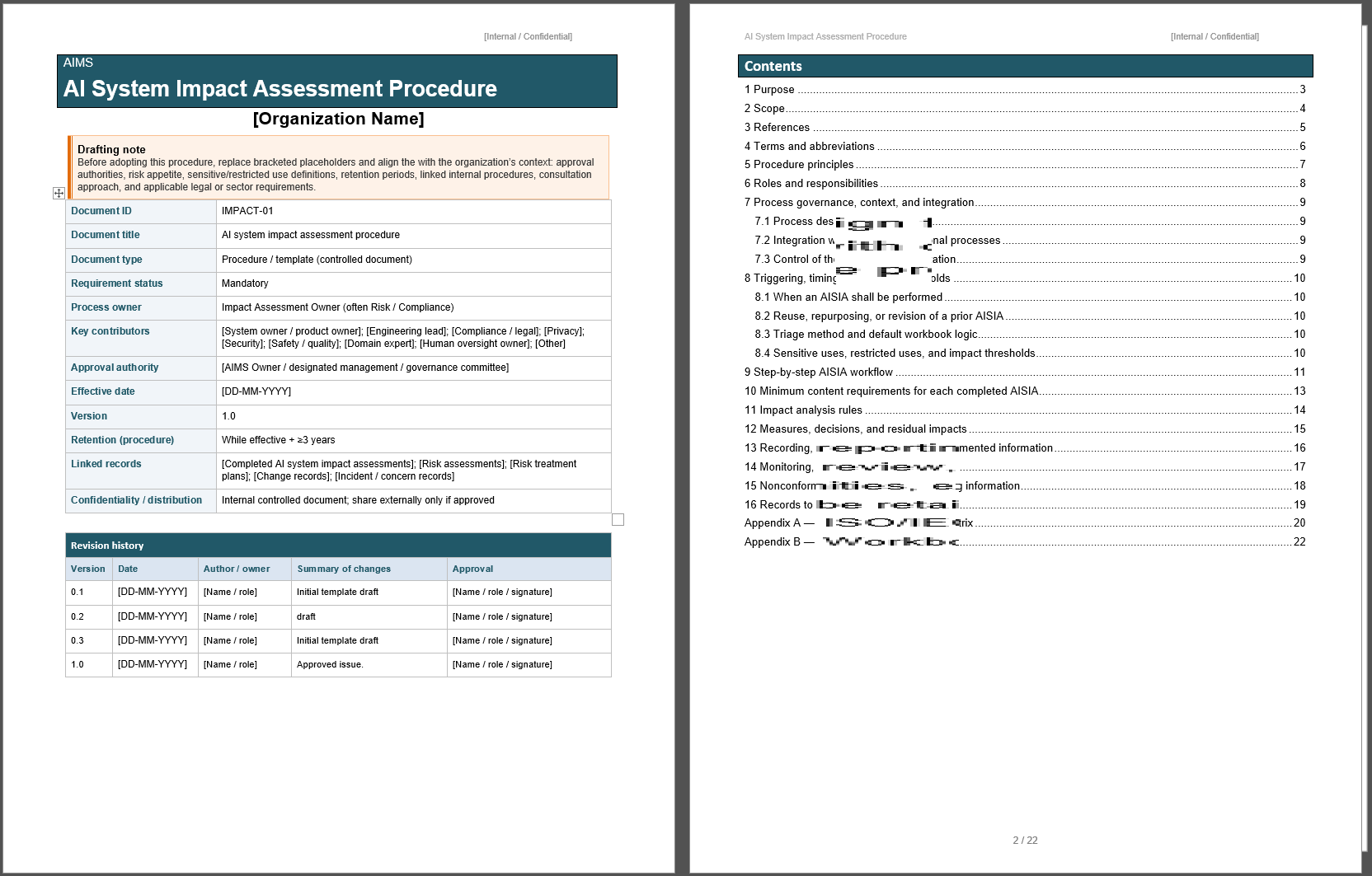
- Document control and revision history
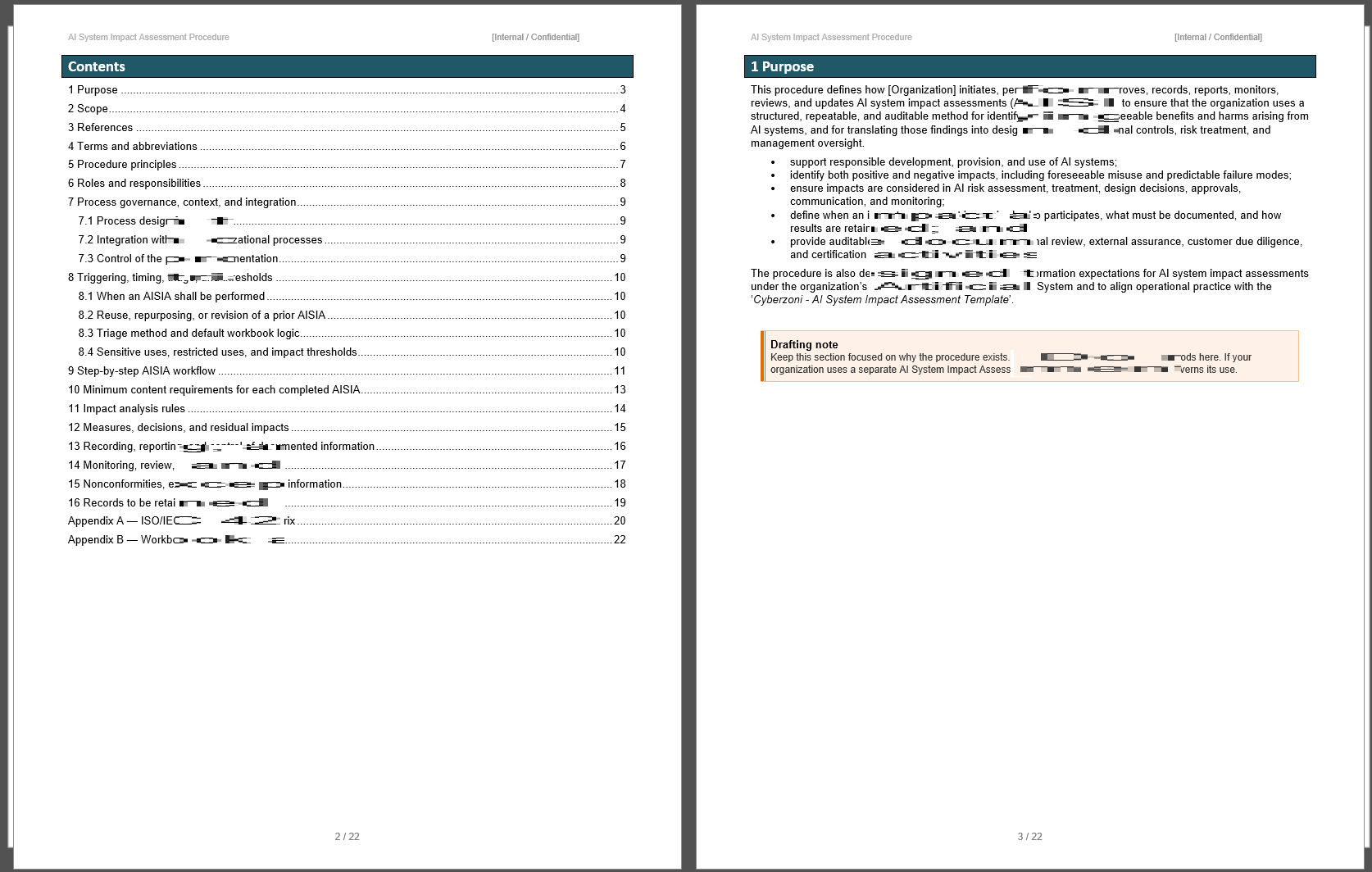
- Purpose of the procedure
- Scope and applicability
- References to ISO/IEC 42005, ISO/IEC 42001, and related AI governance standards
- Definitions and abbreviations
- Governance principles
- Roles and responsibilities
- Integration with other management processes
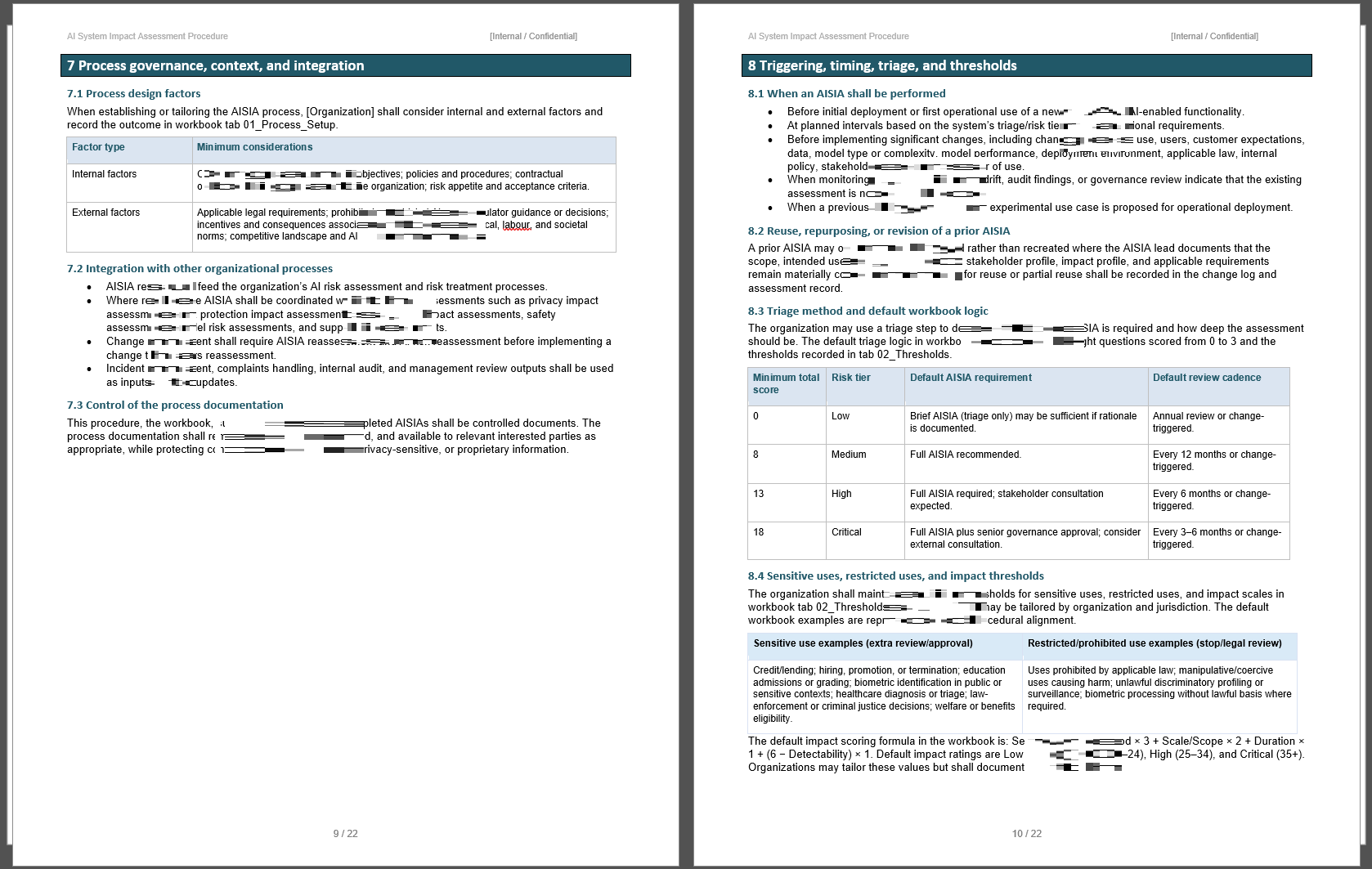
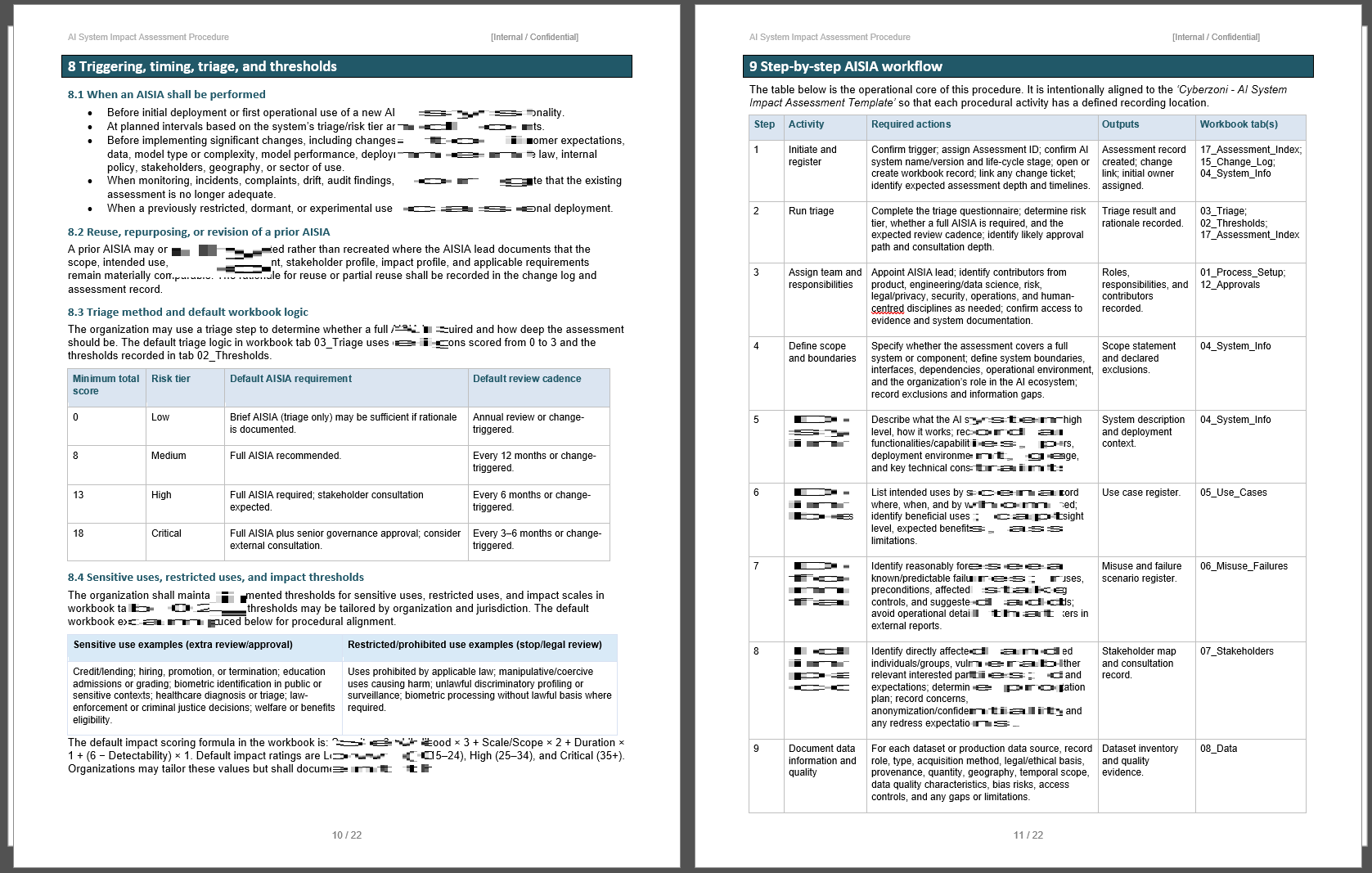
- Timing and reassessment triggers
- Triage process
- Assessment levels
- Thresholds for sensitive and restricted uses
- Impact scale criteria
- Step-by-step AI system impact assessment workflow
- Stakeholder consultation requirements
- AI system information requirements
- Data, algorithm, model, and deployment documentation requirements
- Impact identification and scoring process
- Measures to address harms and benefits
- Residual impact evaluation
- Approval process
- Internal and external reporting expectations
- Monitoring and review process
- Records and retention requirements
- Escalation and deviation handling
- ISO/IEC 42005 coverage matrix
- Workbook alignment matrix
- Minimum completed assessment checklist
- Supporting flowcharts and process illustrations
What is this AI System Impact Assessment Procedure Template?
This product is a detailed procedure document that describes how an organization should perform an AI system impact assessment in line with the guidance of ISO/IEC 42005 and in support of the broader AI management system requirements of ISO/IEC 42001.
An AI system impact assessment is used to identify and assess how an AI system may affect individuals, groups of individuals, organizations, and society. These impacts may include both beneficial and harmful effects, such as impacts related to fairness, discrimination, privacy, transparency, explainability, accountability, reliability, safety, security, and environmental considerations.
This template gives your organization a documented method for performing those assessments. It can be used as a standalone AI governance procedure or together with an AI system impact assessment workbook, register, or Excel-based assessment template.
Why use this AI System Impact Assessment Procedure Template?
Many organizations know that they need to assess the impact of AI systems, but they struggle to turn the requirements and guidance from standards into a practical internal process. The standards explain what should be considered, but organizations still need to create their own procedures, roles, records, approval steps, and review mechanisms.
This AI system impact assessment procedure template saves time by giving you a ready-made structure that can be customized to your organization or client environment.
Instead of starting from a blank page, you receive a professional procedure that already includes the core elements needed for an AI system impact assessment process, including:
- when assessments are required;
- how assessments are triggered;
- how triage should be performed;
- how the scope of an assessment should be defined;
- which roles and responsibilities should be assigned;
- how stakeholders and affected parties should be identified;
- how intended uses, foreseeable misuse, and AI system failures should be assessed;
- how data, model, algorithm, and deployment information should be documented;
- how impacts should be scored and analyzed;
- how mitigation measures and action plans should be defined;
- how approvals, reporting, monitoring, review, and reassessment should be handled.
What does the procedure accomplish?
The procedure helps an organization establish a formal, repeatable process for conducting AI system impact assessments. It supports the organization in documenting how AI impacts are identified, evaluated, treated, approved, and monitored throughout the AI system lifecycle.
The template helps accomplish the following:
- Establishes a formal AI impact assessment process
The procedure defines how the organization performs AI system impact assessments. This includes the process steps, decision points, responsibilities, records, approvals, and monitoring requirements.
- Supports ISO/IEC 42005 alignment
The document is structured around the key process themes and documentation expectations of ISO/IEC 42005, including process development, scope, timing, responsibilities, thresholds, performance of the assessment, analysis of results, recording, reporting, approval, monitoring, and review.
- Supports ISO/IEC 42001 implementation
ISO/IEC 42001 requires organizations to manage AI-related risks and perform AI system impact assessments where applicable. This procedure helps organizations demonstrate that they have defined a controlled process for conducting and retaining documented information related to AI system impact assessments.
- Creates consistency across AI assessments
Using one procedure helps ensure that AI system impact assessments are performed consistently across different AI systems, business units, projects, or clients.
- Improves audit readiness
The template includes document control, records, evidence expectations, approval requirements, and alignment matrices. This helps organizations prepare for internal audits, management reviews, external reviews, and certification readiness activities.
How does this template align with our AI system impact assessment template?
This procedure template is designed to work together with an AI system impact assessment Excel template or workbook. The procedure explains the process, governance, roles, timing, and decision-making requirements, while the workbook can be used to capture the actual assessment information.
In other words:
- the procedure explains how the organization performs AI system impact assessments;
- the Excel template records the results of each AI system impact assessment.
This combination gives organizations both the governance documentation and the operational tool needed to perform assessments in a structured way.
The procedure can be aligned with workbook sheets covering:
- process setup;
- thresholds;
- triage;
- assessment index;
- AI system information;
- intended uses;
- misuse and failure scenarios;
- stakeholders and consultation;
- data information;
- model and algorithm information;
- impact register;
- measures and action plans;
- approvals;
- reporting;
- monitoring and review;
- change log;
- evidence register.
This makes the template especially useful for consultants and organizations that want a complete, reusable AI governance documentation set.
When should this procedure be used?
This AI system impact assessment procedure template can be used when an organization wants to define how AI system impact assessments are performed. It is especially useful before deploying AI systems or when implementing an AI management system.
Organizations can use the procedure when:
- developing a new AI system;
- procuring or implementing a third-party AI system;
- deploying an AI system into production;
- changing the intended use of an AI system;
- changing data sources, model architecture, algorithms, or deployment environment;
- expanding AI use into new countries, sectors, departments, or user groups;
- assessing high-impact or sensitive AI use cases;
- reviewing AI systems at planned intervals;
- responding to incidents, complaints, failures, or monitoring results;
- preparing for ISO/IEC 42001 implementation or audit readiness;
- establishing responsible AI governance controls.
The procedure helps make sure that impact assessments are not treated as one-time documents, but as part of the organization’s ongoing AI lifecycle management.
What types of AI systems can this template be used for?
This ISO 42005/42001 procedure template can be adapted for many different types of AI systems, including:
- generative AI tools;
- AI chatbots;
- retrieval-augmented generation systems;
- recommendation systems;
- predictive analytics models;
- fraud detection models;
- credit scoring or underwriting models;
- recruitment and HR screening tools;
- biometric identification or verification systems;
- medical or health-related AI systems;
- customer service automation tools;
- automated decision-support systems;
- computer vision systems;
- natural language processing systems;
- internal productivity copilots;
- AI-enabled SaaS platforms.
The template is designed to be flexible. It can be used for high-risk AI systems, lower-risk AI systems, internally developed AI systems, third-party AI services, and AI systems used as part of a larger product or business process.
What questions does the procedure help answer?
A well-structured AI system impact assessment procedure helps organizations answer important governance questions, such as:
- Which AI systems need an impact assessment?
- When should an AI system impact assessment be performed?
- Who is responsible for initiating and completing the assessment?
- What information must be collected about the AI system?
- Who may be affected by the AI system?
- What are the intended uses and reasonably foreseeable misuses?
- What happens if the AI system fails?
- What data, model, algorithm, and deployment information should be reviewed?
- How should impacts on individuals, groups, and society be identified?
- How should benefits and harms be assessed?
- Which impacts require escalation or approval?
- What controls or measures should be implemented?
- How should the results be documented and retained?
- Who should receive internal or external reports?
- How often should the assessment be reviewed?
- What changes trigger reassessment?
- How does the assessment connect to the organization’s risk management process?
Why is an AI system impact assessment procedure important?
AI systems can create significant benefits, but they can also introduce new risks and impacts. These impacts may affect individuals, employees, customers, vulnerable groups, business partners, regulators, and society as a whole.
Without a documented procedure, AI impact assessments may become inconsistent, incomplete, or difficult to audit. Different teams may use different criteria, skip stakeholder consultation, overlook foreseeable misuse, or fail to record approval decisions.
A documented ISO 42005 AI system impact assessment procedure helps prevent this by defining a clear and repeatable process. It supports better decision-making, stronger accountability, and more transparent AI governance.
The procedure helps organizations:
- identify AI impacts before they become incidents;
- consider both benefits and harms;
- involve the right stakeholders;
- document AI system information consistently;
- assess sensitive and restricted uses;
- connect impact assessment results to risk treatment;
- improve management review and oversight;
- retain evidence for audits and compliance reviews;
- support responsible AI development and deployment.
How does this help with ISO/IEC 42001?
ISO/IEC 42001 is focused on establishing, implementing, maintaining, and continually improving an AI management system. Within that context, organizations need to manage AI-related risks and impacts in a structured way.
This procedure supports ISO/IEC 42001 by helping organizations define how AI system impact assessments are performed and documented. It supports the management system approach by including:
- process ownership;
- roles and responsibilities;
- documented information;
- integration with risk management;
- approval and escalation;
- monitoring and review;
- continual improvement;
- management review inputs;
- retained evidence.
This makes the template a useful supporting document for organizations building an AI management system and preparing for ISO/IEC 42001 readiness.
How does this help with ISO/IEC 42005?
ISO/IEC 42005 provides guidance for AI system impact assessments. This template turns that guidance into a practical procedure that can be implemented within an organization.
The procedure addresses key ISO/IEC 42005 themes, including:
- developing and documenting an AI system impact assessment process;
- integrating the assessment with other organizational processes;
- defining assessment timing and reassessment triggers;
- defining the scope of an assessment;
- assigning responsibilities;
- establishing thresholds for sensitive uses, restricted uses, and impact scales;
- performing the AI system impact assessment;
- analyzing assessment results;
- recording and reporting assessment outcomes;
- defining approval requirements;
- monitoring and reviewing assessments;
- documenting AI system information, data, models, stakeholders, impacts, failures, misuse, and measures.
This makes the product a strong foundation for organizations looking for an AI impact assessment procedure template that is practical, structured, and easy to customize.
Benefits of using this template
Using this AI system impact assessment procedure template can provide several practical benefits:
- saves time compared to writing a procedure from scratch;
- provides a professional structure for AI impact assessment governance;
- supports ISO/IEC 42005 and ISO/IEC 42001 alignment;
- helps standardize AI system impact assessments across the organization;
- supports consistent documentation and evidence retention;
- helps define responsibilities, approvals, and escalation paths;
- improves communication between technical, legal, compliance, risk, and business teams;
- supports management review and continual improvement;
- can be reused across multiple AI systems and client projects;
- helps consultants deliver more mature AI governance documentation.
Is this template only for high-risk AI systems?
No. The procedure can be used for different AI system risk levels. It includes the concept of triage, which helps determine whether a full AI system impact assessment is needed or whether a lighter assessment is appropriate.
This makes the template suitable for:
- low-risk AI use cases;
- medium-risk AI systems;
- high-impact AI systems;
- sensitive AI use cases;
- restricted or escalated AI use cases;
- third-party AI tools;
- internal AI tools;
- production AI systems;
- pilot or proof-of-concept AI systems.
The procedure can be adapted so that the level of assessment is proportional to the AI system’s context, intended use, affected stakeholders, and potential impacts.
Is this a policy, procedure, or assessment form?
This product is a procedure template. It explains how the AI system impact assessment process should be performed.
It is different from:
- an AI policy, which defines high-level commitments and rules;
- an AI risk register, which records risks;
- an AI impact assessment form, which captures one assessment;
- an AI governance framework, which describes the overall governance model.
This procedure can sit between the organization’s AI policy and the operational AI system impact assessment workbook. The policy states what the organization commits to; the procedure explains how impact assessments are performed; the workbook records the assessment results.
Does this template guarantee ISO/IEC 42001 certification?
No template can guarantee certification. Certification depends on how the organization implements its AI management system, how well the process is followed, and how effectively records and evidence are maintained.
However, this AI system impact assessment procedure template can support ISO/IEC 42001 readiness by providing a structured, documented process for AI system impact assessments. It helps organizations create evidence that the process has been defined, implemented, reviewed, and improved.
How customizable is the template?
The template is designed to be customized. You can adapt it to fit the organization’s size, sector, AI maturity, risk appetite, management system structure, and legal environment.
You can customize:
- scope and applicability;
- roles and responsibilities;
- approval thresholds;
- triage criteria;
- risk scoring method;
- impact categories;
- reporting requirements;
- review frequency;
- retention period;
- integration with other processes;
- references to internal procedures and tools;
- terminology used by the organization.
This makes the template suitable for small organizations, larger enterprises, consulting firms, and organizations with existing ISO management systems.
Questions or Custom Requests
Have questions about the AI System Impact Assessment Procedure Template or need help choosing the right ISO 42001 templates for your organization? Our team is happy to help.
Whether you need clarification about what is included, how the documents support AIMS implementation, or how the toolkit can be used for ISO/IEC 42001 readiness, you can contact us at any time.
Looking for an individual ISO 42001 document, AI policy, risk assessment template, impact assessment form, Statement of Applicability, or another specific policy or procedure?
Reach out to us with your requirements, and we will be glad to discuss the best option for your organization.
Reviews
There are no reviews yet.