
ISO/IEC 42001 AI Risk Assessment Step-by-Step Guide
An ISO/IEC 42001 AI risk assessment is best treated as a repeatable management-system process
In this Article
- June 12, 2026
- CyberZoni
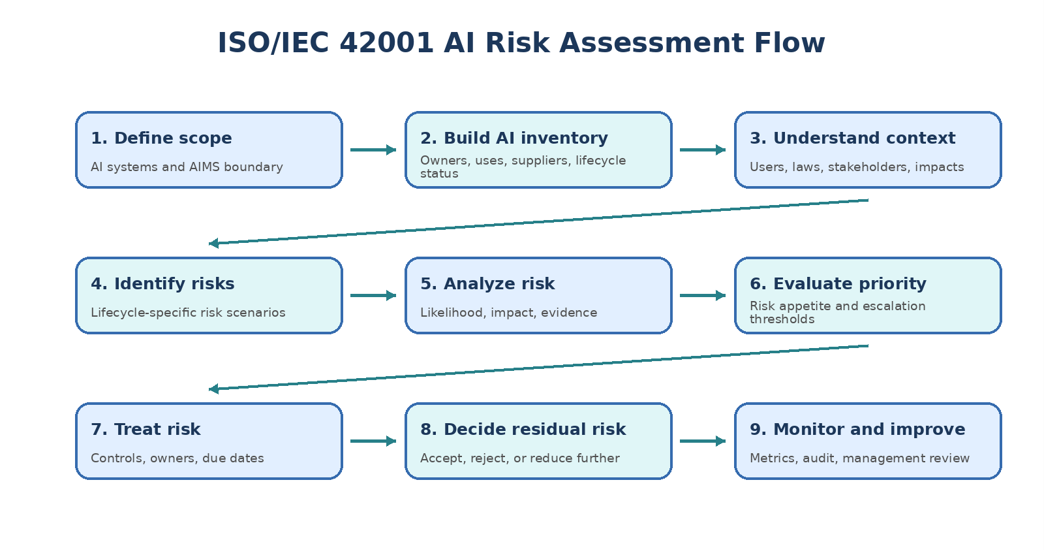
What the AI risk assessment is supposed to achieve
An ISO/IEC 42001 AI risk assessment should answer five questions:
- What AI systems are in scope?
- Who or what could be harmed or adversely affected?
- What can go wrong across the AI lifecycle?
- How serious and likely are those risks?
- What controls, owners, monitoring, and acceptance decisions are required?
The assessment should feed your AI management system: AI policy, risk treatment plan, control selection, supplier management, human oversight, monitoring, internal audit, and management review.
ISO/IEC 23894 is a useful companion because it provides guidance for organizations that develop, deploy, produce, or use AI systems to manage AI-related risk and integrate that risk management into AI activities. ISO/IEC 42005:2025 is also relevant because it provides guidance for AI system impact assessments focused on effects on individuals, groups, and society across the AI lifecycle.
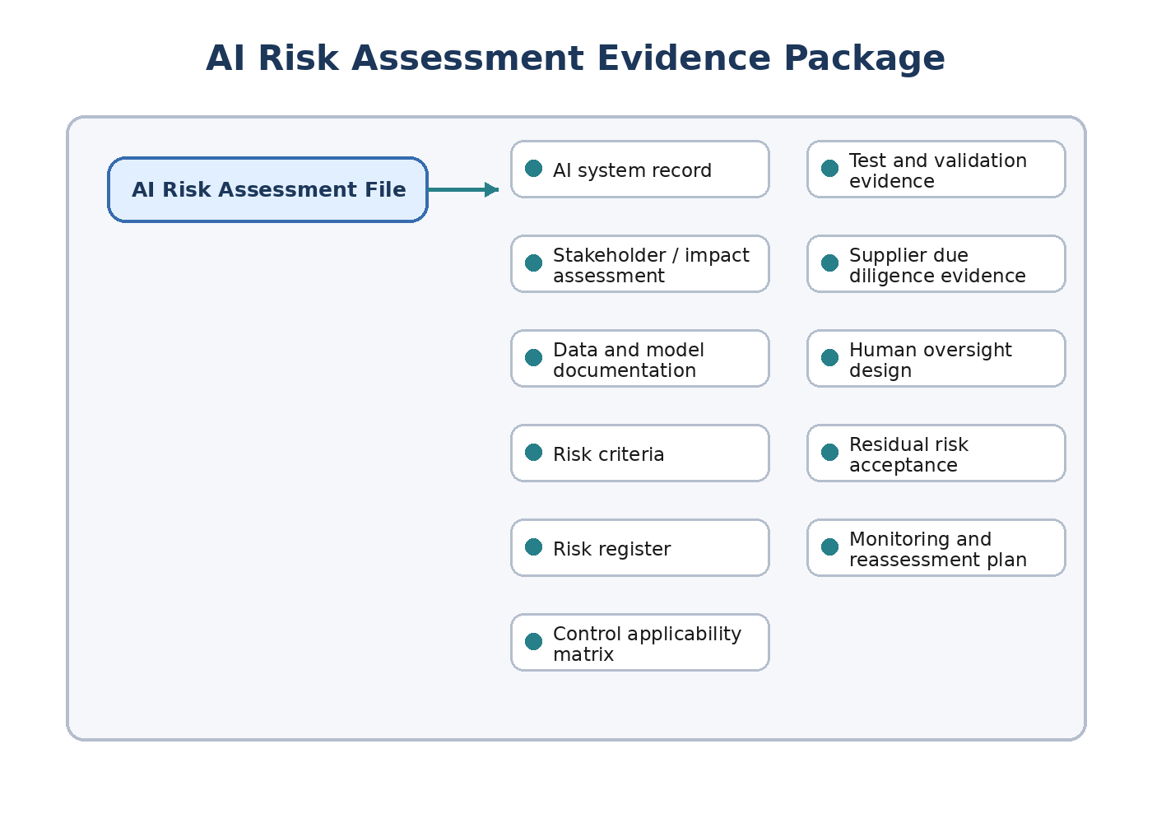
Core deliverables
At the end of the assessment, you should have these records:
Deliverable | Purpose |
AI inventory | List of AI systems, use cases, owners, users, suppliers, lifecycle status, and criticality. |
AI system description | Business purpose, model type, data, interfaces, users, outputs, dependencies, and deployment context. |
Stakeholder and impact assessment | Identification of affected individuals, groups, customers, employees, regulators, and society-level effects. |
Risk criteria | Likelihood, impact, risk appetite, severity thresholds, and escalation rules. |
Risk register | Risk scenarios, causes, impacts, inherent risk, controls, residual risk, owner, treatment plan, evidence. |
Risk treatment plan | Control actions, responsible owners, deadlines, evidence, and validation method. |
Statement of applicability or control applicability matrix | Which AI controls are applicable, not applicable, implemented, or planned. |
Residual risk acceptance record | Formal approval by accountable management for remaining risk. |
Monitoring plan | Metrics, alerts, review cadence, drift checks, incident triggers, and re-assessment triggers. |
Step-by-step method
Step 1: Define the assessment scope
Do not assess “AI” in the abstract. Assess a specific system in a specific use context.
Start by deciding whether you are assessing:
- a single AI system,
- a portfolio of AI systems,
- a business process using AI,
- a third-party AI service,
- a general-purpose AI or generative AI capability,
- or the entire organization’s AIMS.
For each assessment, document:
Field | Example |
Assessment name | Customer Support GenAI Assistant Risk Assessment |
Business owner | VP Customer Operations |
Technical owner | Head of AI Engineering |
AI system owner | Product Manager, Support Automation |
Assessment lead | AI Governance Manager |
Lifecycle stage | Design, pilot, production, retirement |
In-scope components | LLM API, retrieval system, prompt templates, user interface, support knowledge base |
Out-of-scope components | Human-only escalation process, billing platform |
Intended users | Support agents |
Affected parties | Customers, support agents, company |
Assessment date | 2026-06-04 |
Review date | Quarterly or after material change |
Step 2: Create or update the AI inventory
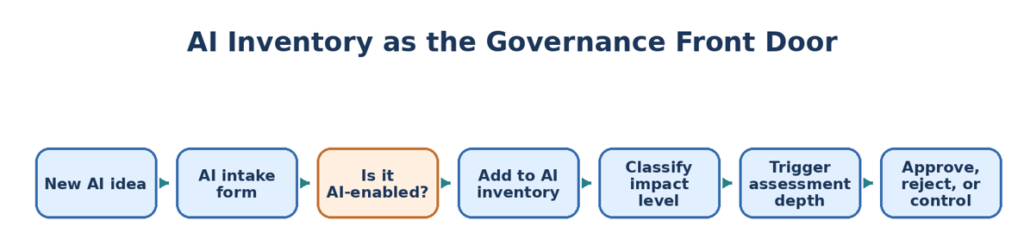
Before assessing risk, you need a complete inventory of AI systems. The inventory is the control point that prevents shadow AI from bypassing governance.
Minimum fields:
Field | Description |
AI system ID | Unique identifier |
Name | System name |
Business process | Where it is used |
Purpose | Intended use |
AI type | ML model, rules plus ML, LLM, computer vision, recommender, classifier, agent |
Build/buy status | Internal, vendor, open-source, embedded third party |
Data used | Training, validation, production, personal, sensitive, confidential |
Users | Employees, customers, public, automated system |
Decision role | Advisory, assistive, semi-automated, fully automated |
Impact level | Low, medium, high, critical |
Owner | Accountable business owner |
Status | Idea, development, pilot, production, retired |
Last assessment | Date |
Next review | Date |
Step 3: Describe the AI system clearly
The risk team cannot assess what it cannot understand. Create a concise system description before scoring risks.
A. Business purpose
Explain what the system is supposed to do and why the organization uses it.
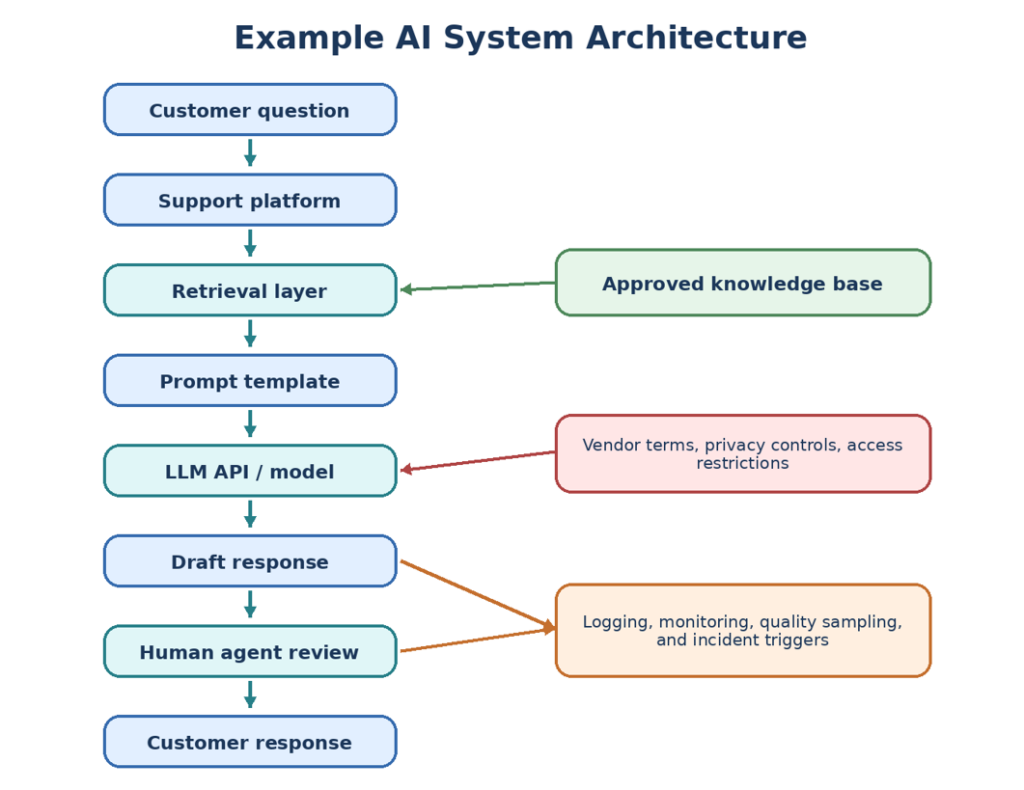
Example: The system assists customer support agents by drafting responses based on approved knowledge-base articles. Agents review and edit responses before sending them to customers.
B. Intended use and prohibited use
Document both.
| Category | Example |
| Intended use | Draft support responses for low-risk product questions |
| Prohibited use | Making refund decisions, legal claims, medical advice, or account termination decisions |
C. System architecture
Include the model, data, interfaces, human users, downstream systems, and vendors.
D. Decision role
Classify how much authority the AI has:
| Role | Description | Risk implication |
| Informational | Provides information only | Usually lower risk |
| Assistive | Helps a human decide | Requires human oversight |
| Recommending | Ranks or recommends options | Risk of automation bias |
| Semi-automated | AI output normally followed unless overridden | Higher oversight burden |
| Fully automated | AI makes or executes decision | Highest governance burden |
Step 4: Identify stakeholders and affected parties
AI risk is not only risk to the company. It includes risks to people, groups, customers, employees, business partners, and society.
Stakeholders may include:
Stakeholder | Possible concern |
Customers | Incorrect decisions, unfair treatment, privacy invasion |
Employees | Surveillance, deskilling, unfair performance evaluation |
Vulnerable groups | Discrimination, exclusion, accessibility barriers |
Regulators | Non-compliance, inadequate documentation |
Business units | Operational failure, reputational damage |
Security team | Prompt injection, data leakage, model abuse |
Legal/privacy team | Personal data misuse, IP issues, automated decision concerns |
Suppliers | Contractual, service, auditability, transparency issues |
ISO/IEC 42005 is especially useful here because it focuses on identifying, evaluating, and documenting intended and unintended impacts of AI systems on individuals, groups, and society.
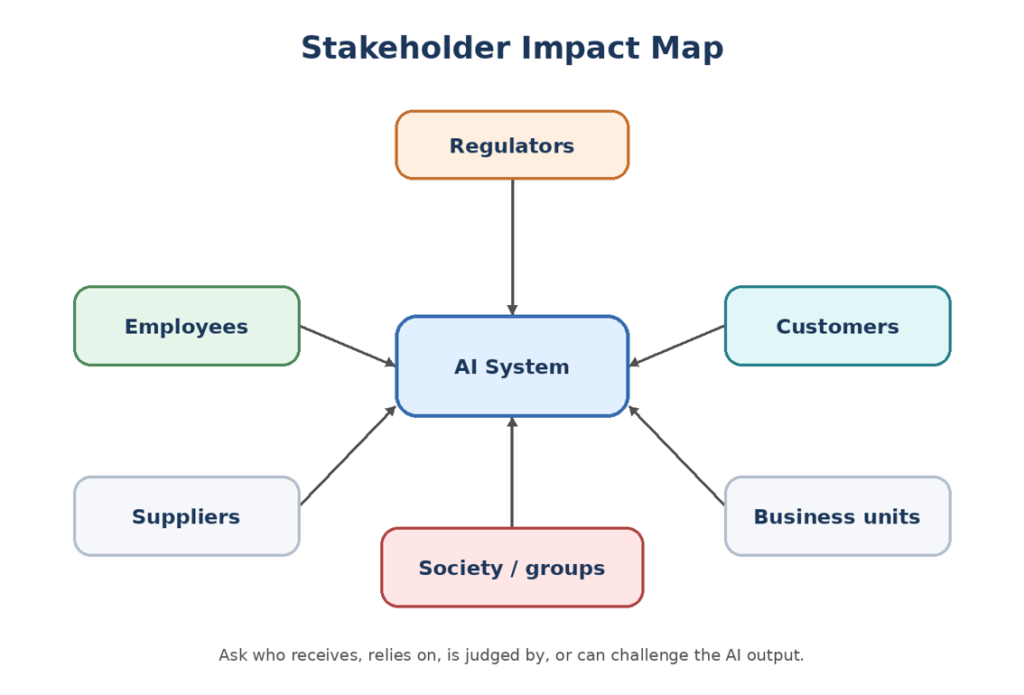
Ask:
- Who receives the AI output?
- Who is judged, ranked, predicted, profiled, or affected?
- Who may be excluded by data, language, disability, geography, or digital access?
- Who can challenge the output?
- Who is accountable when the AI causes harm?
Step 5: Define risk criteria before scoring
Do not start by arguing whether a risk is high or medium. First define the scoring rules.
A simple ISO/IEC 42001-compatible method can use: Risk score = Likelihood x Impact.
Likelihood scale
Score | Level | Meaning |
1 | Rare | Highly unlikely; would require exceptional conditions |
2 | Unlikely | Could occur, but not expected |
3 | Possible | Could occur under normal conditions |
4 | Likely | Expected to occur periodically |
5 | Almost certain | Expected to occur often or continuously |
Impact scale
Score impact across multiple dimensions, then use the highest relevant impact score.
Score | Level | Example impact |
1 | Negligible | Minor inconvenience, no material harm |
2 | Minor | Small customer issue, easily corrected |
3 | Moderate | Material service error, complaint, limited legal or privacy concern |
4 | Major | Serious harm, regulatory exposure, discrimination, major operational disruption |
5 | Severe | Physical harm, major rights impact, systemic discrimination, major legal exposure, severe reputational damage |
Risk rating
Score | Rating | Action |
1-4 | Low | Manage through standard controls |
5-9 | Medium | Treatment plan required |
10-16 | High | Senior owner approval required |
17-25 | Critical | Do not deploy unless risk is reduced or formally accepted by executive governance |
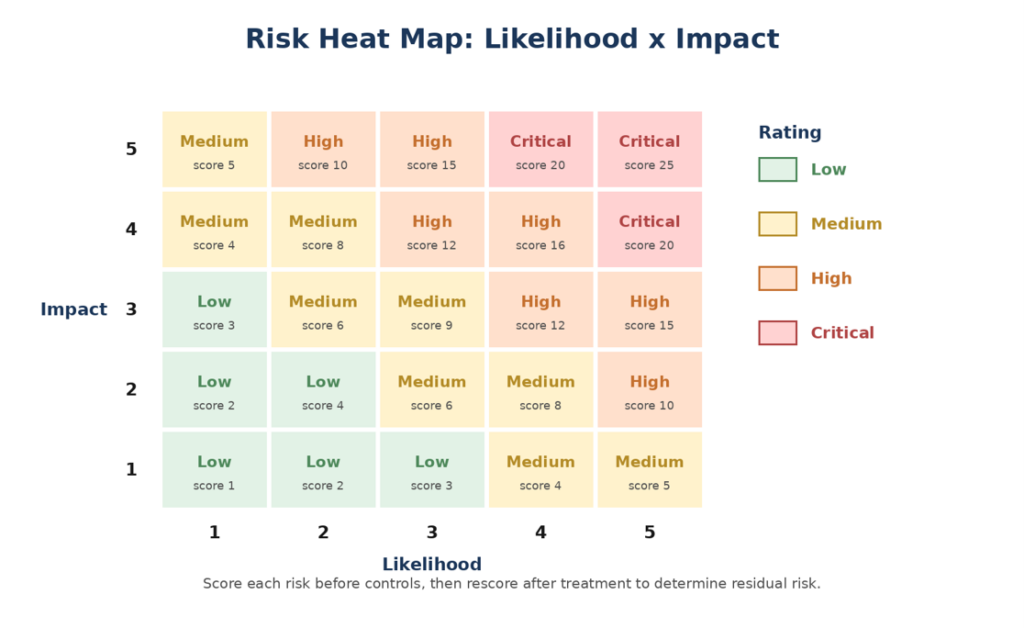
For AI systems, numeric scoring should be supported by evidence. A 3 x 4 = 12 score is not enough. Record why the likelihood and impact were chosen.
Step 6: Identify AI-specific risk scenarios
Use scenario-based risk identification. A useful format is:
Because [cause / threat / condition], the AI system may [risk event], which could cause [impact] to [stakeholder / asset / objective].
Example: Because the support assistant retrieves outdated knowledge-base content, it may generate inaccurate instructions, which could cause customers to take incorrect account actions and create customer harm, complaints, and remediation cost.
Assess risks across the full AI lifecycle.
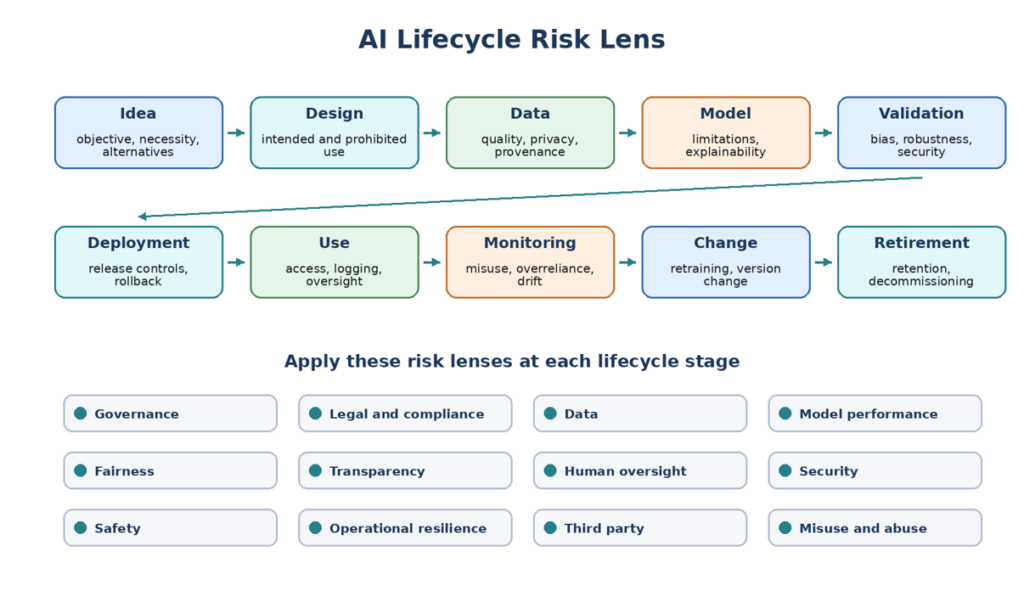
AI risk categories to consider
Category | Example risks |
Governance | No accountable owner, unclear approval authority, undocumented intended use |
Legal and compliance | Privacy violation, unlawful automated decision-making, inadequate records |
Data | Poor data quality, biased data, missing consent/provenance, sensitive data leakage |
Model performance | Inaccuracy, hallucination, overfitting, brittleness, poor calibration |
Fairness and non-discrimination | Disparate impact, proxy discrimination, unequal error rates |
Transparency and explainability | Users cannot understand limitations or contest outcomes |
Human oversight | Rubber-stamping, automation bias, unclear escalation |
Security | Prompt injection, data poisoning, model extraction, adversarial examples |
Safety | Physical or psychological harm, unsafe recommendations |
Operational resilience | Downtime, vendor outage, uncontrolled model change |
Third-party risk | Vendor opacity, inadequate audit rights, unclear data use |
Misuse and abuse | Users apply system outside intended purpose |
Environmental and societal | Resource use, labor displacement, manipulation, exclusion |
Generative AI-specific risks
GenAI-specific risk | Example |
Hallucination | Fabricated facts in customer, legal, medical, or financial context |
Prompt injection | External text manipulates the model into ignoring instructions |
Confidentiality leakage | Sensitive data appears in prompts or outputs |
Toxic or unsafe content | Harmful, biased, or policy-violating output |
IP/copyright risk | Generated or retrieved content creates IP exposure |
Untraceable output | Organization cannot explain source or basis of answer |
NIST’s AI RMF is a useful cross-check: its core functions are Govern, Map, Measure, and Manage, which align well with governance, context-setting, measurement, and risk treatment activities in an AI risk assessment.
Step 7: Analyze inherent risk
Inherent risk means the level of risk before new or enhanced controls.
For each risk scenario, score:
Field | Description |
Risk ID | Unique number |
Risk scenario | What could happen |
Cause | Why it could happen |
Impacted stakeholder | Customer, employee, public, business, regulator |
Existing controls | Controls already in place |
Likelihood | 1-5 |
Impact | 1-5 |
Inherent score | Likelihood x Impact |
Inherent rating | Low, medium, high, critical |
Evidence | Data, testing, incidents, expert review, vendor evidence |
Step 8: Evaluate risk against appetite and acceptance criteria
Now decide whether the risk is acceptable, unacceptable, or acceptable only with additional controls.
Use three tests:
1. Threshold test
Does the score exceed your defined risk appetite?
Example: Critical risk cannot deploy. High risk requires a treatment plan and senior approval. Medium risk requires a treatment plan. Low risk can be monitored through standard controls.
2. Red-line test
Some risks should trigger escalation regardless of score, such as:
- potential physical harm,
- unlawful discrimination,
- children or vulnerable-person impacts,
- sensitive personal data misuse,
- fully automated consequential decisions,
- inability to provide meaningful human oversight,
- inability to stop or roll back the system,
- lack of supplier transparency for a high-impact use case.
3. Evidence test
Ask whether the score is defensible.
Bad evidence: The team believes the risk is low.
Better evidence: The validation set covers the intended user groups, measured error rates are within approved tolerance, human review is mandatory before customer communication, and monitoring alerts trigger if unsupported output exceeds 2%
Step 9: Select risk treatment options
For each unacceptable risk, select one or more treatment options.
Treatment option | Meaning | AI example |
Avoid | Do not proceed with the risky use | Do not use AI for employee termination recommendations |
Reduce | Add controls to lower likelihood or impact | Add human review, testing, retrieval grounding, access control |
Transfer/share | Shift or share risk contractually or operationally | Vendor warranties, insurance, contractual audit rights |
Accept | Formally accept residual risk | Executive approval with monitoring |
Exploit opportunity | Use AI benefit under controlled conditions | Pilot in low-risk workflow before expansion |
Control types
Use a layered control model.
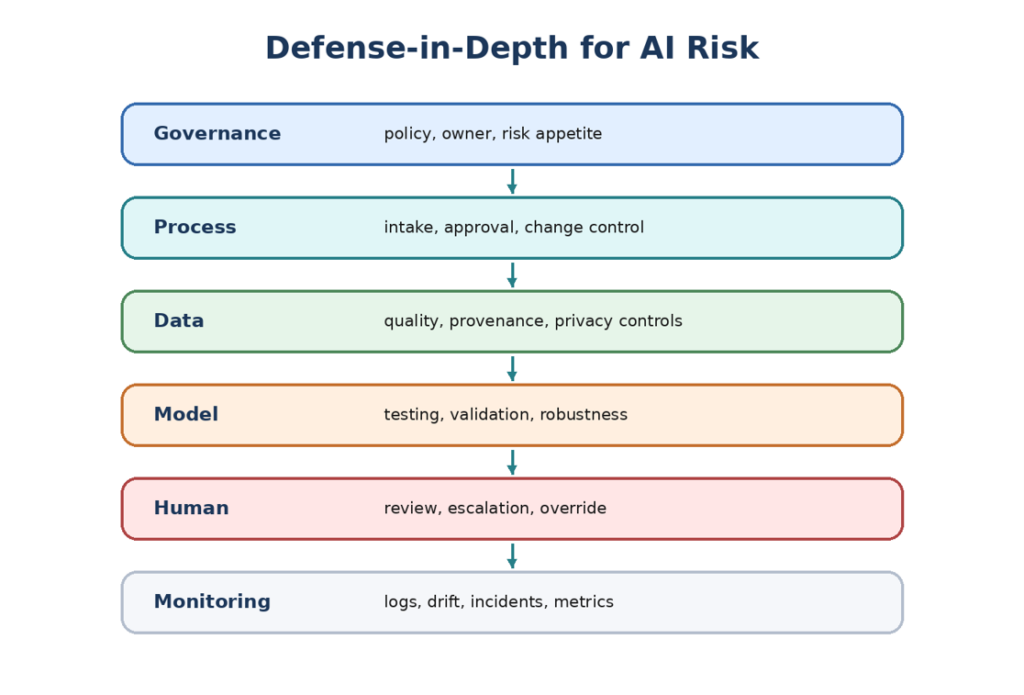
| Risk | Possible controls |
| Bias or disparate impact | Representative data review, fairness metrics, subgroup testing, independent review |
| Hallucination | Retrieval grounding, output constraints, confidence thresholds, human review |
| Prompt injection | Input filtering, tool-use restrictions, system prompt hardening, sandboxing, monitoring |
| Privacy leakage | Data minimization, redaction, access control, retention limits, privacy review |
| Model drift | Performance monitoring, drift detection, scheduled revalidation |
| Automation bias | User training, interface warnings, mandatory justification for decisions |
| Vendor opacity | Due diligence, contractual audit rights, model/data-use commitments |
| Misuse | Intended-use policy, access restrictions, user logging, prohibited-use monitoring |
Step 10: Link risks to ISO/IEC 42001 controls and your control applicability matrix
For certification readiness, your risk assessment should drive control selection. In practice, create a control applicability matrix similar to a Statement of Applicability.
Control area | Applicable? | Why? | Implementation evidence | Risk IDs |
AI policy and responsibilities | Yes | All AI systems require accountable ownership | AI policy, RACI, approval minutes | AI-R-001 |
Impact assessment | Yes | Customer-facing AI affects individuals | Impact assessment report | AI-R-003, AI-R-009 |
Data governance | Yes | System uses customer support records | Data lineage, quality checks, privacy review | AI-R-004 |
Human oversight | Yes | AI drafts customer communications | Agent review workflow, training | AI-R-014 |
Third-party management | Yes | LLM API supplied by vendor | Vendor due diligence, contract addendum | AI-R-021 |
Model monitoring | Yes | Output quality may drift | Monitoring dashboard, incident thresholds | AI-R-018 |
The key audit logic is: Risk identified -> Control selected -> Control implemented -> Evidence retained -> Residual risk evaluated -> Management accepts or rejects.
Step 11: Estimate residual risk
After defining controls, rescore the risk.
Field | Before controls | After controls |
Likelihood | 4 | 2 |
Impact | 3 | 3 |
Score | 12 | 6 |
Rating | High | Medium |
Decision | Treat | Accept with monitoring |
Document why the residual score changed. Do not lower the score just because a policy exists. Lower it only when the control is implemented, operating, and supported by evidence.
Good evidence includes:
- validation results,
- access-control screenshots,
- monitoring dashboards,
- test cases,
- red-team results,
- bias/fairness analysis,
- human review logs,
- supplier attestations,
- training records,
- incident response exercises,
- approval minutes.
Step 12: Obtain formal risk acceptance
Residual risks must be accepted by the right level of authority.
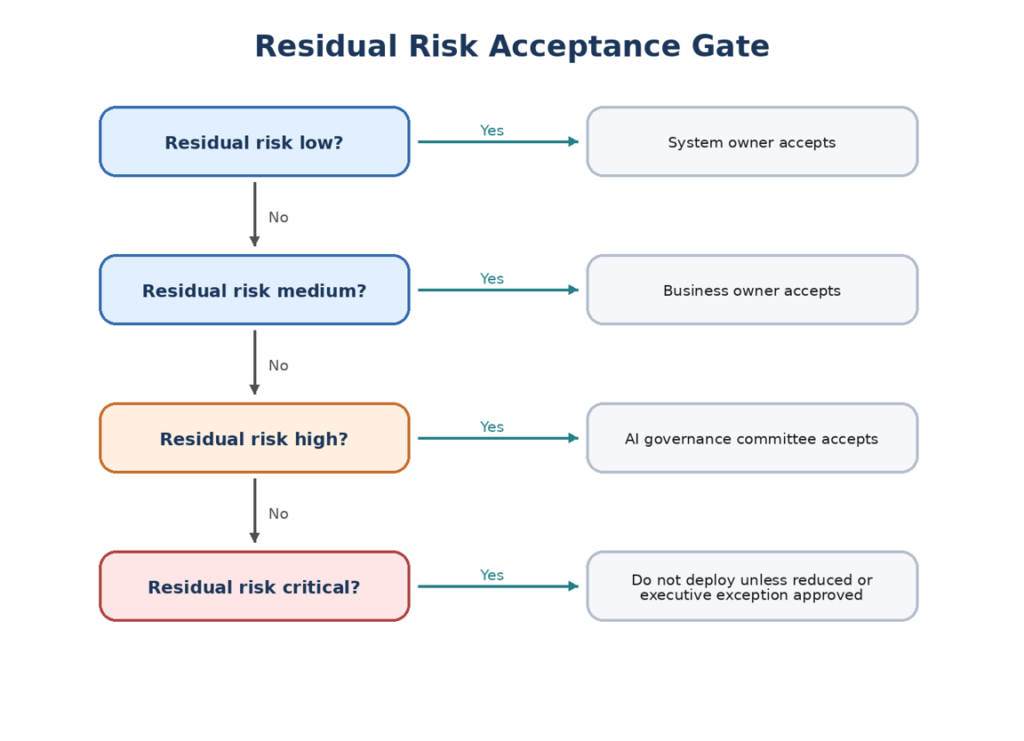
Example authority model:
Residual rating | Acceptance authority |
Low | System owner |
Medium | Business owner |
High | AI governance committee or executive risk owner |
Critical | Executive committee; usually not deployable without further treatment |
Acceptance record:
Field | Example |
Risk ID | AI-R-014 |
Residual rating | Medium |
Residual risk summary | Incorrect support response remains possible despite grounding and human review |
Required monitoring | Unsupported output rate, complaint rate, override rate |
Acceptance owner | VP Customer Operations |
Acceptance date | 2026-06-04 |
Expiry/review date | 2026-09-04 |
Conditions | No expansion to refund decisions without reassessment |
Step 13: Build the monitoring and reassessment plan
AI systems can drift, vendors can change models, data can shift, and users can misuse outputs.
Monitor:
Metric type | Examples |
Model performance | Accuracy, precision/recall, hallucination rate, unsupported answer rate |
Fairness | Error rates by protected or relevant groups, adverse impact indicators |
Safety | Harmful output rate, severity of incidents |
Security | Prompt injection attempts, unauthorized access, data exfiltration attempts |
Human oversight | Override rate, review completion rate, escalation rate |
Usage | Use volume, unusual use, prohibited-use attempts |
Data | Drift, missing values, data quality failures |
Vendor | Model version changes, service incidents, SLA failures |
Complaints/incidents | Customer complaints, regulator inquiries, internal reports |
Trigger reassessment when:
- intended use changes,
- user group changes,
- data source changes,
- model or vendor changes,
- the system is integrated into a new business process,
- performance drops below threshold,
- incident or near miss occurs,
- new legal/regulatory obligation applies,
- monitoring shows drift or unexpected behavior,
- the system moves from pilot to production.
Step 14: Keep documented information
For ISO-style management systems, documentation matters because it proves the process is repeatable and controlled.
Maintain:
Record | Owner |
AI inventory | AI governance or risk team |
Risk assessment procedure | AIMS owner |
Risk criteria | Risk management function |
Risk register | System owner plus risk lead |
Impact assessment | Business owner plus AI governance |
Technical validation evidence | AI engineering / data science |
Privacy/security reviews | Privacy/security teams |
Supplier due diligence | Procurement / vendor risk |
Residual risk acceptance | Accountable business owner |
Monitoring reports | System owner |
Incident records | Operations / security / compliance |
Internal audit results | Internal audit |
Management review minutes | Executive sponsor / AIMS owner |
Recommended Template Workflow
- Start with scope and governance. Use the AIMS scope, AI policy, roles and responsibilities, and legal register templates to define boundaries, responsibilities, obligations, and approval authority.
- Build the risk register. Use the ISO 42001 Risk Assessment Template to capture AI risks and opportunities, score likelihood and impact, define inherent risk, record existing controls, and decide whether risk treatment is required.
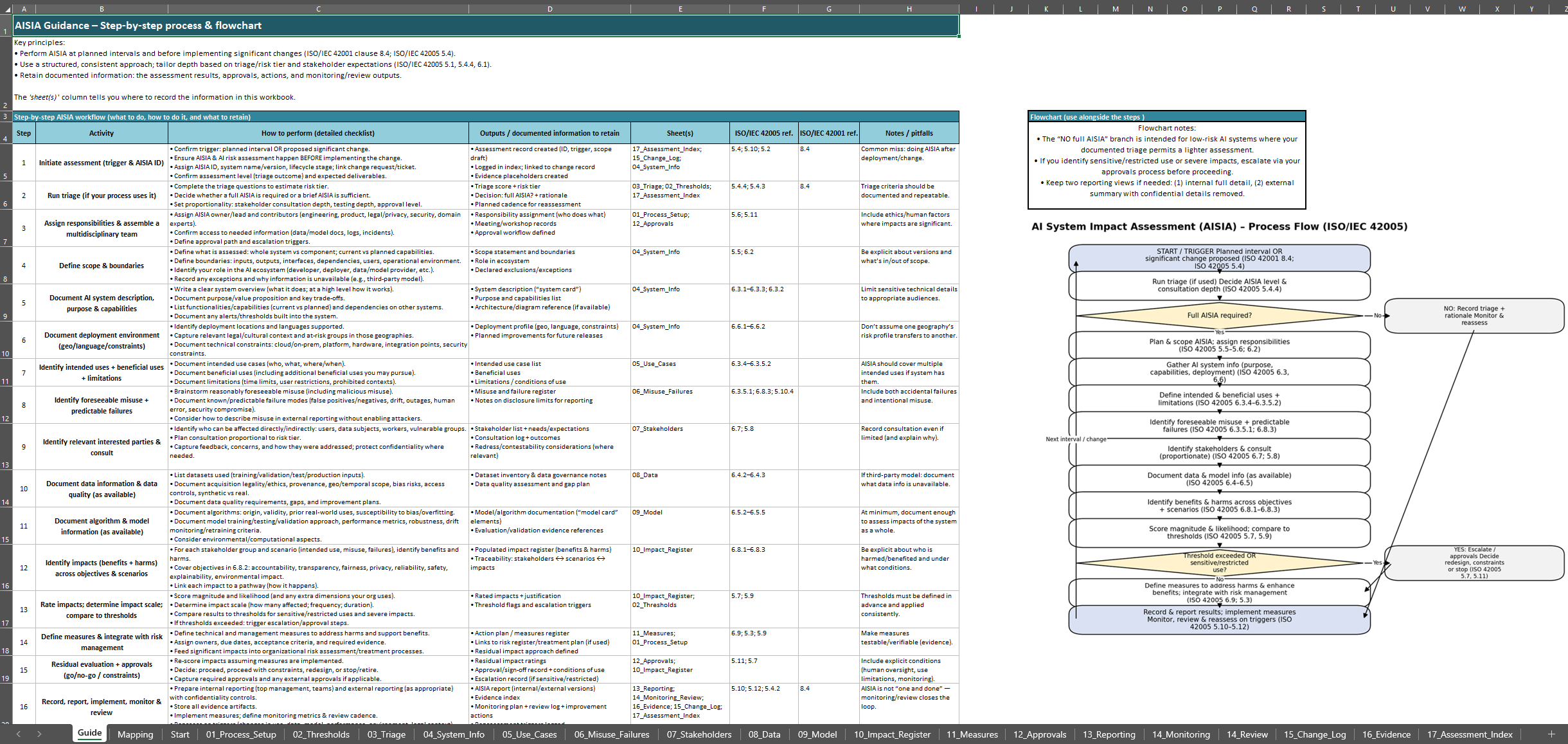
- Assess human and societal impacts. Use the AI System Impact Assessment Template to document affected parties, intended use, foreseeable misuse, potential harms, safeguards, oversight, and residual impact concerns.
- Select controls and document applicability. Use the Statement of Applicability Template to justify which ISO 42001 Annex A controls apply, assign owners, link controls to risks, and record implementation evidence.
- Operationalize treatment actions. Use the risk treatment plan, controls tracker, and lifecycle process template to convert assessment findings into accountable actions, deadlines, evidence, and lifecycle stage gates.
- Prepare for review and audit. Use the internal audit checklist and management review records to test whether the AIMS is implemented, maintained, effective, and continually improved.
Recommended Templates
- ISO 42001 Risk Assessment Template – Main working template for AI risk scoring, treatment actions, residual risk, owners, and control traceability.
- ISO 42001 Toolkit Bundle – Complete AIMS documentation set for policy, scope, responsibilities, risk, impact, control applicability, lifecycle governance, and audit readiness.
- AI System Impact Assessment Template – Template for documenting impacts on individuals, groups, users, customers, employees, society, and the environment.
- ISO 42001 Statement of Applicability Template – Control applicability and justification template for linking selected controls to risk treatment and evidence.
- AI System Life Cycle Process Template – Lifecycle procedure template for embedding risk controls into initiation, design, development, validation, deployment, monitoring, change, and retirement.
ISO/IEC 42001 AI risk assessment checklist
This checklist provides a practical summary of the key activities involved in conducting an ISO/IEC 42001 AI risk assessment.
The checklist can be used during AI system intake, pre-deployment review, supplier assessment, internal audit preparation, or periodic reassessment. It covers essential areas such as governance, intended use, stakeholder impact, data and model risks, human oversight, third-party dependencies, risk treatment, residual risk acceptance, and ongoing monitoring.
For a free downloadable version of the checklist, use the link below:
Common mistakes to avoid
Treating the risk assessment as a compliance form
A risk register with generic entries like bias risk or privacy risk is weak. Use concrete scenarios tied to a real system, real data, real users, and real decisions.
Ignoring intended use
The same model can be low risk in one context and high risk in another. A chatbot that summarizes public help articles is different from a chatbot that gives medical, legal, financial, or employment advice.
Scoring risk without evidence
Risk scores should be supported by validation results, incident data, user testing, vendor evidence, security testing, or expert review.
Confusing human oversight with human accountability
A human in the loop is not enough. The human must have enough time, information, authority, competence, and interface support to challenge or override the AI.
Forgetting third-party AI dependencies
Vendor AI systems still need assessment. Outsourcing the model does not outsource accountability.
Failing to reassess after change
AI risk changes when prompts, models, data, thresholds, integrations, vendors, users, or business purposes change.
A simple operating rhythm
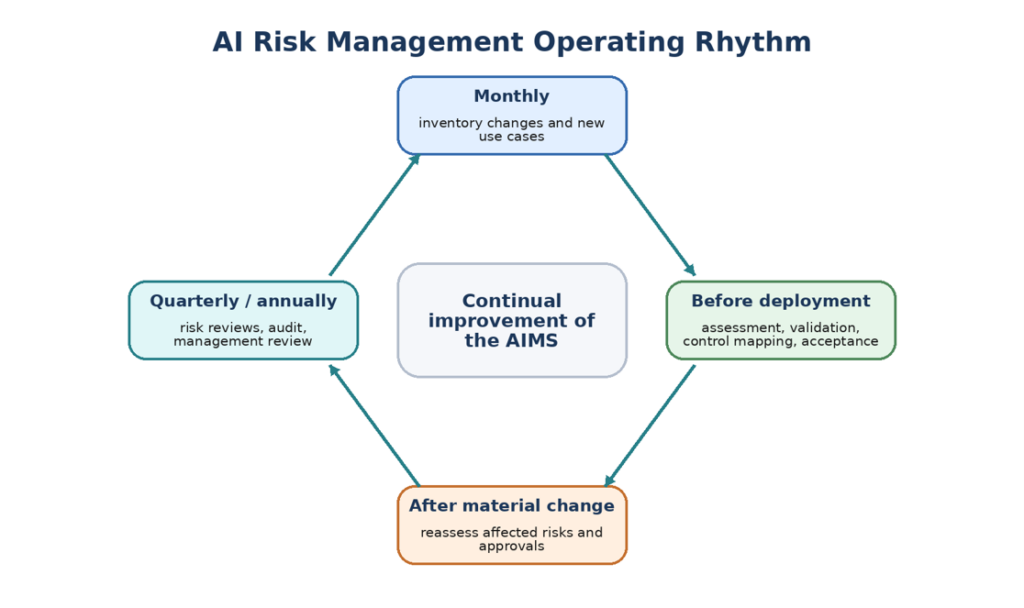
Cadence | Activity |
Monthly | Review AI inventory changes and new use cases. |
Quarterly | Review high and medium AI risks, monitoring metrics, incidents, and overdue treatments. |
Before deployment | Complete risk assessment, impact assessment, validation, control mapping, and residual risk acceptance. |
After material change | Reassess affected risks and obtain new approval. |
Annually | Review risk methodology, appetite, control effectiveness, internal audit findings, and management review outputs. |
Final recommended procedure
For each AI system, follow this repeatable procedure:
- Register the AI system in the AI inventory.
- Assign accountable owners for business, technical, risk, and operational responsibilities.
- Document intended and prohibited use.
- Map the system architecture, data flows, users, suppliers, and outputs.
- Identify affected stakeholders and complete an impact assessment.
- Define likelihood, impact, risk appetite, and escalation criteria.
- Identify risk scenarios across the AI lifecycle.
- Score inherent risk using documented evidence.
- Evaluate risks against appetite and red-line criteria.
- Select treatment options and AI controls.
- Implement and test controls.
- Score residual risk.
- Obtain formal risk acceptance.
- Monitor performance, fairness, security, usage, drift, incidents, and supplier changes.
- Reassess after material change or at a defined review interval.
- Feed results into AIMS performance evaluation, internal audit, management review, and continual improvement.
A strong ISO/IEC 42001 AI risk assessment is a controlled management-system process that connects AI inventory, impact assessment, risk scoring, control selection, residual risk acceptance, monitoring, audit, and improvement.
Related Templates & Documents
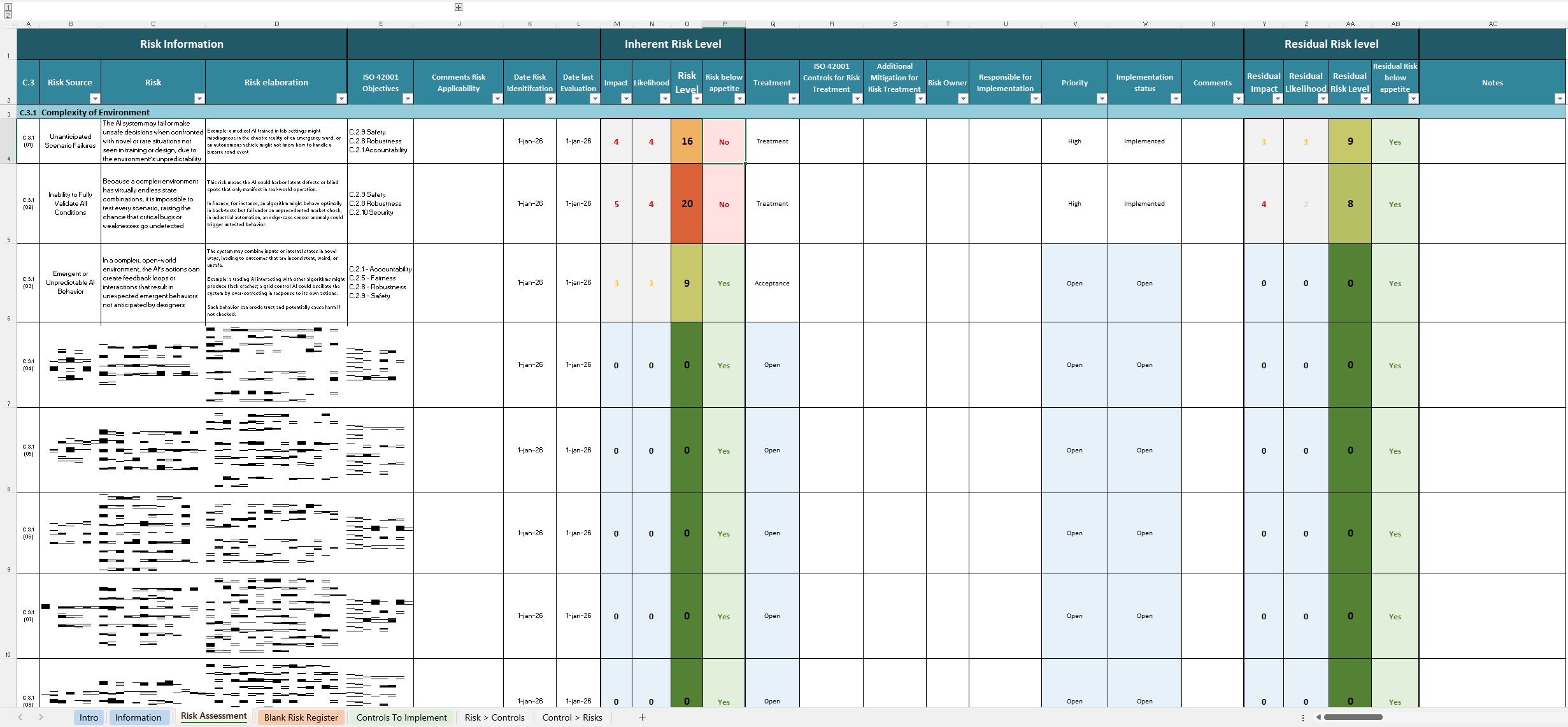
ISO 42001 Risk Assessment Template
✓ Editable Excel AI Risk Assessment Template
✓ ISO/IEC 42001 Clause 6.1.2 Aligned
<span
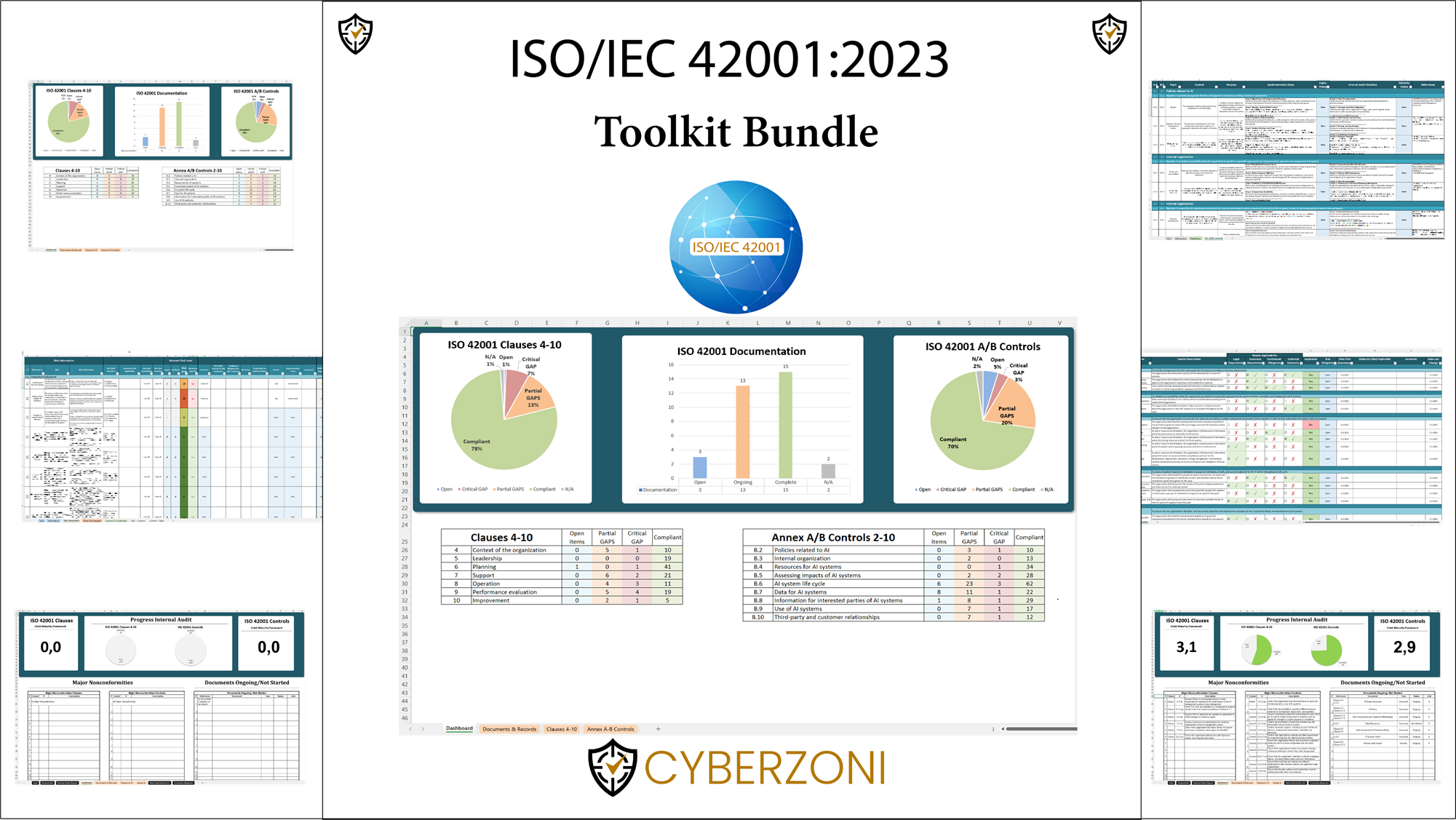
ISO 42001 Custom Toolkit Builder
✓ Configure your own ISO/IEC 42001 toolkit based on your organization’s needs.
✓ Structure AI
AI System Impact Assessment Template
✓ Editable Excel Template for AI System Impact Assessments
✓ Includes ISO/IEC 42005 Guidance