PESTLE Analysis Template: Understand External Risks and Opportunities
This PESTLE Analysis template is a practical and fully editable pestle template created to help businesses, consultants, compliance professionals, and cyber security teams assess the external factors that can influence strategy, risk, and decision-making.
If you are looking for a professional pestle template, pestle template excel, or a structured pestle tool, this template gives you a simple but effective way to document and review external influences in one place.
The PESTLE Analysis method is widely used to evaluate Political, Economic, Social, Technological, Legal, and Environmental factors.
If you are searching for the pestle analysis full form or want to better understand the pestle analysis meaning, this template helps turn the theory into a usable working document.
What Is the PESTLE Model?
PESTLE is a popular technique to cover external issues under Clause 4.1.
The pestle model is a strategic planning method used to assess the external environment around a business, department, project, or compliance initiative.
This Pestle framework is useful for identifying trends, risks, market pressures, regulatory changes, and growth opportunities.
Whether you call it a Pestle framework, pestle framework template, pestel framework template, or even template pestel, the purpose is the same: helping organizations analyze the outside factors that can affect performance and planning.
This product gives you a ready-to-use pestle model template that can be customized for different industries and use cases.
For a complete ISO-ready “context,” you also consider internal issues and interested parties—and then link what’s relevant into planning and risk treatment.
Why Use This PESTLE Template
This excel-based pestle template is built for easy editing, practical use, and repeatable assessments.
Instead of starting from a blank document, you get a structured pestle analysis template excel that helps you organize findings clearly and consistently.
Compared to a static worksheet or a basic pestle analysis template word file, Excel gives you more flexibility for ongoing updates, internal collaboration, filtering, and tracking.
That makes this resource a useful pestle tool for businesses that want a working template rather than just a one-time document.
This template can also serve as a reusable pestle model template excel for consultants and managers who need to perform the same type of external analysis across multiple clients, departments, or projects.
When to Use this Template
This PESTLE Analysis template can be used in a wide range of business, compliance, and risk-related scenarios.
Use Cases: |
This pestle model template is suitable for: |
|
|
PESTLE Analysis Example and Visual Overview
A good external analysis should not just list factors, but also help interpret them.
This template supports a more structured approach, making it easier to document each factor and create your own pestle analysis example based on your organization, sector, or compliance goals.
It can also help you build a simple pestle analysis diagram or summary overview for reporting purposes, presentations, workshops, or management review discussions.
What’s included
A good external analysis should not just list factors, but also help interpret them.
This template supports a more structured approach, making it easier to document each factor and create your own pestle analysis example based on your organization, sector, or compliance goals.
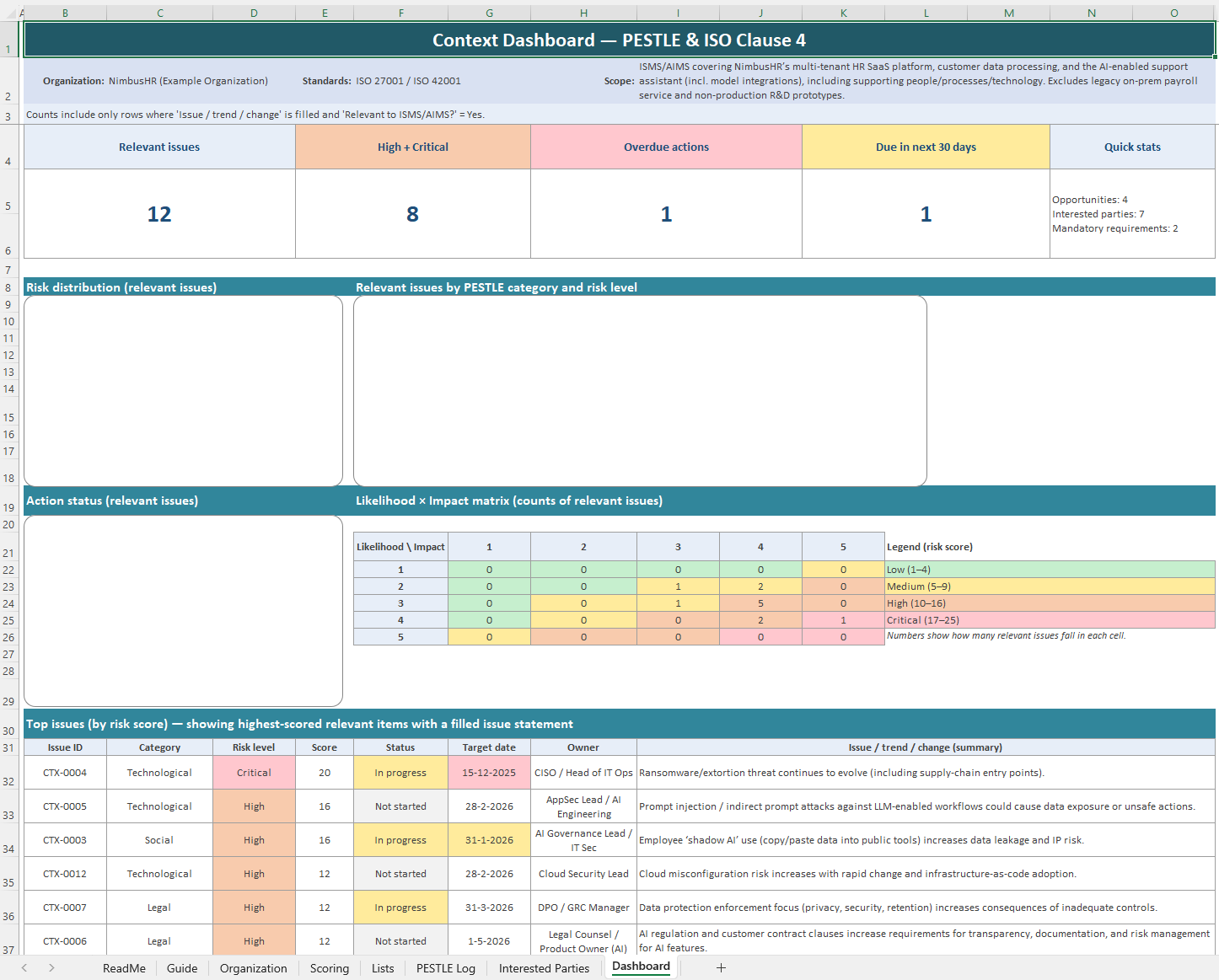
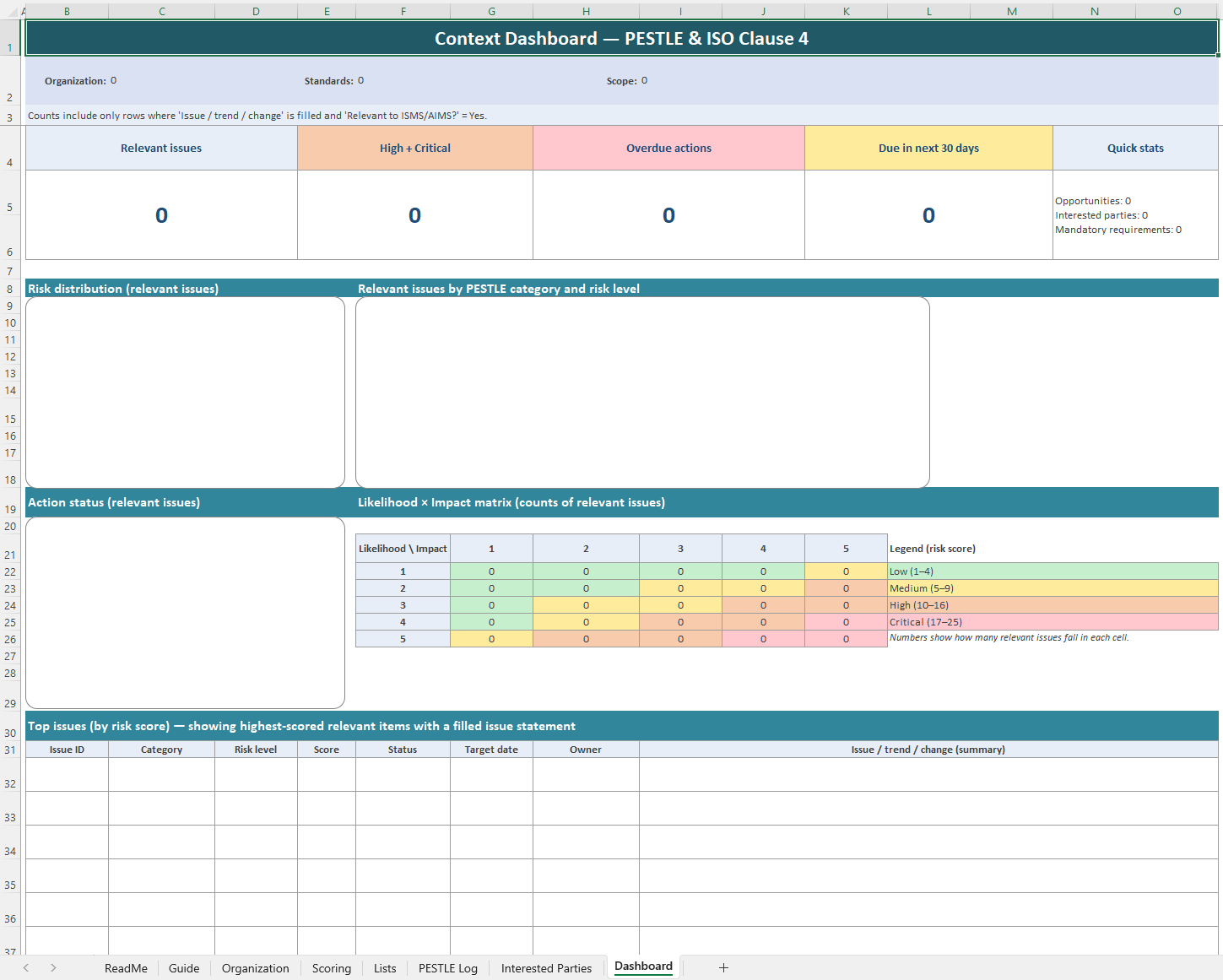
1) Management-ready Dashboard (auto-updating)
Top management loves visibility. The dashboard provides:
-
-
- KPI cards (relevant issues, High/Critical, overdue, due soon, opportunities)
- Risk distribution and category breakdown charts
- Action status overview
- A 5×5 Likelihood × Impact “heatmap” (counts and color-coded thresholds)
- Top issues list for executive focus
-
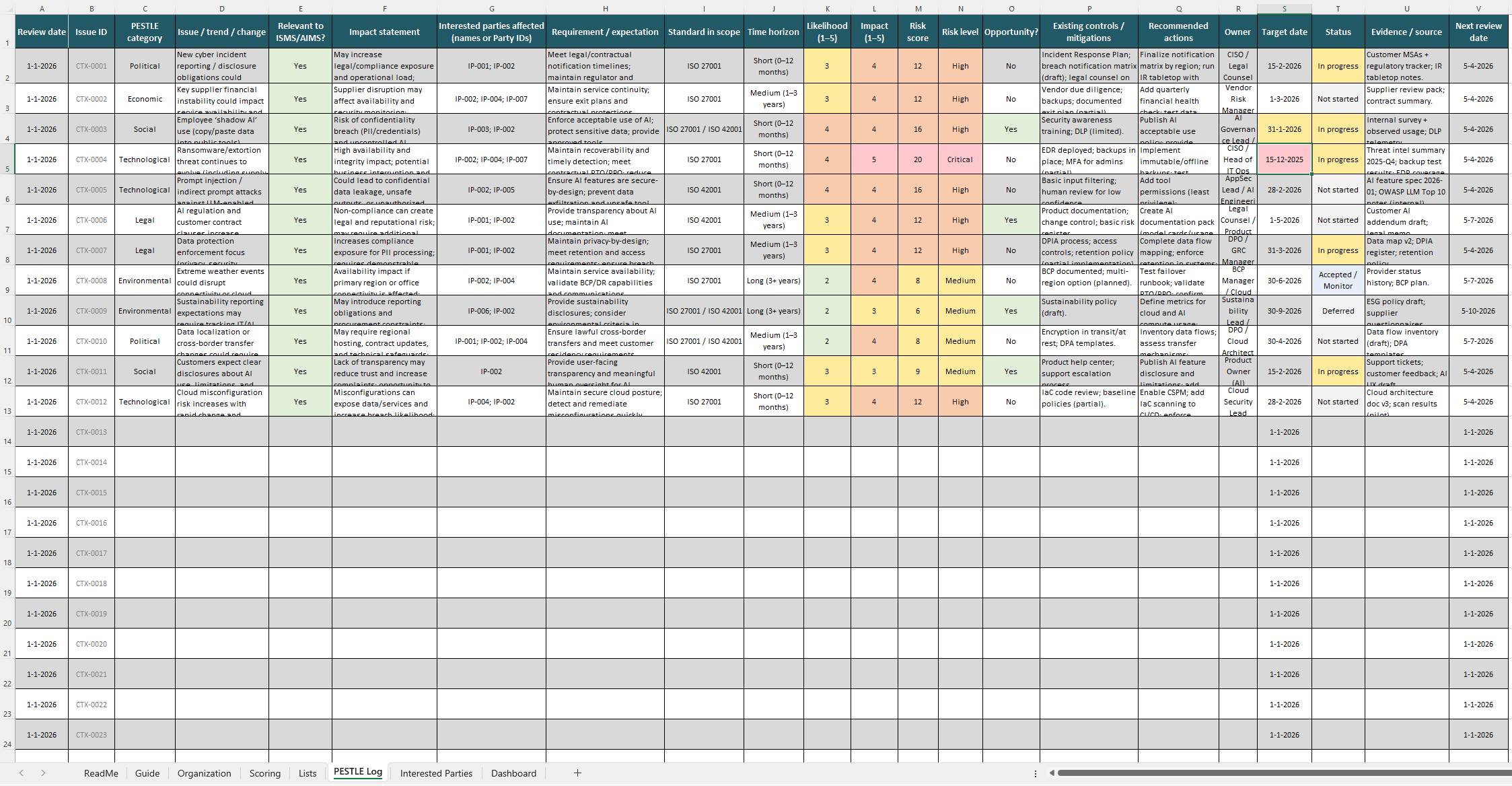
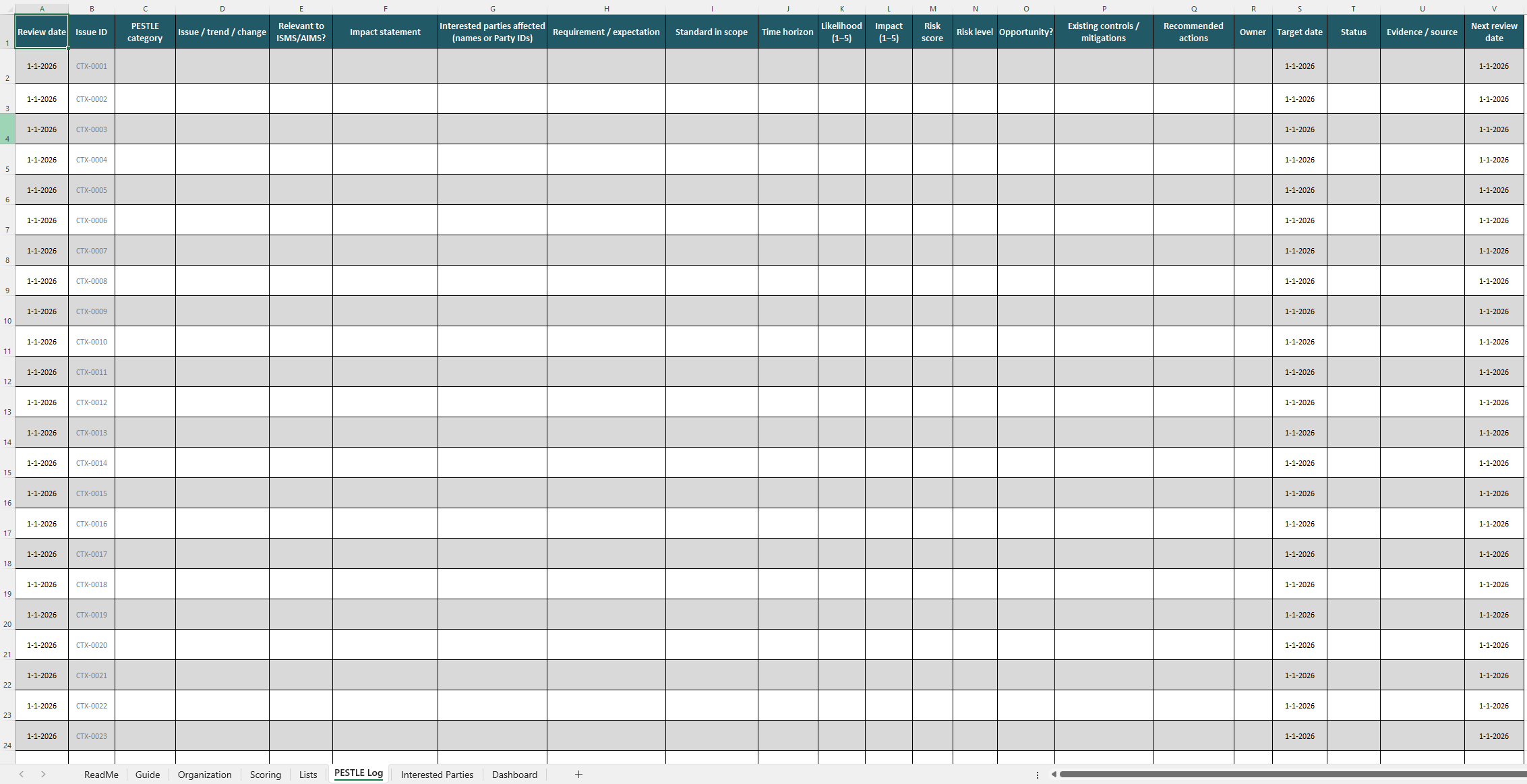
2) PESTLE Log (Clause 4.1) that drives action
Capture each issue once, then use it through the process:
-
-
- PESTLE category + issue statement + relevance decision
- Likelihood / Impact scoring and auto risk level
- Owner, actions, dates, status, evidence fields
- Built-in conditional formatting for:
- Low/Medium/High/Critical emphasis
- Overdue / due soon actions
- High/Critical issues missing an owner or actions
- “Relevant = No” row muting to reduce noise
-
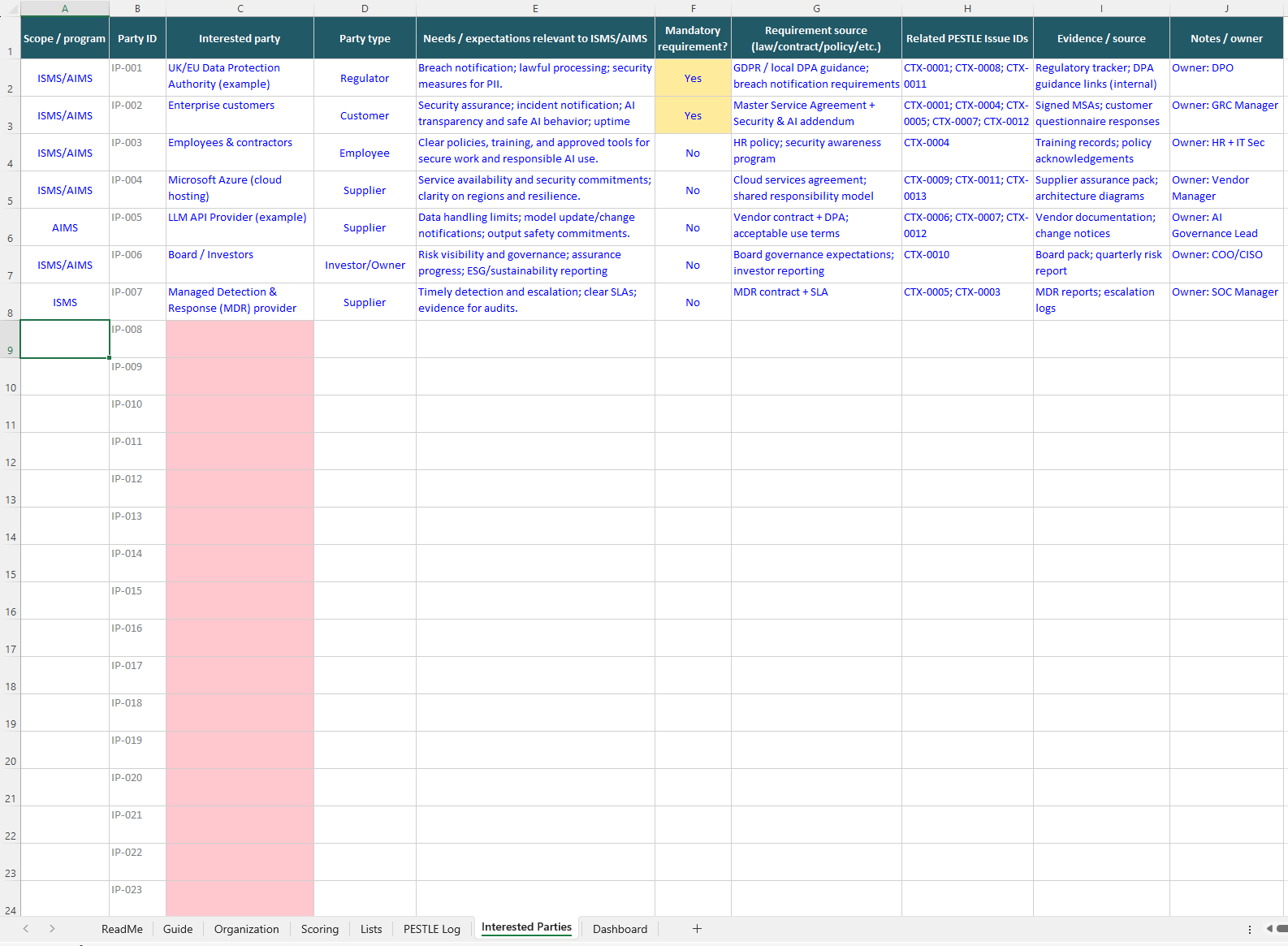
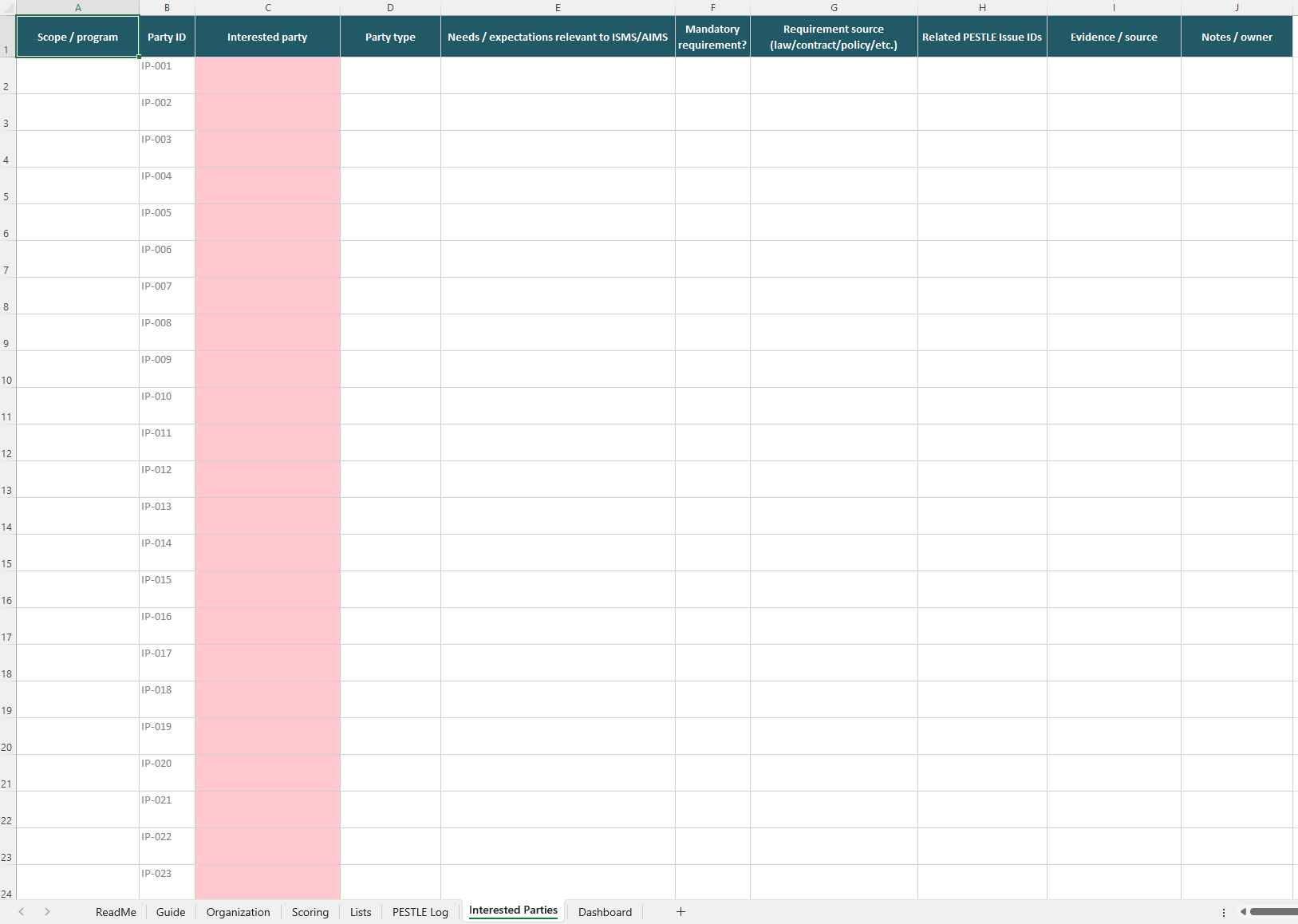
3) Interested Parties register (Clause 4.2)
A structured way to document stakeholders and their requirements:
-
-
- Interested party types and requirements sources
- Mandatory requirement flags and evidence references
- Conditional formatting highlights gaps (e.g., “mandatory but missing source”)
-
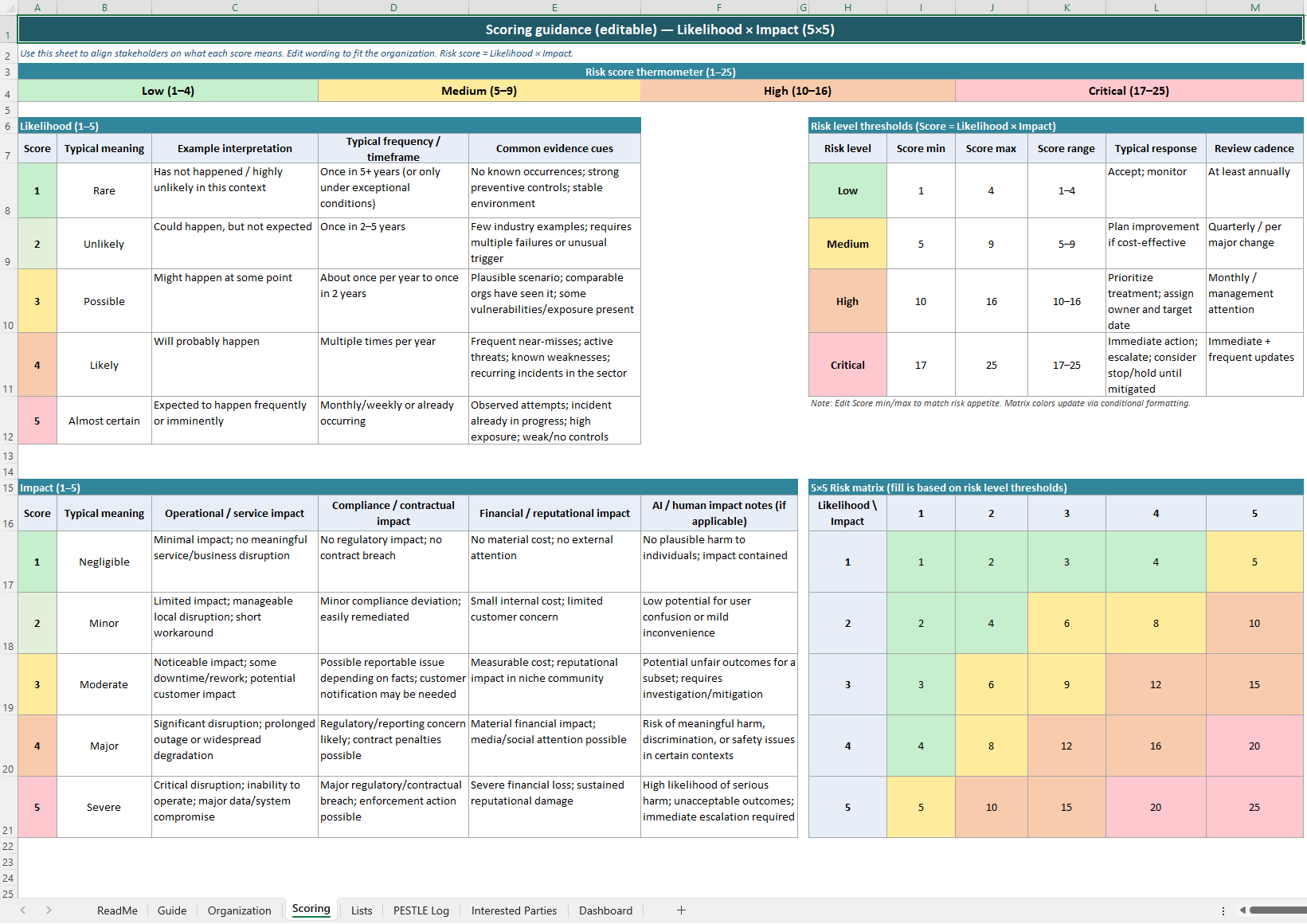
4) Expanded Scoring Guide + 5×5 Matrix (consulting-friendly)
A dedicated scoring reference sheet with consistent colors across:
-
-
- Likelihood guidance
- Impact guidance (including ISO 42001-style harm/impact considerations)
- Risk thresholds and response guidance
- 5×5 risk matrix that visually matches the thresholds
-
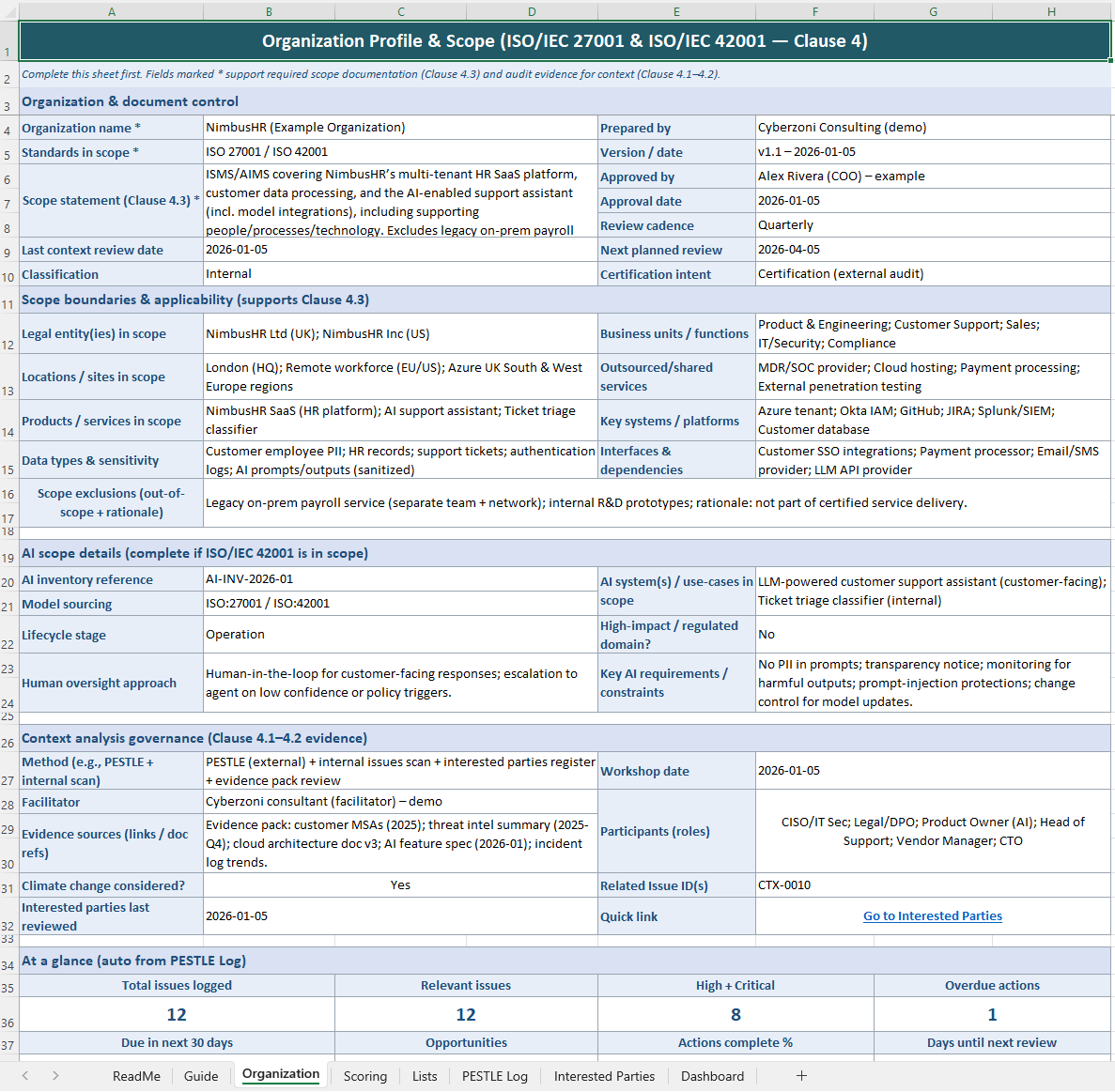
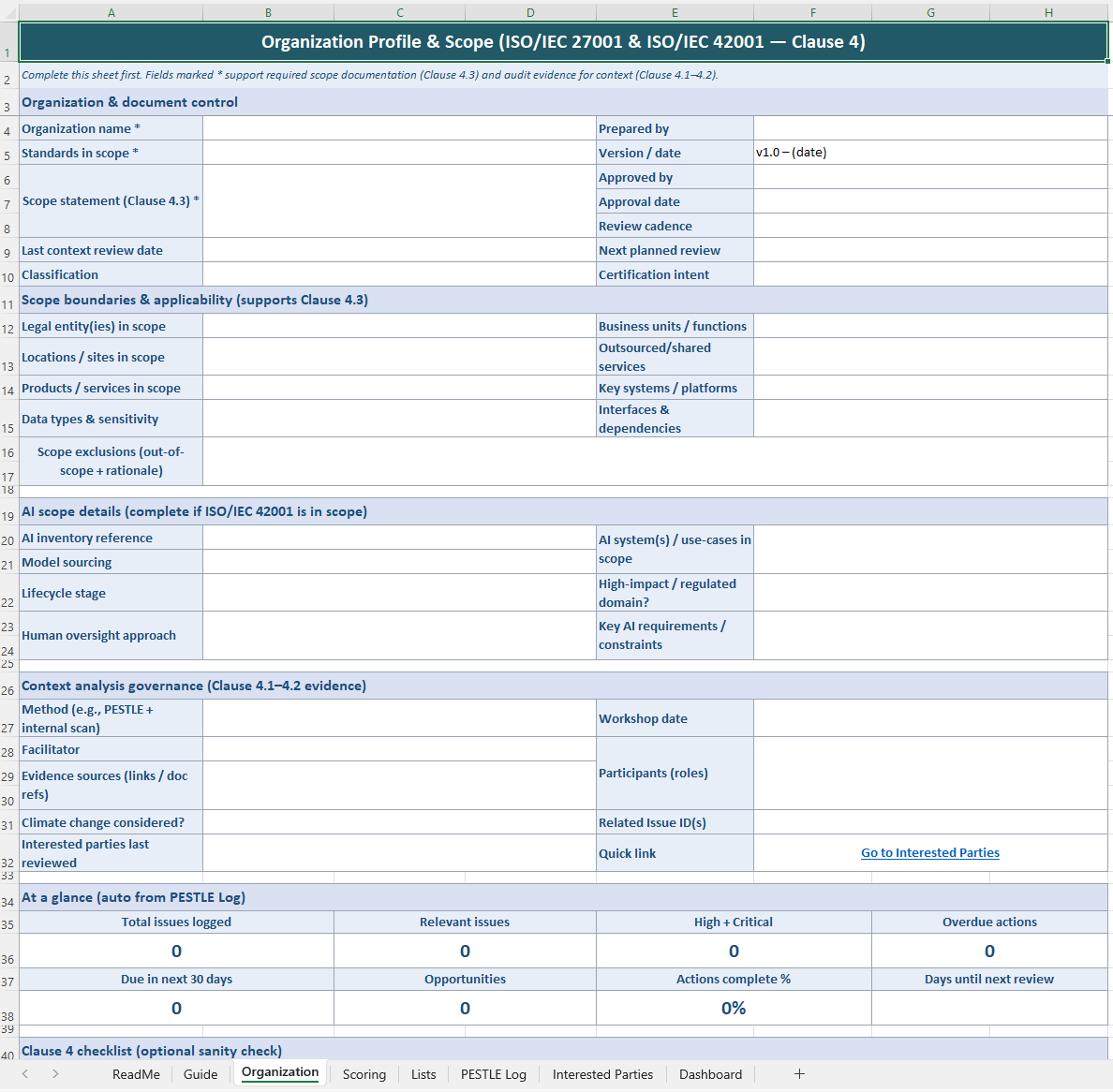
5) Organization “front page” (audit and management friendly)
A clean cover sheet that captures what auditors and leadership typically want:
-
-
- Organization details, standards in scope, review cadence
- Scope statement + structured scope boundaries (Clause 4.3 support)
- Evidence pointers and review metadata
- ISO 42001-specific AI scope prompts (when applicable)
- At-a-glance KPIs pulled from the log
-
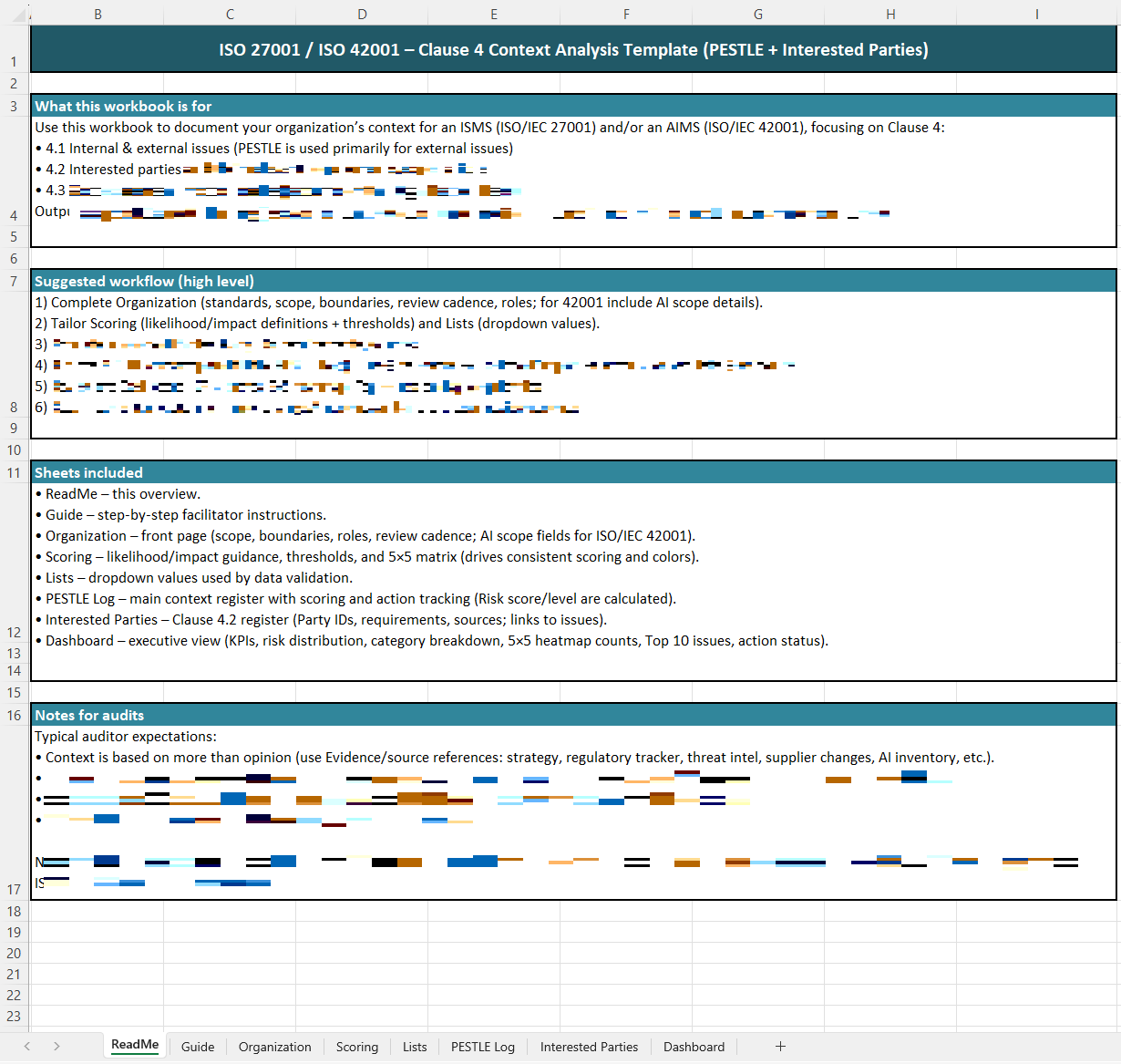
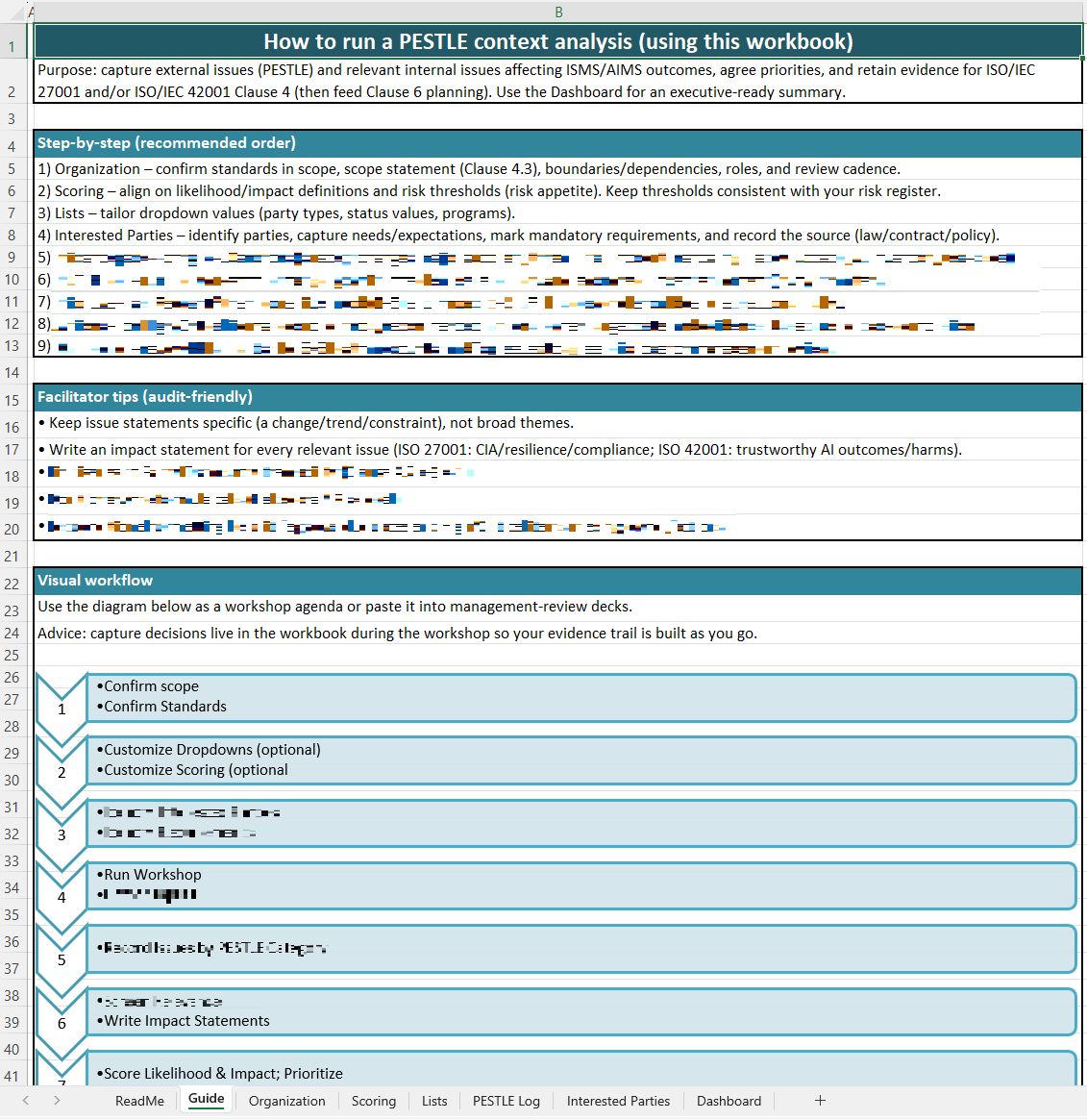
6) ReadMe + Guide (how to run a workshop)
-
-
- A practical step-by-step process for conducting the workshop
- Tips for evidence collection and relevance decisions
- A visual workflow diagram embedded in the Guide
-
PESTLE Analysis for Cyber Security
This template is also suitable for pestle analysis cyber security activities.
A strong cyber security pestle analysis can help organizations identify how external developments influence information security risks, compliance requirements, technology decisions, and business resilience.
For example, pestle cybersecurity reviews may look at changing cyber regulation, economic pressure on security budgets, social behavior affecting phishing risks, new technology trends, legal requirements around privacy, and environmental risks affecting infrastructure.
That makes this template useful for teams performing pestle analysis iso 27001 work as part of understanding organizational context, external issues, and strategic risks relevant to an ISMS.
How the PESTLE framework supports ISO 27001 & ISO 42001
This workbook is intentionally designed around the most common “pain point” in audits: showing traceability.
- PESTLE Analysis ISO 27001: Helps demonstrate how external/internal issues influence the ISMS and how they flow into risk planning and control decisions.
- PESTLE Analysis ISO 42001: Helps identify AI governance drivers (regulation, societal expectations, AI supply chain risk, model drift, misuse) and connect context to AI risk and impact processes.
It demonstrates that your organization didn’t just “fill in a spreadsheet,” you actually understood the organization’s context and acted on it.
Additional guidance on Clause 4
If you’d like deeper guidance beyond the workbook, we’ve written dedicated pages that explain Clause 4 (Context of the organization) and how to evidence it during ISO implementation and audits.
These guides complement the template and help you understand what auditors are looking for and how to document it efficiently.
ISO/IEC 27001 — Clause 4 guidance
- Clause 4 overview (ISO 27001): What “context” means for an ISMS and how it ties into planning/risk.
- Clause 4.1 (External + internal issues): How to use PESTLE + internal issues in a practical, audit-friendly way.
- Clause 4.2 (Interested parties): How to identify stakeholders and capture their relevant requirements.
- Clause 4.3 (Scope): How to define an ISMS scope that’s clear, defensible, and auditable.
- Clause 4.4 (ISMS processes): How to describe the key ISMS processes and their interactions.
ISO/IEC 42001 — Clause 4 guidance
- Clause 4 overview (ISO 42001): What “context” means for an AI management system and governance expectations.
- Clause 4.1 (External + internal issues): How to capture AI-specific drivers (regulation, harms, supply chain, drift, misuse).
A Practical Alternative to Free Templates
Many users search online for a pestle template free download, but free templates are often too basic, poorly structured, or difficult to reuse in a professional setting.
This pestle analysis template excel file is designed to provide a more practical and professional starting point.
It is ideal for anyone who wants a reliable pestle tool, a reusable pestle model, and a clear pestle framework template that saves time and supports better analysis.
FAQ
What is this template exactly?
This is a standalone pestle analysis template excel workbook designed to help you document and present the Context of the Organization (Clause 4) for ISO/IEC 27001 and/or ISO/IEC 42001.
It includes a PESTLE log, interested parties register, scoring guidance with a 5×5 risk matrix, and a management-ready dashboard.
Is this a “PESTEL framework template” or “PESTLE” template?
It supports both. Some people spell it PESTEL and others PESTLE—the meaning is the same (Political, Economic, Social, Technological, Legal, Environmental).
This workbook can be used as a pestel framework template or a template for pestle analysis.
What is a PESTLE analysis (in plain language)?
A PESTLE analysis is a structured way to identify external factors that can affect an organization—like new regulations, changing threat landscapes, economic pressure, customer expectations, or technology shifts.
In ISO implementations, it’s commonly used to capture external issues under Clause 4.1 and then link what matters into planning and risk work.
Is PESTLE analysis only for external issues?
Mostly, yes. PESTLE is primarily an external environment tool.
However, ISO Clause 4.1 requires you to consider both external and internal issues. Many organizations use:
- PESTLE for external issues, and
- a separate “internal issues” scan (people/process/technology/governance)
to ensure Clause 4.1 is fully covered.
Is this a “pestle analysis excel template” or do I need special software?
It’s an .xlsx workbook (Excel format). You don’t need special software.
Download and Get Started
If you need a consulting-grade, ready-to-use PESTLE Analysis template for business strategy, compliance, or pestle cybersecurity use cases, this product offers a structured and reusable solution.
It combines the practical benefits of an Excel-based pestle template with the flexibility of an editable pestle template.
Download your pestle template and turn it into a valuable resource for your organization, enabling you to apply the Pestle framework in a consistent and professional way.