Legal & Contractual Register Template
If you need an audit-ready way to manage legal, statutory, regulatory, and contractual obligations, this legal register template excel workbook is built for you.
It works as an iso 27001 legal register template and an iso 42001 legal register template—with structured registers and mapping so you can link requirements to controls, evidence, owners, review cadence, and improvement actions.
Why this template is needed
Most organizations have legal and contractual obligations, but they are often scattered across:
- procurement files and supplier agreements
- customer security requirements and DPAs
- privacy documentation
- internal policy documents
- emails and ad-hoc knowledge
That creates real compliance risk and audit friction.
Common problems include:
- obligations being missed when expanding into new markets or adopting new vendors
- no traceability from a law/contract requirement → internal control → evidence
- requirements going out of date as laws, regulator guidance, and contracts change
- unclear ownership (nobody accountable for review and evidence)
This workbook helps you operationalize iso 27001 compliance with legal and contractual requirements and supports AI governance alignment under ISO 42001.
What requirements this template covers
This template supports a complete view of “requirements,” including:
1) Legal and regulatory requirements
Track laws, regulations, sector requirements, and regulator expectations by:
- country/region
- topic area (privacy/PII, cybersecurity, AI, records/retention, sector rules, etc.)
- regulator/authority
- in-force/effective date (and notes on phased commencement where relevant)
- applicability scope (what applies to your organization and why)
- plain-language obligation summary
- owners, evidence expectations, and review cadence
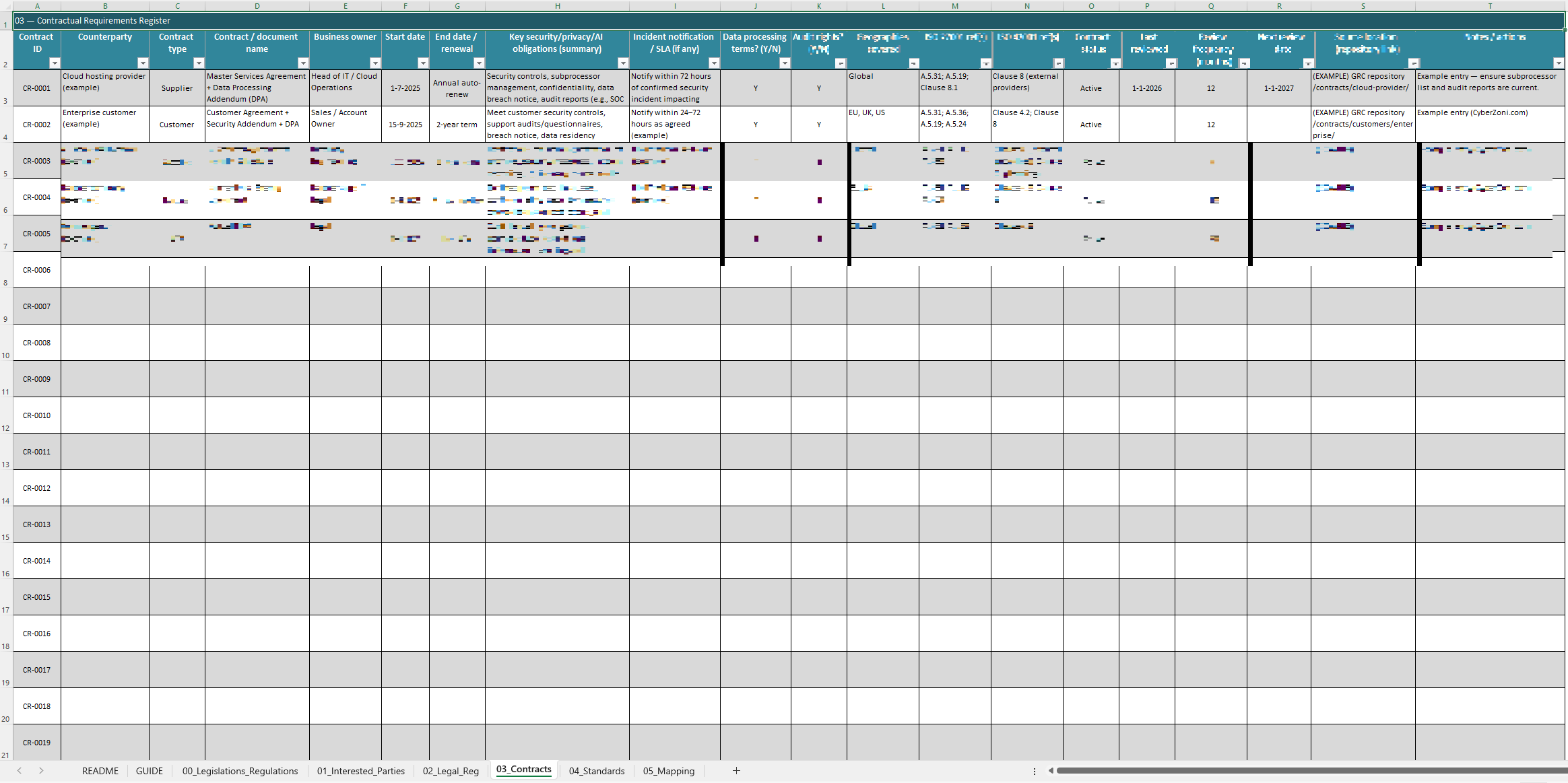
2) Contractual requirements
Maintain an auditable record of obligations from:
- customer security requirements
- DPAs and privacy terms
- supplier contracts and sub-processor obligations
- SLAs, audit rights, flow-down clauses, and incident notification requirements
3) Standards and frameworks
Capture requirements that come from:
- adopted external standards (e.g., ISO, NIST, sector frameworks)
- customer-required security standards
- internal standards the business commits to follow
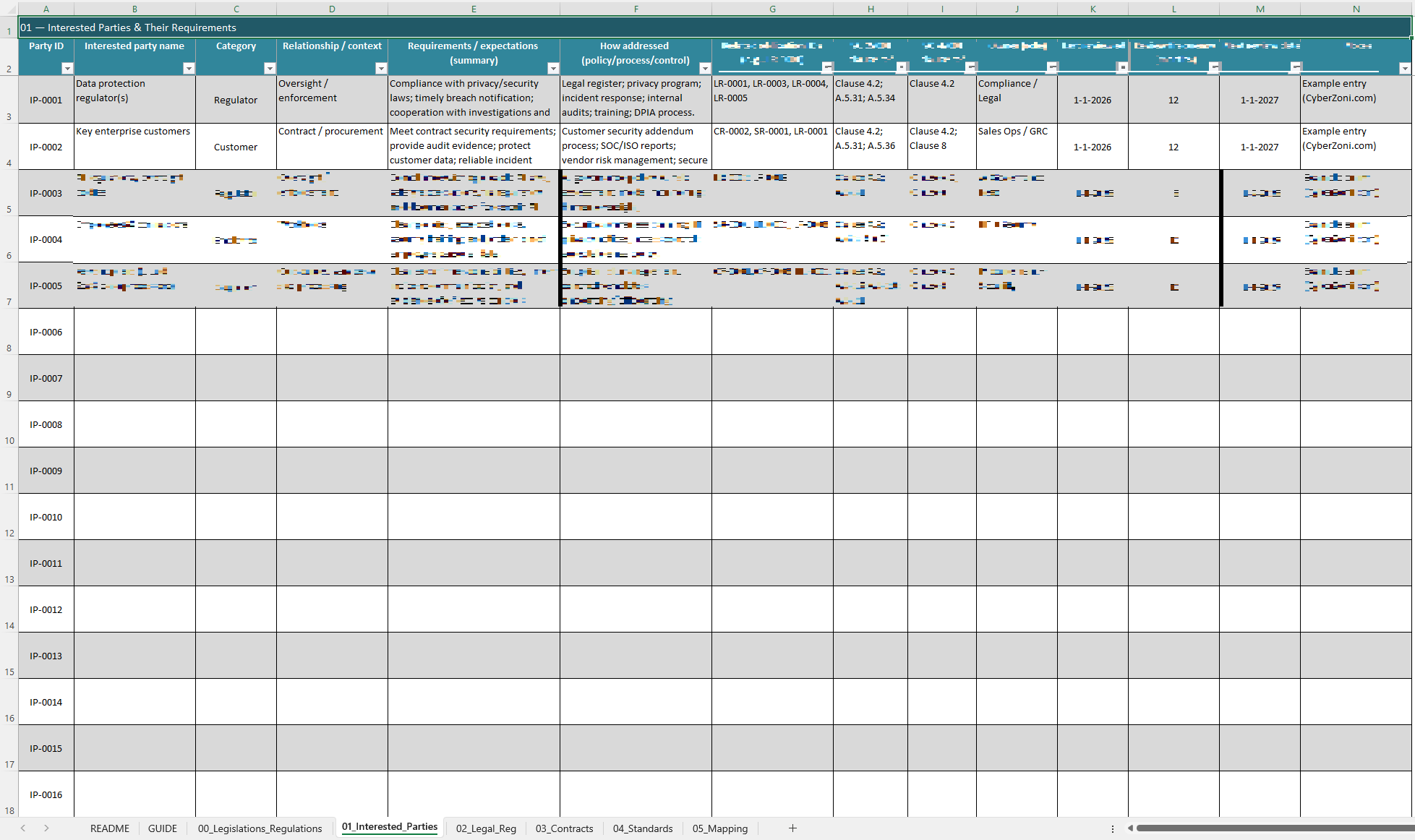
4) Interested parties requirements
A structured way to record requirement sources such as:
- regulators and supervisory authorities
- key customers
- suppliers and cloud providers
- internal stakeholders
- auditors/certification bodies
5) Evidence and traceability
The mapping approach helps you consistently show:
- which internal controls/policies/procedures satisfy each obligation
- who owns the control
- what evidence proves it’s operating
- related risks, residual risk, and improvement actions
What’s included in the Excel workbook
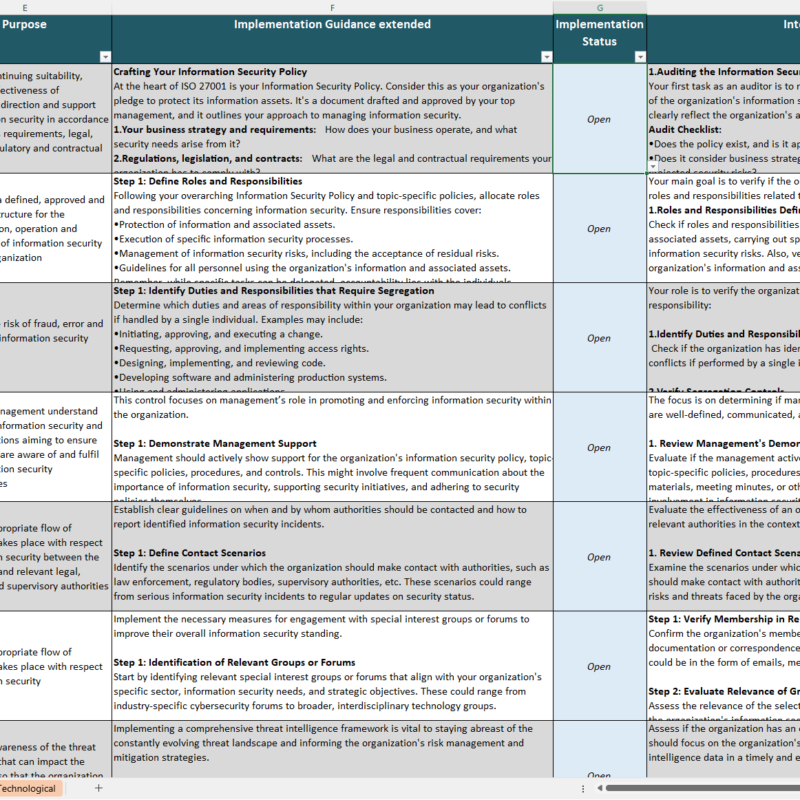
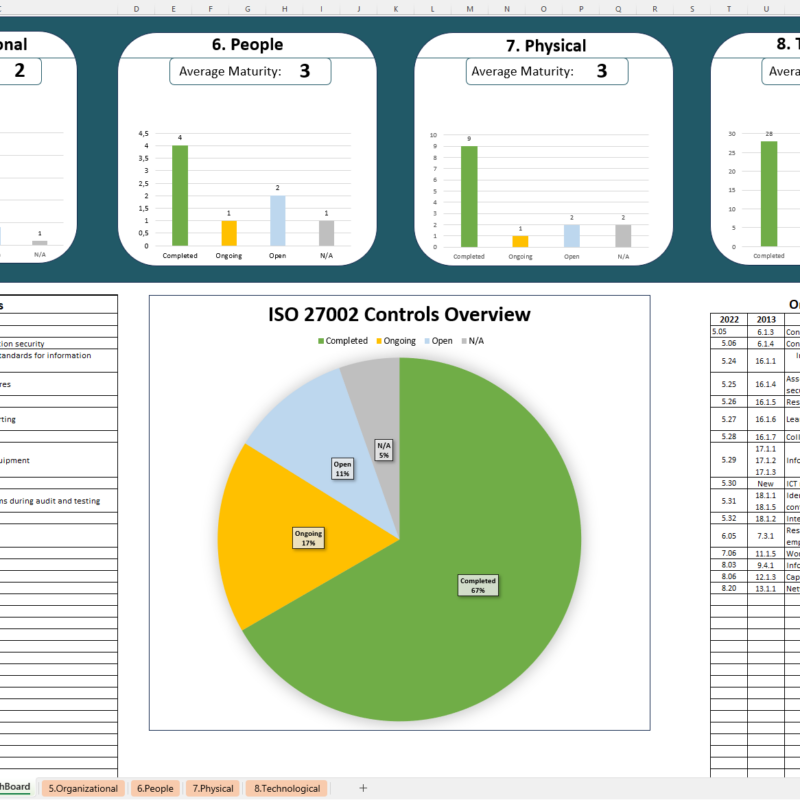
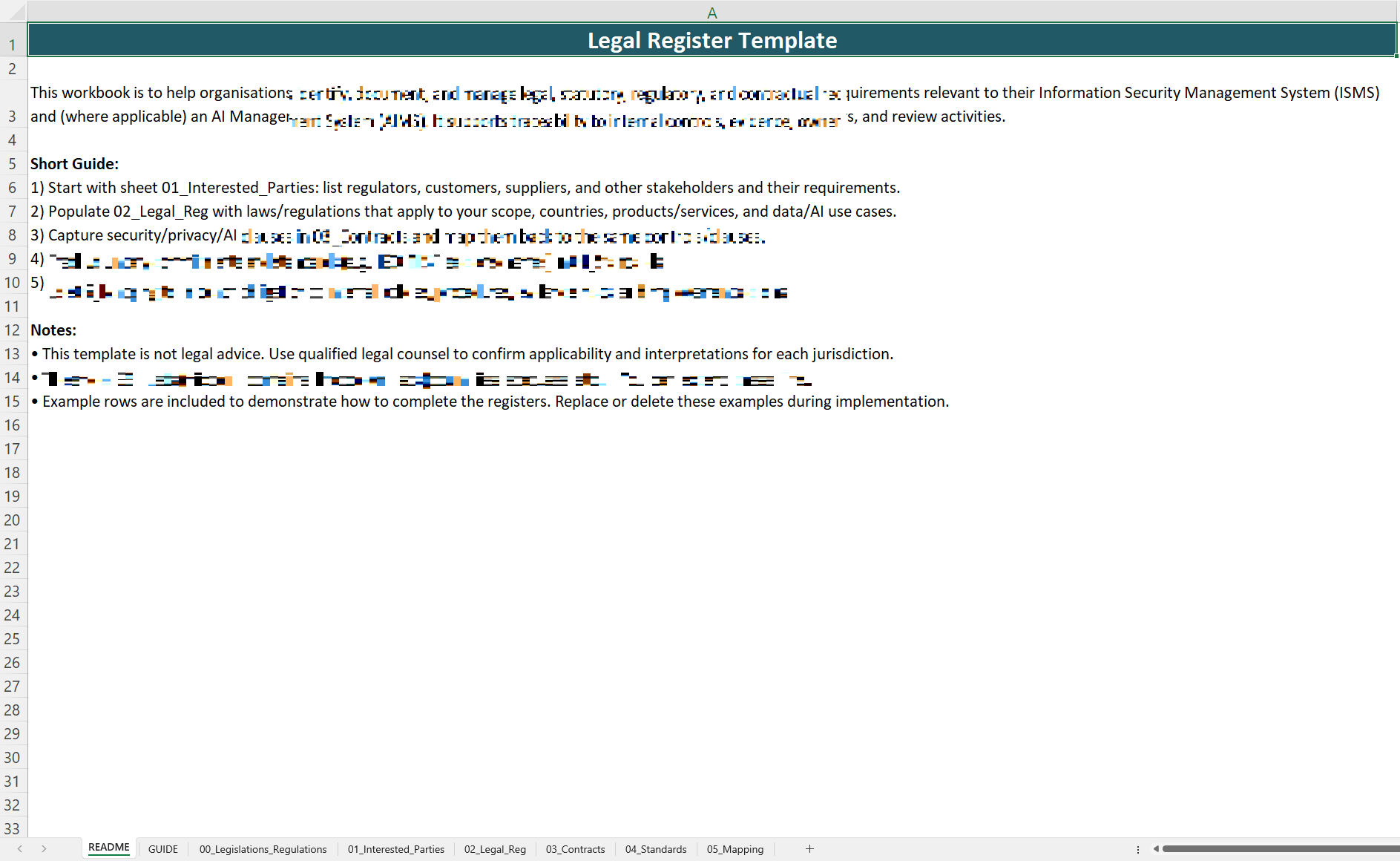
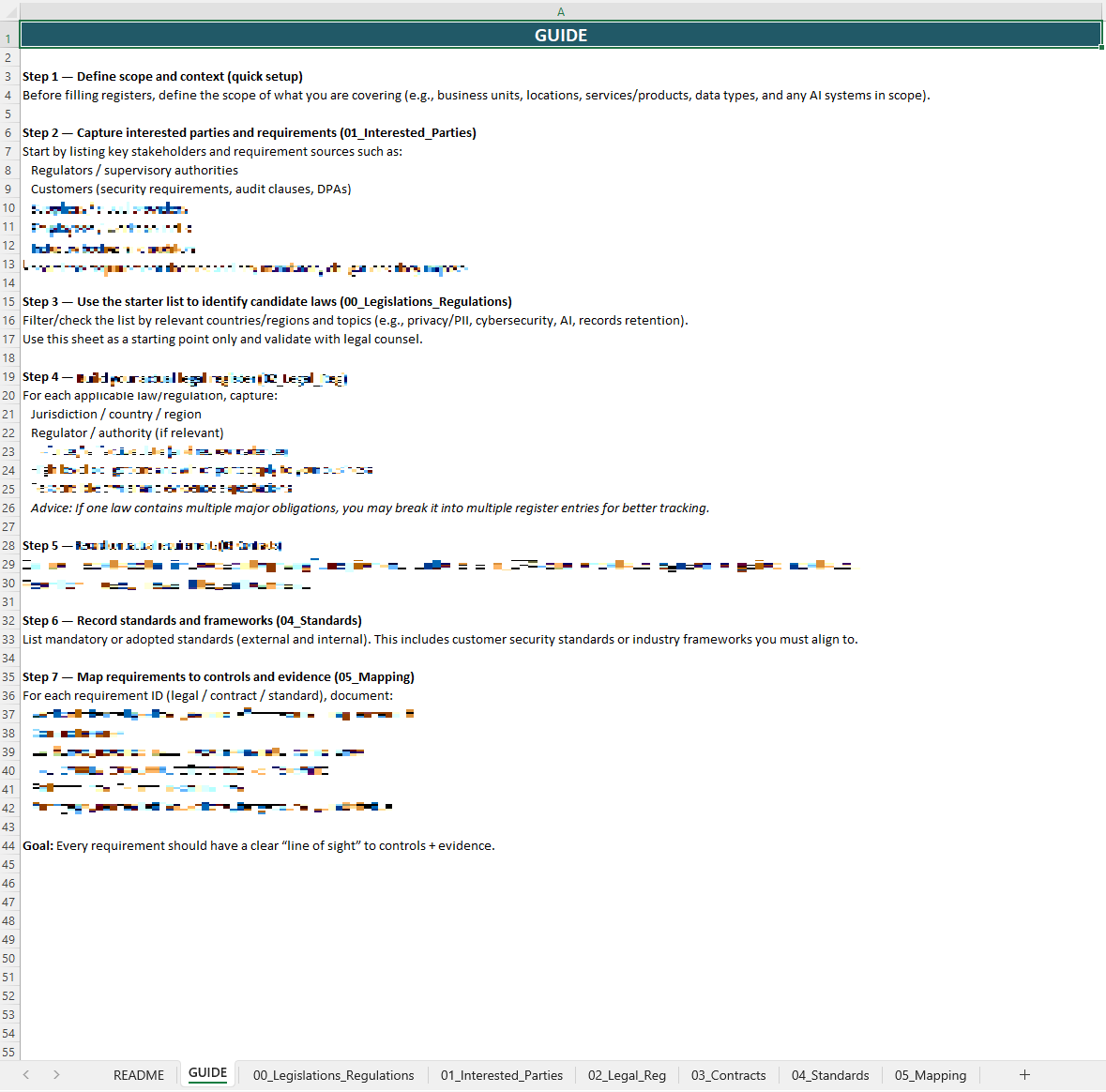
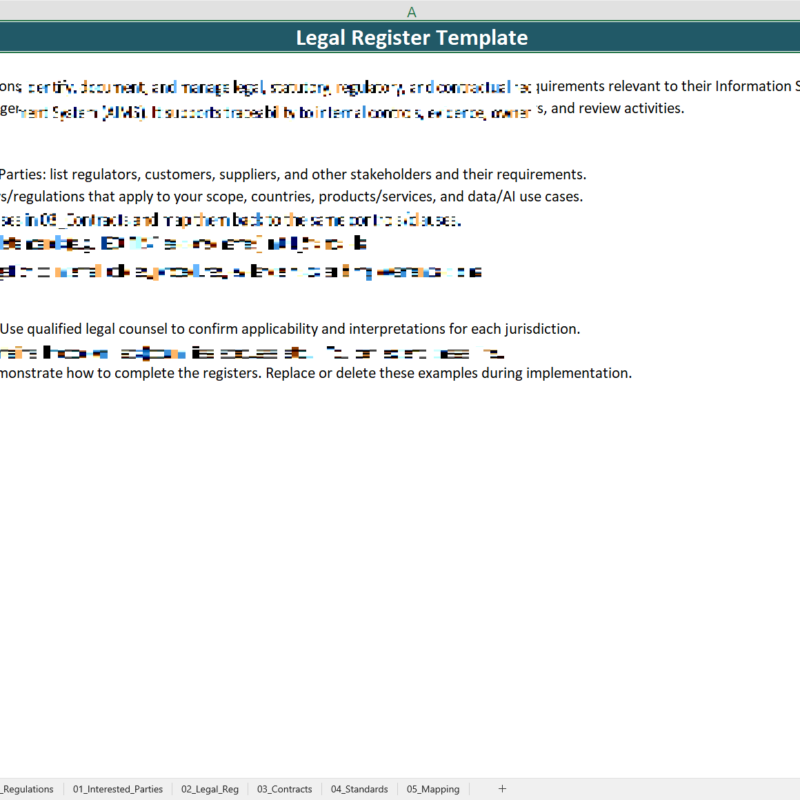
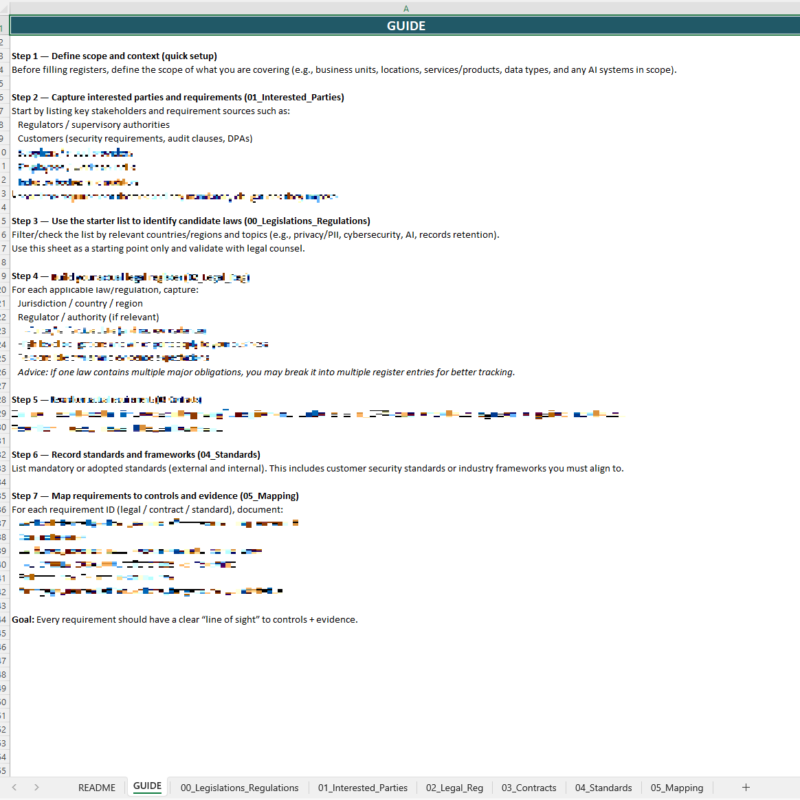
- README – step-by-step workflow and guidance
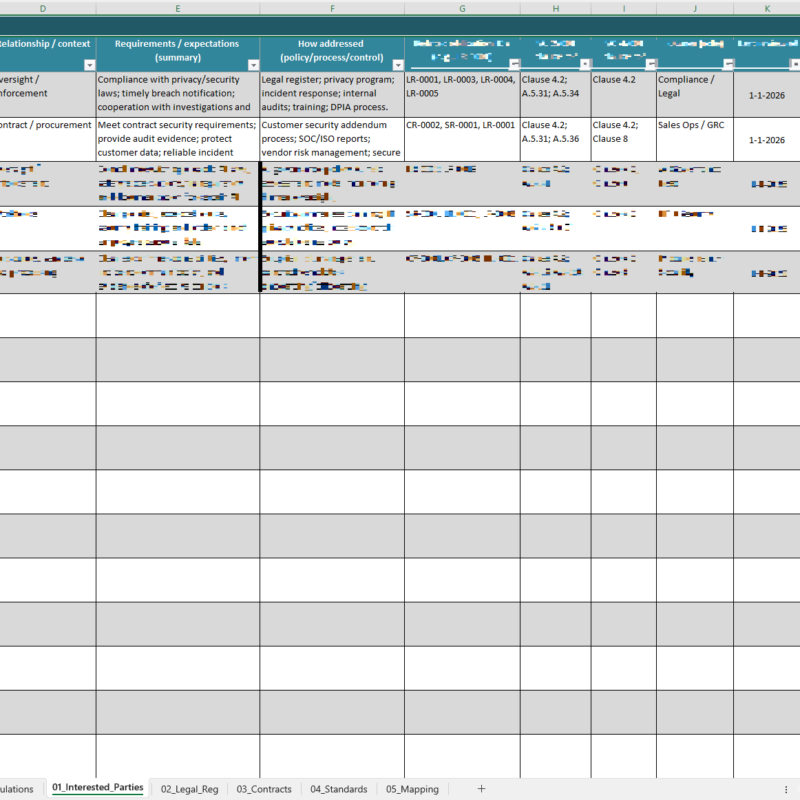
- Interested Parties register – capture stakeholders and requirement sources first (recommended start)
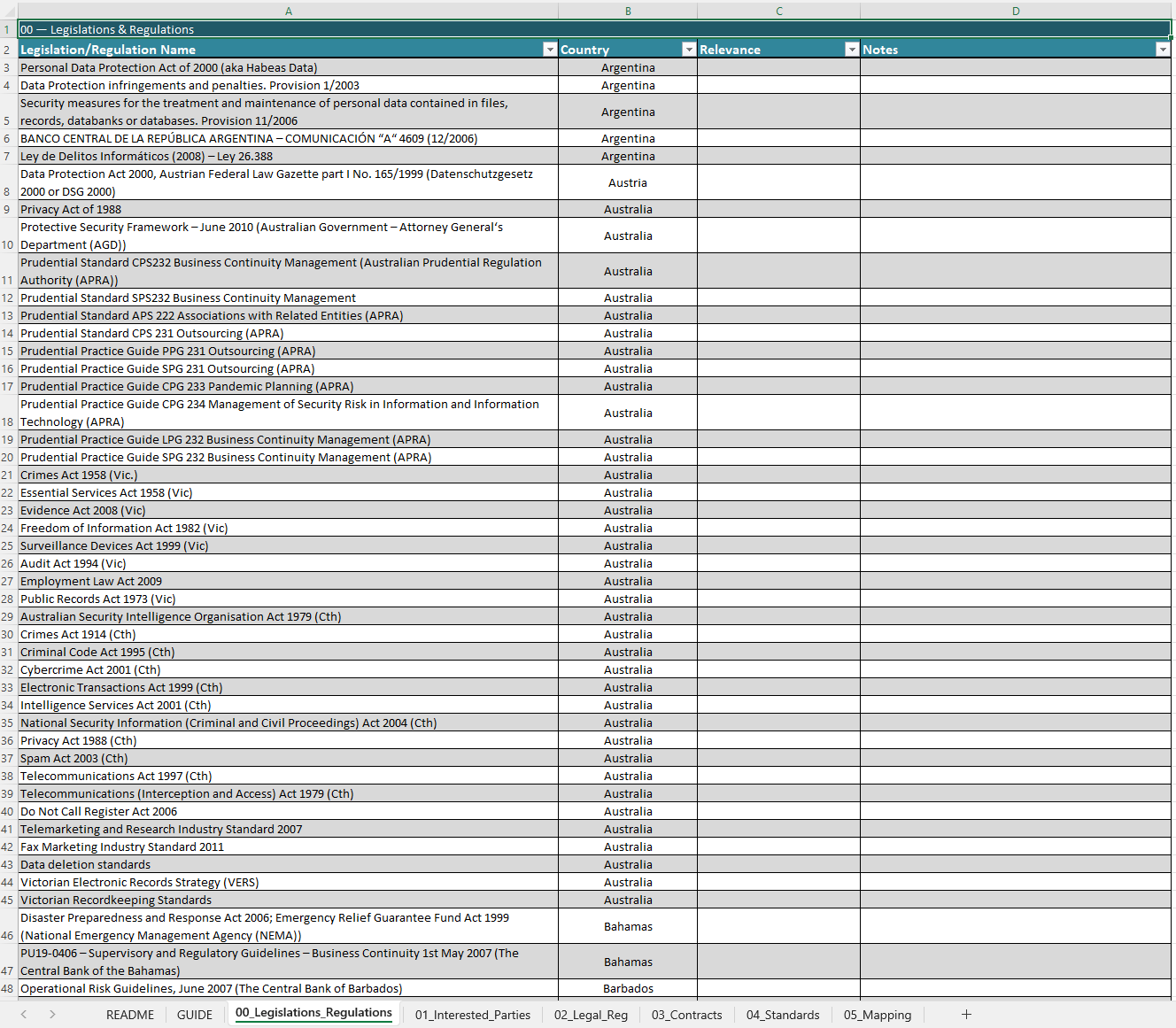
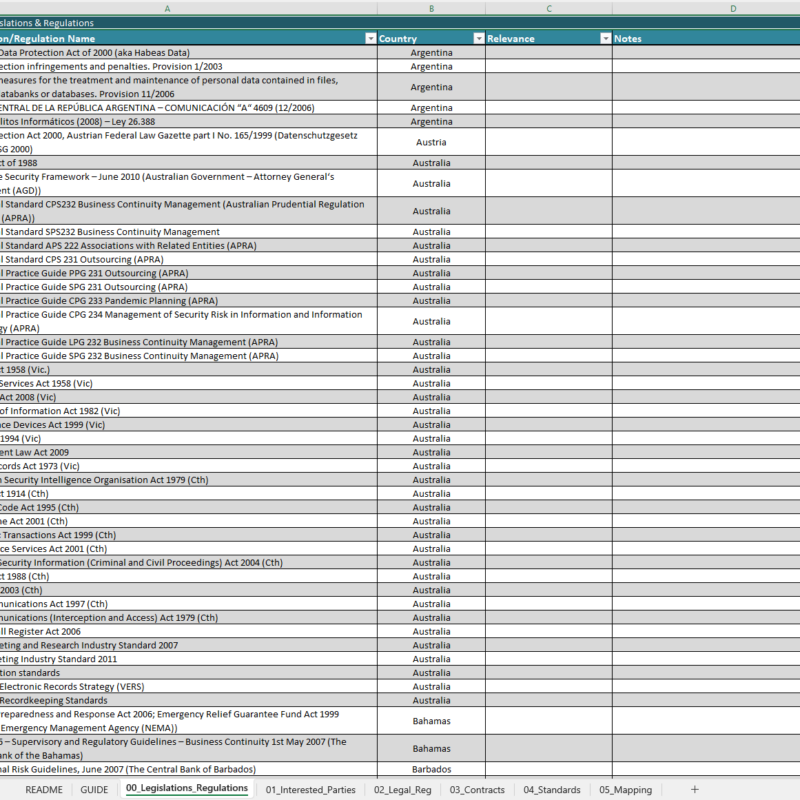
- Legislations & Regulations checklist – non-exhaustive starter library for faster identification
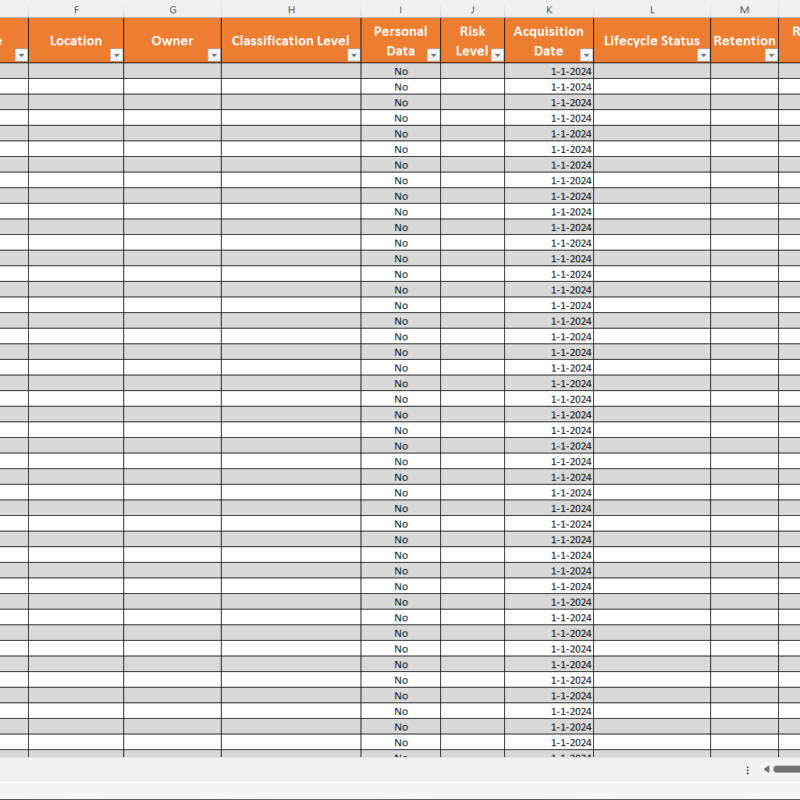
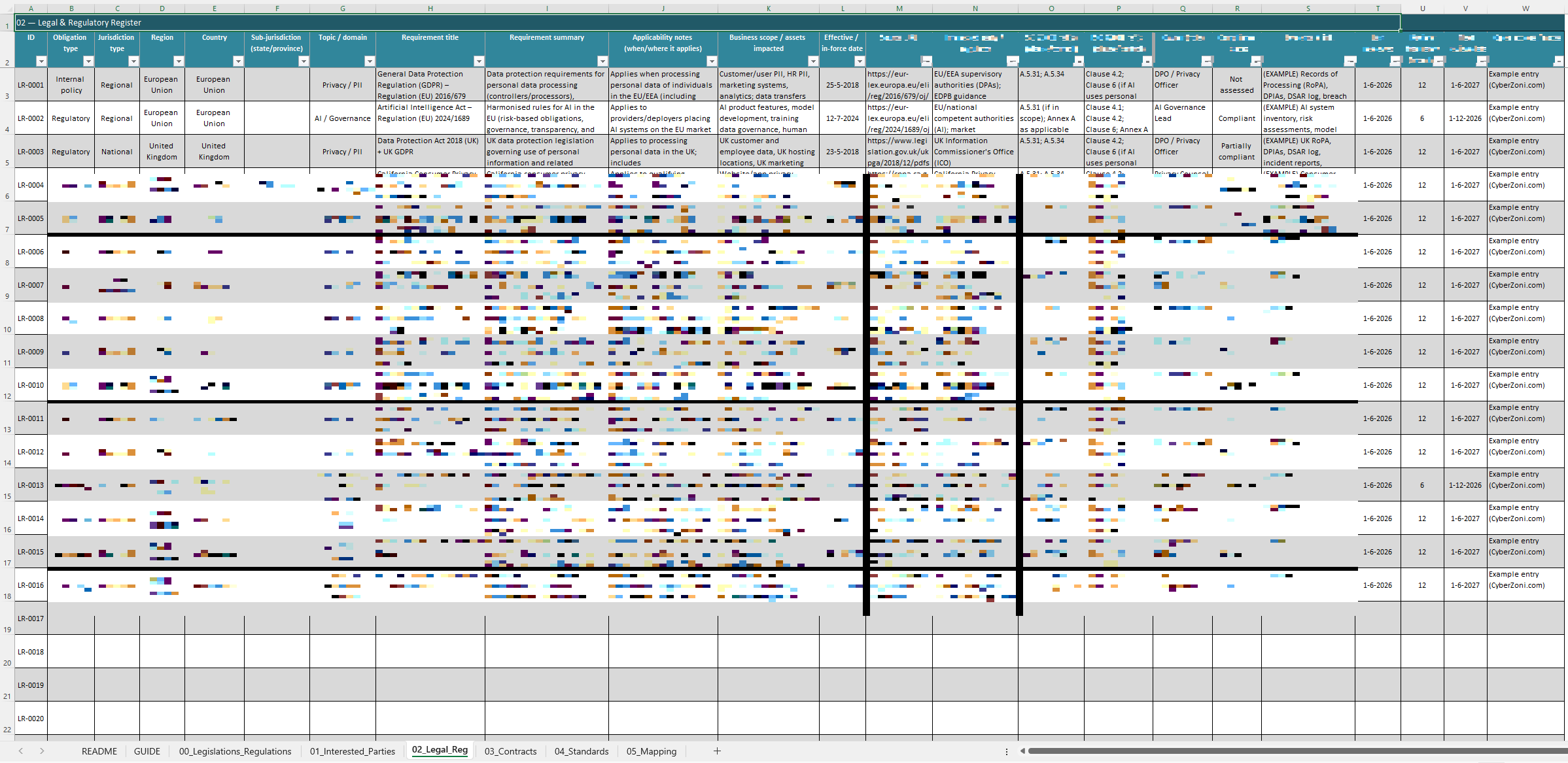
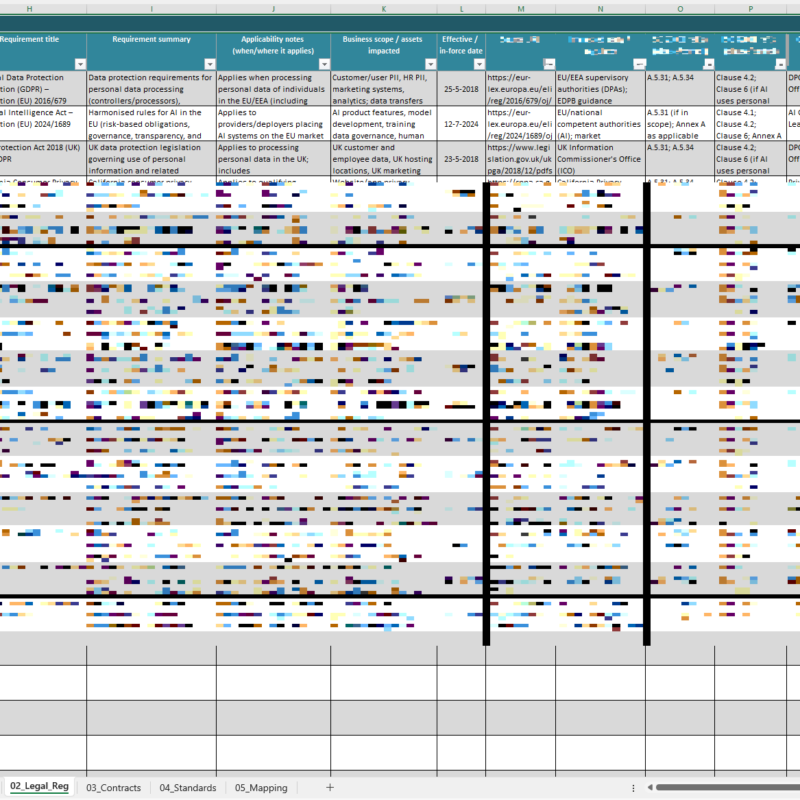
- Legal Register – your organization’s applicable legal/regulatory obligations with ownership, review, and evidence references
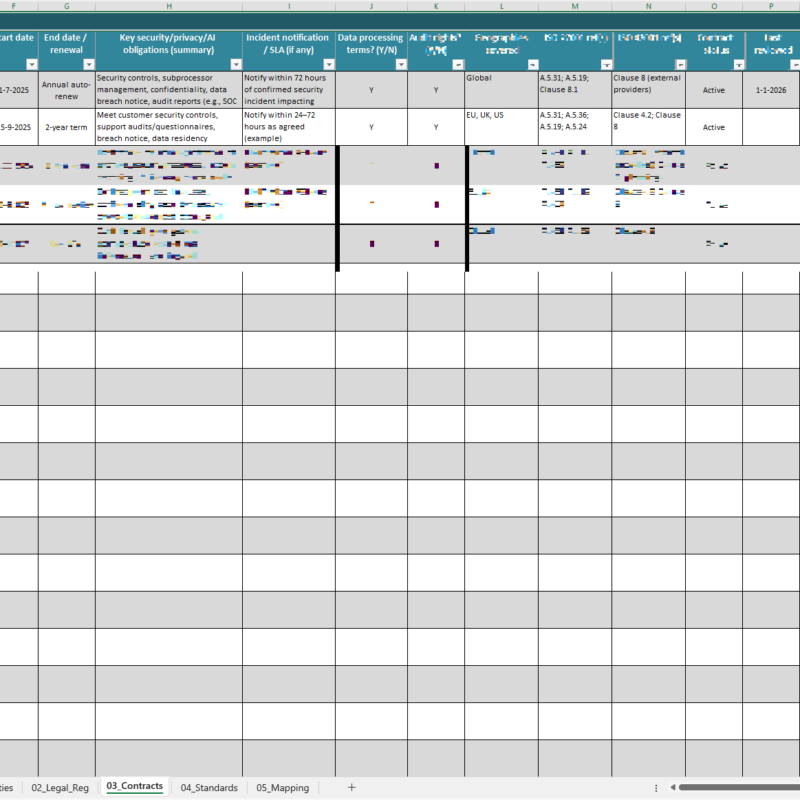
- Contracts Register – contractual compliance obligations (customers and suppliers)
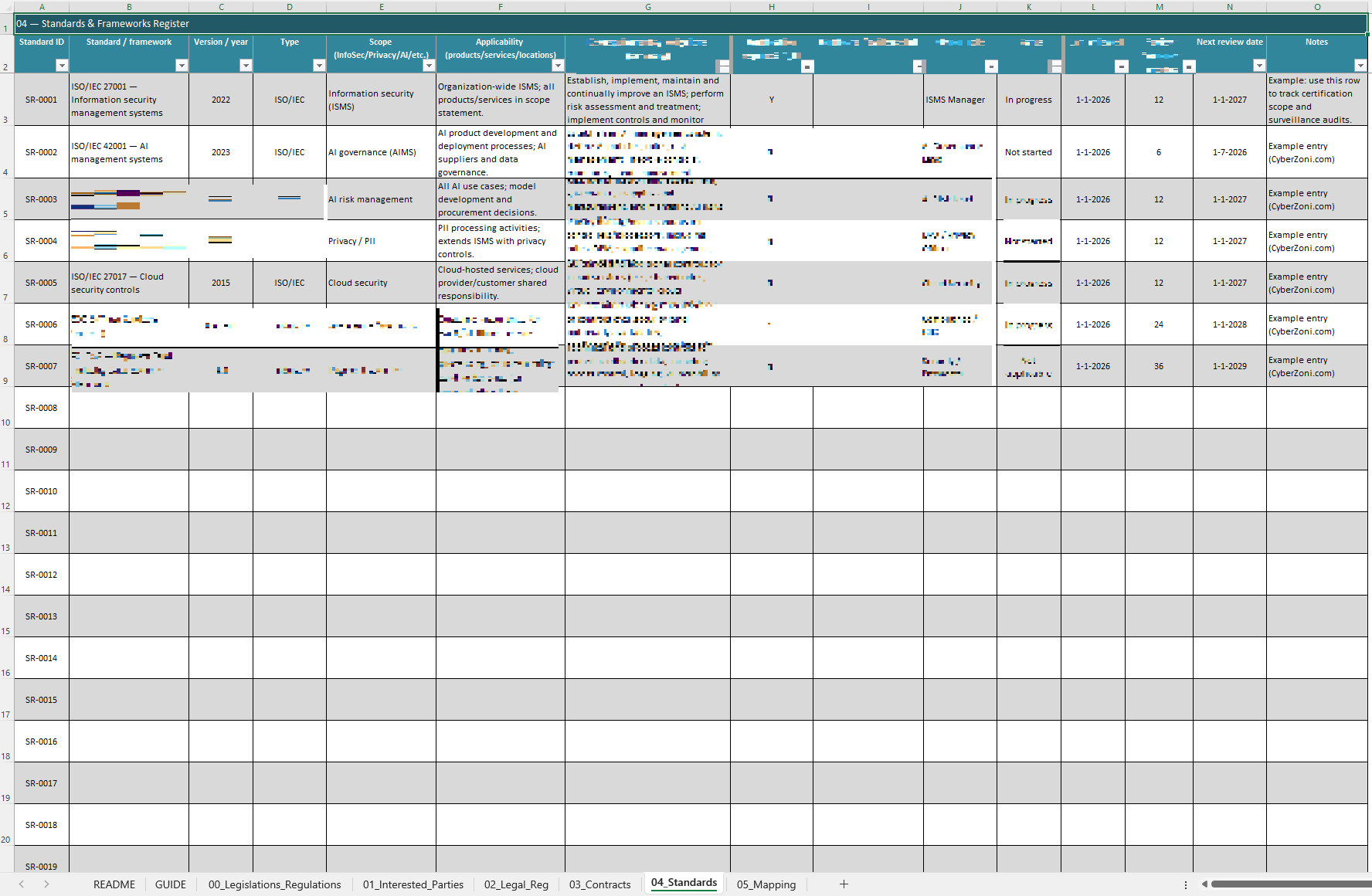
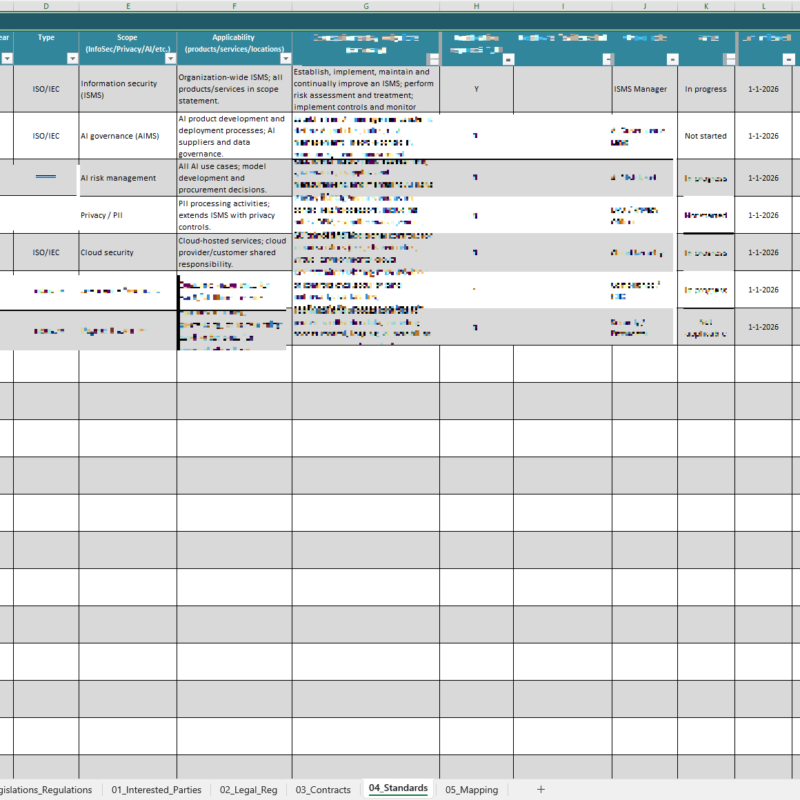
- Standards Register – standards/framework obligations and commitments
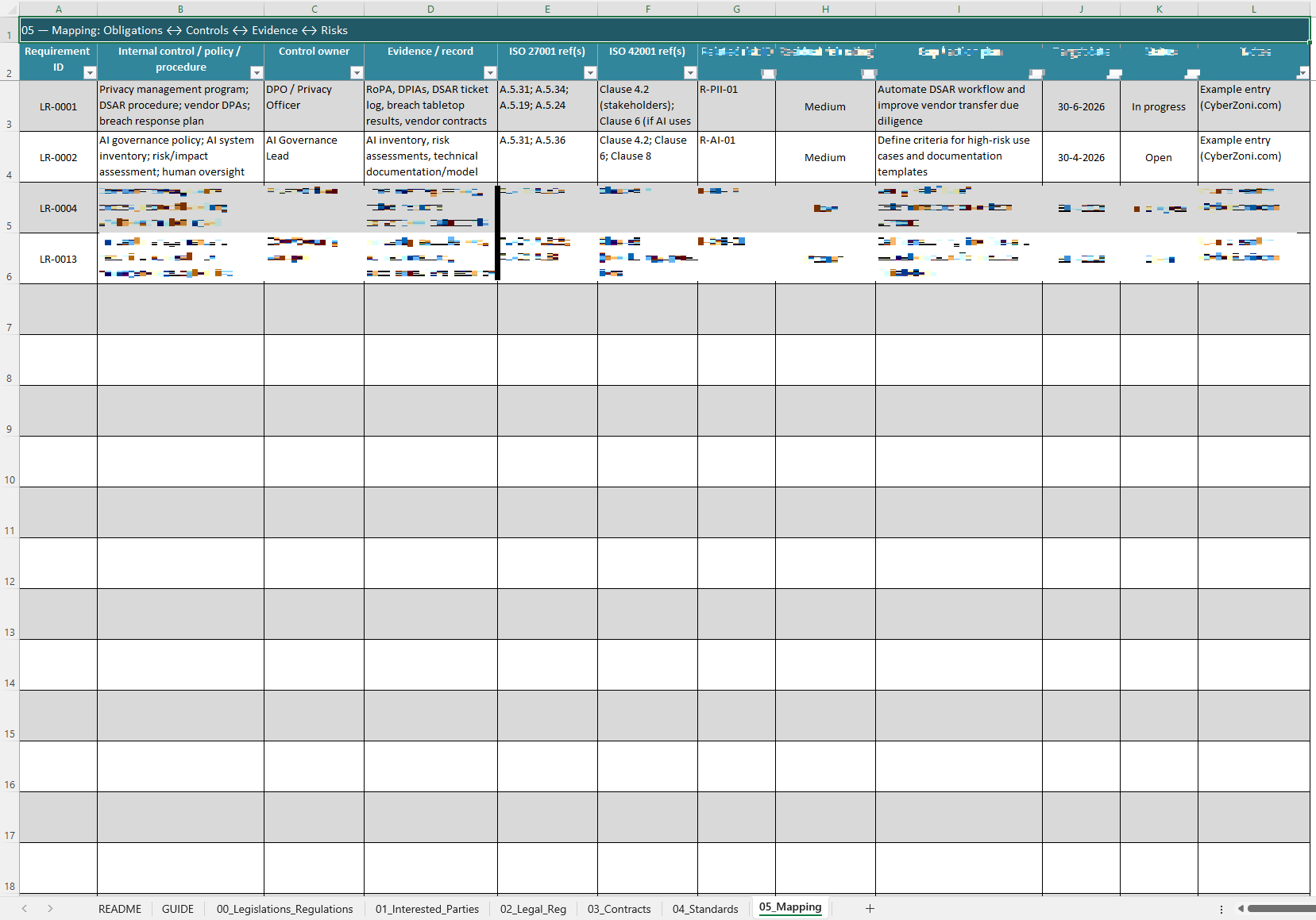
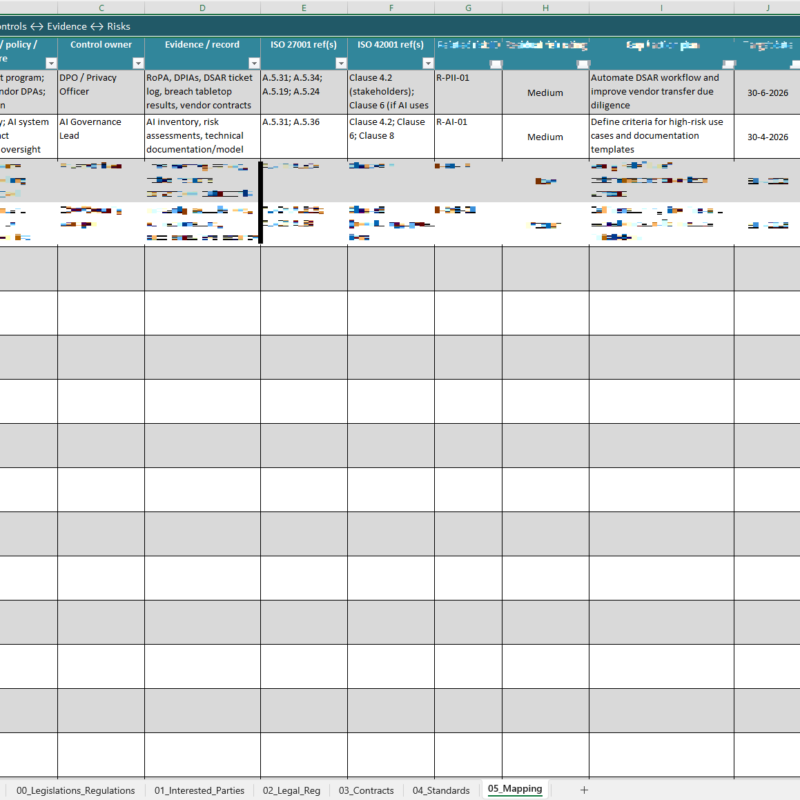
- Mapping sheet – requirement → internal control/policy/procedure → evidence → ISO references → risk → status/action plan
- Hidden validation lists – dropdowns and consistent values stored in a hidden sheet for a clean user experience
To help you get started faster, the workbook also includes example entries you can adapt—an iso 27001 legal register example approach built as editable rows rather than static text.
ISO 27001 alignment: clauses and Annex A controls
This workbook is built as an iso 27001 legal and contractual requirements register template and supports the intent of ISO/IEC 27001:2022 by ensuring requirements are identified, documented, kept up to date, assigned to owners, and mapped to controls and evidence.
Main ISO 27001 control
The core control behind establishing and maintaining a legal and contractual requirements register.
- ISO 27001 Annex A Control 5.31 – Legal, statutory, regulatory and contractual requirements
Key ISO 27001 clauses supported by this template
- Clause 4.2 – Understanding the needs and expectations of interested parties
(This is why the template starts with the Interested Parties sheet.) - Clause 6.1.3 – Information security risk treatment
(Supports mapping obligations to the controls you use to treat risk.) - Clause 7.5 – Documented information
(Registers and evidence references support documented information needs.) - Clause 8.2 – Information security risk assessment
(Legal/contractual obligations feed risk identification and evaluation.) - Clause 9.2 – Internal audit and Clause 9.3 – Management review
(Review cadence and evidence help auditors and management review inputs.) - Clause 10 – Improvement
(Gap and action tracking supports continual improvement.)
Related ISO 27001 controls often mapped in legal/contractual compliance
- Control 5.32 – Intellectual property rights
- Control 5.33 – Protection of records
- Control 5.34 – Privacy and protection of PII
- Control 5.36 – Compliance with policies, rules and standards for information security
Supplier and contractual obligations (high-impact controls)
These controls are commonly used to implement contractual requirements and supplier governance:
- Control 5.19 – Information security in supplier relationships
- Control 5.20 – Addressing information security within supplier agreements
- Control 5.21 – Managing information security in the ICT supply chain
- Control 5.22 – Monitoring, review and change management of supplier services
- Control 5.23 – Information security for use of cloud services
ISO 42001 alignment: clauses and controls
If your organization develops, deploys, or governs AI systems, you also need a structured way to manage AI-related legal/regulatory obligations and stakeholder requirements.
This workbook supports ISO/IEC 42001:2023 by helping you capture external requirements, translate them into governance controls, and retain auditable evidence over time.
Key ISO 42001 clauses supported
- Clause 4 – Context of the organization
- Clause 6 – Planning
- Clause 7 – Support
- Clause 8 – Operation
- Clause 9 – Performance evaluation
- Clause 10 – Improvement
Relevant ISO 42001 controls (documentation and impact governance)
- Control 4.2 – Resource documentation
- Control 5.2 – AI system impact assessment process
- Control 5.3 – Documentation of AI system impact assessments
Who this template is for
- Organizations implementing or maintaining ISO/IEC 27001 certification
- Organizations implementing ISO/IEC 42001 for AI governance and trustworthy AI
- Consultants who want a client-ready, repeatable register and mapping structure
- Compliance, security, privacy, procurement, and risk teams managing obligations across multiple suppliers or jurisdictions
How to use it
- Start with Interested Parties to identify requirement sources (regulators, customers, suppliers, auditors).
- Use the Legislations & Regulations checklist as a starting reference to identify candidate obligations.
- Populate your Legal Register (only what applies to your scope) and add Contractual + Standards requirements.
- Complete the Mapping sheet to link each obligation to controls, owners, evidence, and any gaps/actions.
- Review regularly and update as your organization, suppliers, or regulations change.
FAQ
Is this template legal advice?
No. This is a documentation and compliance management template. Users should validate applicability and obligations with qualified legal counsel.
Does it include every law and regulation worldwide?
No. The legislation/regulation list is a starter reference and not exhaustive. It is designed to speed up identification, not replace legal research.
Can I use this as an ISO 27001 legal register example for auditors?
Yes—once tailored to your scope. The workbook includes example entries and a mapping structure that supports audit discussions, but you must populate it with your applicable obligations and evidence.
How does this support ISO 27001 Control 5.31?
It structures your register so legal, statutory, regulatory, and contractual requirements are identified, documented, assigned to owners, reviewed, and mapped to controls and evidence.
Does this support supplier and customer contractual requirements?
Yes. The workbook includes a dedicated Contracts register and mapping so contractual clauses can be linked to internal controls and evidence.
Does this work if I’m only doing ISO 27001 (no ISO 42001)?
Yes. The ISO 42001 reference fields can be left blank.
Can I customize the dropdown lists?
Yes. Dropdown lists are stored in a hidden sheet to keep the workbook clean. You can unhide it, edit values, and re-hide it.