
How to Define your ISMS Scope
For many organizations, defining their ISMS scope is rarely simple. Legal entities, shared services, internal support teams, outsourced providers, regional offices, cloud platforms, and business-critical dependencies all create complexity.
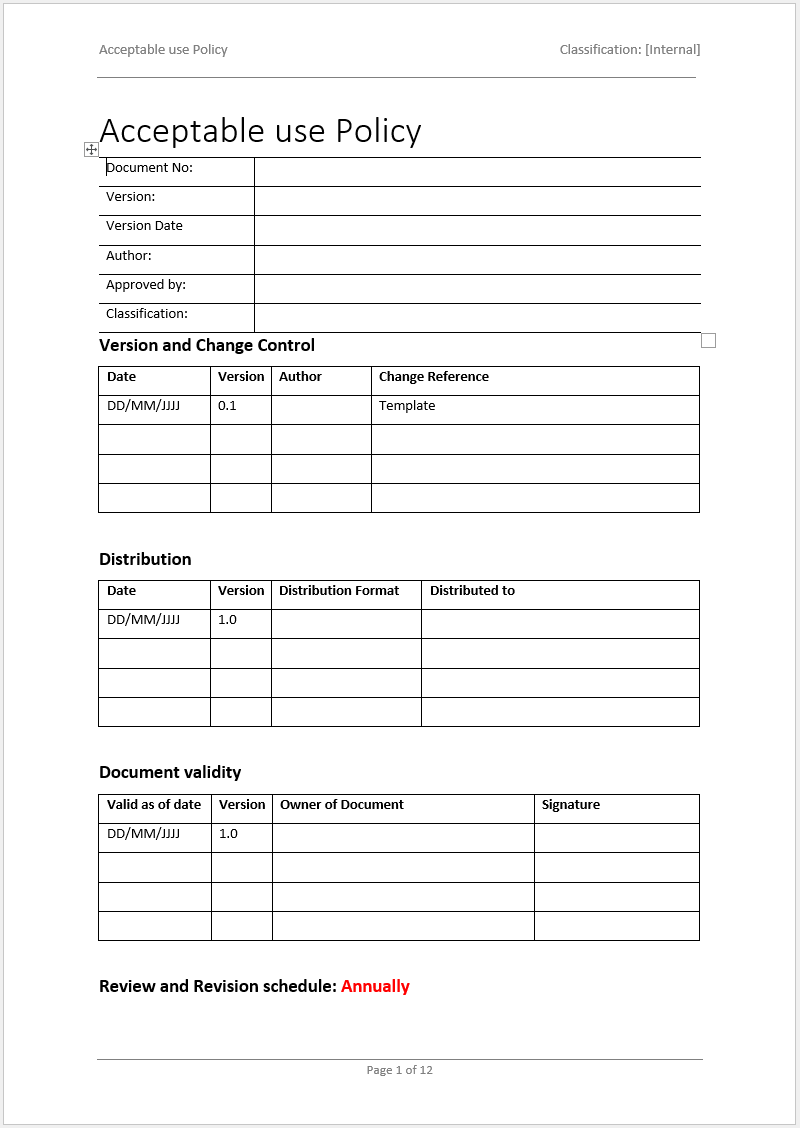
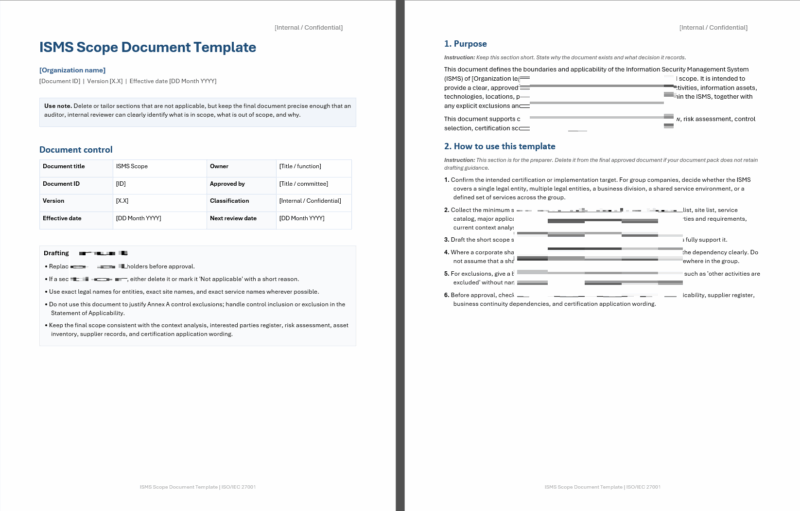
This template gives you a strong, practical starting point for documenting that complexity in a structured and audit-ready format, without having to start from a blank page.
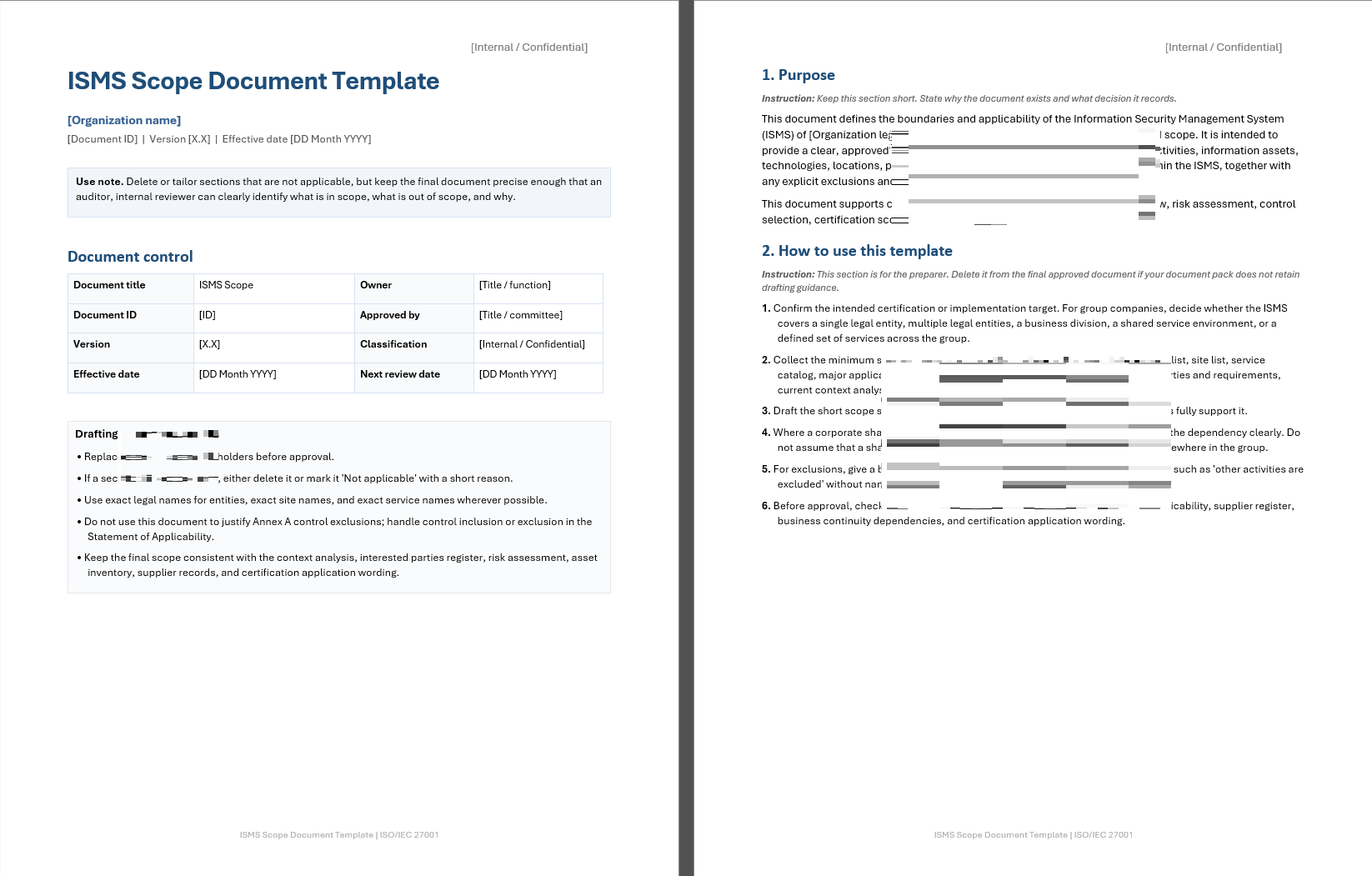
Built for every business environments, this template is intentionally detailed. It is designed so you can remove sections that are not relevant, simplify where needed, and tailor the final document to each organizational structure, operations, and certification goals.
What is included
With this template, you receive a structured ISMS Scope Document framework that includes:
- a formal ISMS Scope Document structure Aligned with ISO/IEC 27001 clause 4.3 (ISO/IEC 27001 clause 4.3)
- editable sections for scoping decisions
- practical and short instructions throughout
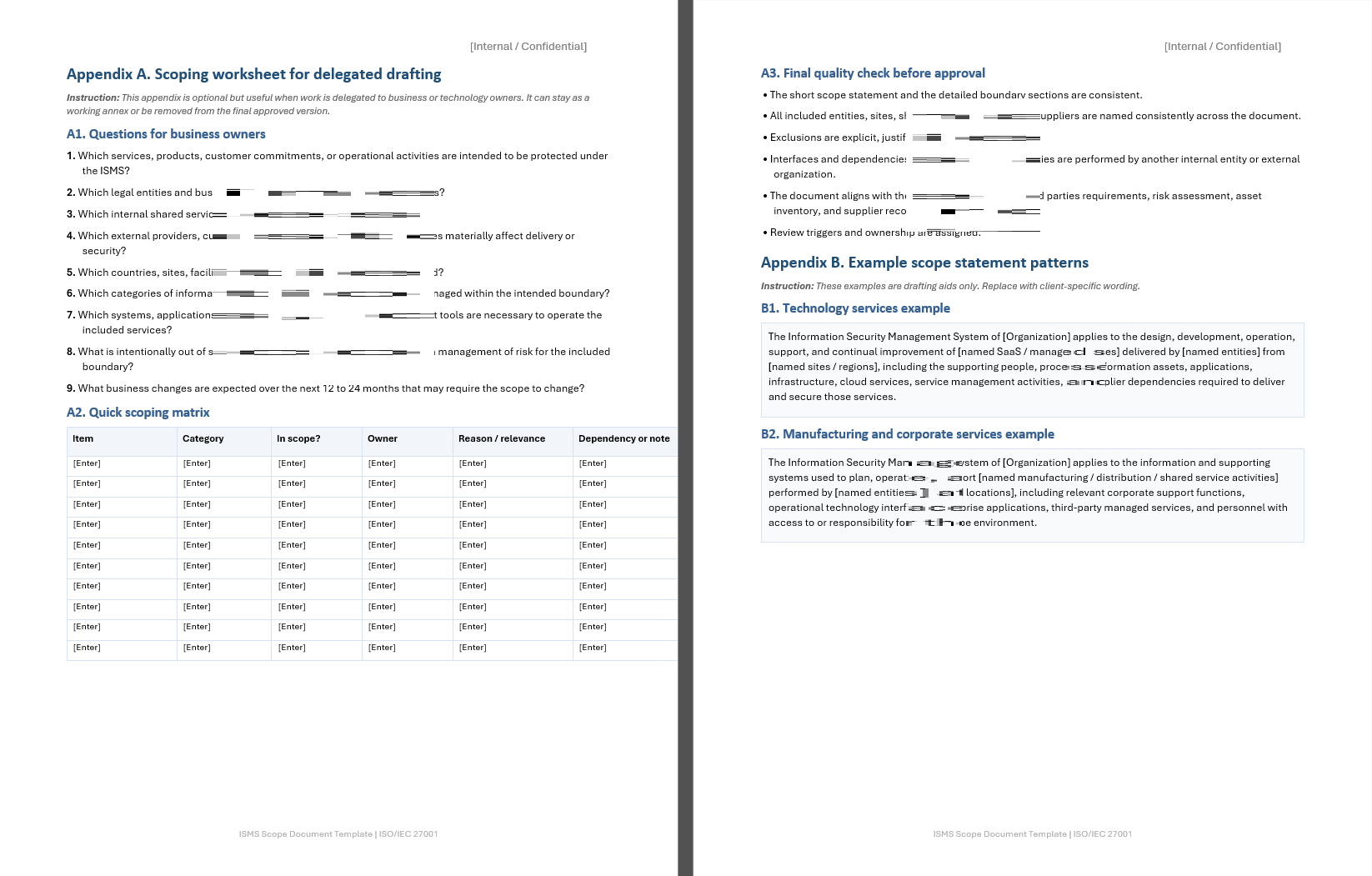
- support for documenting both high-level scope statements and detailed scope boundaries
- explaining exclusions, dependencies, and interfaces
- a format that can be reduced for smaller organizations or expanded further for complex environments
Template Structure and Guidance
The template is structured to help the document owner gather the right information and make better scoping decisions.
Throughout the document, notes are included to indicate what should be added, refined, confirmed, or removed.
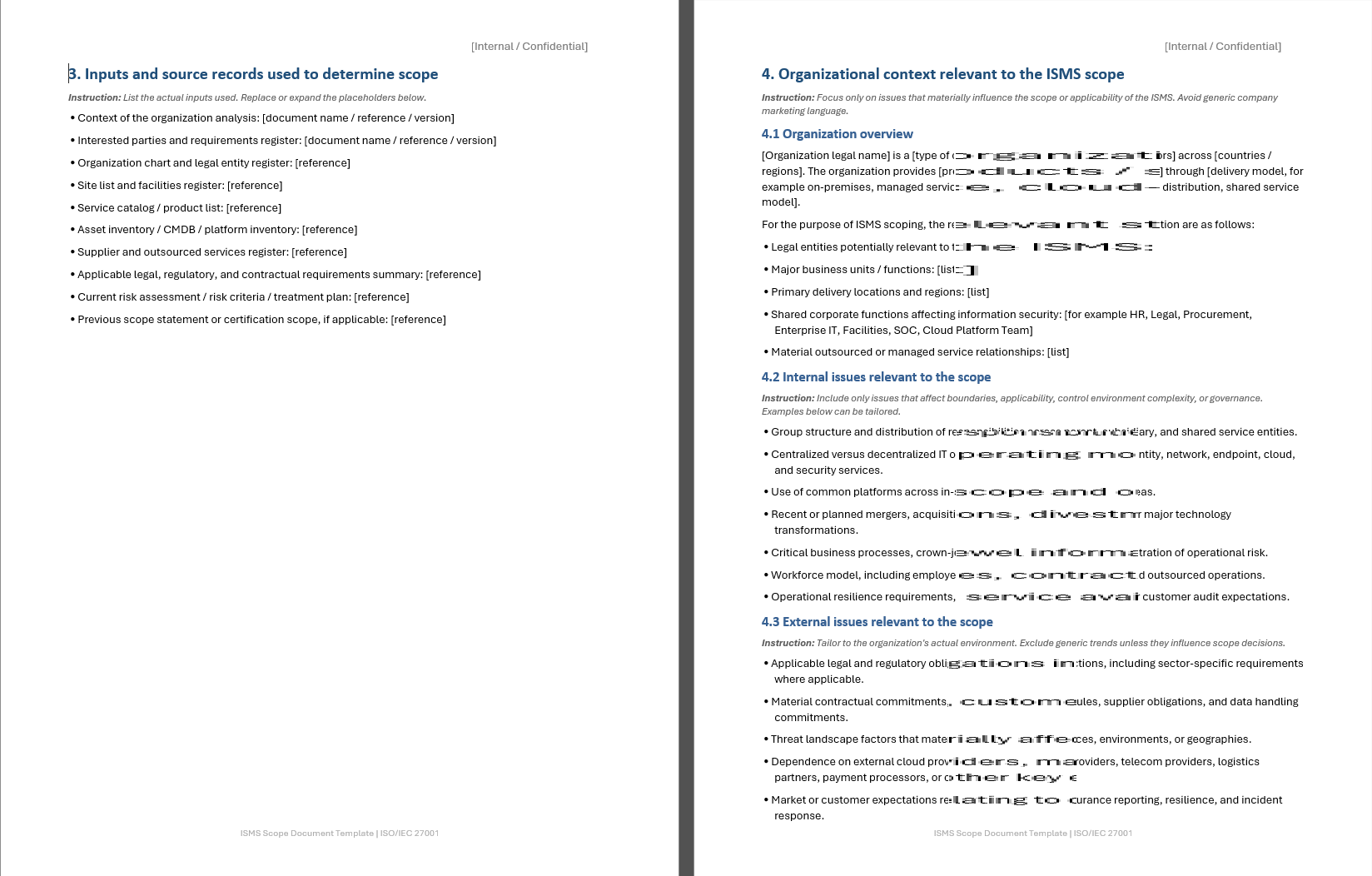
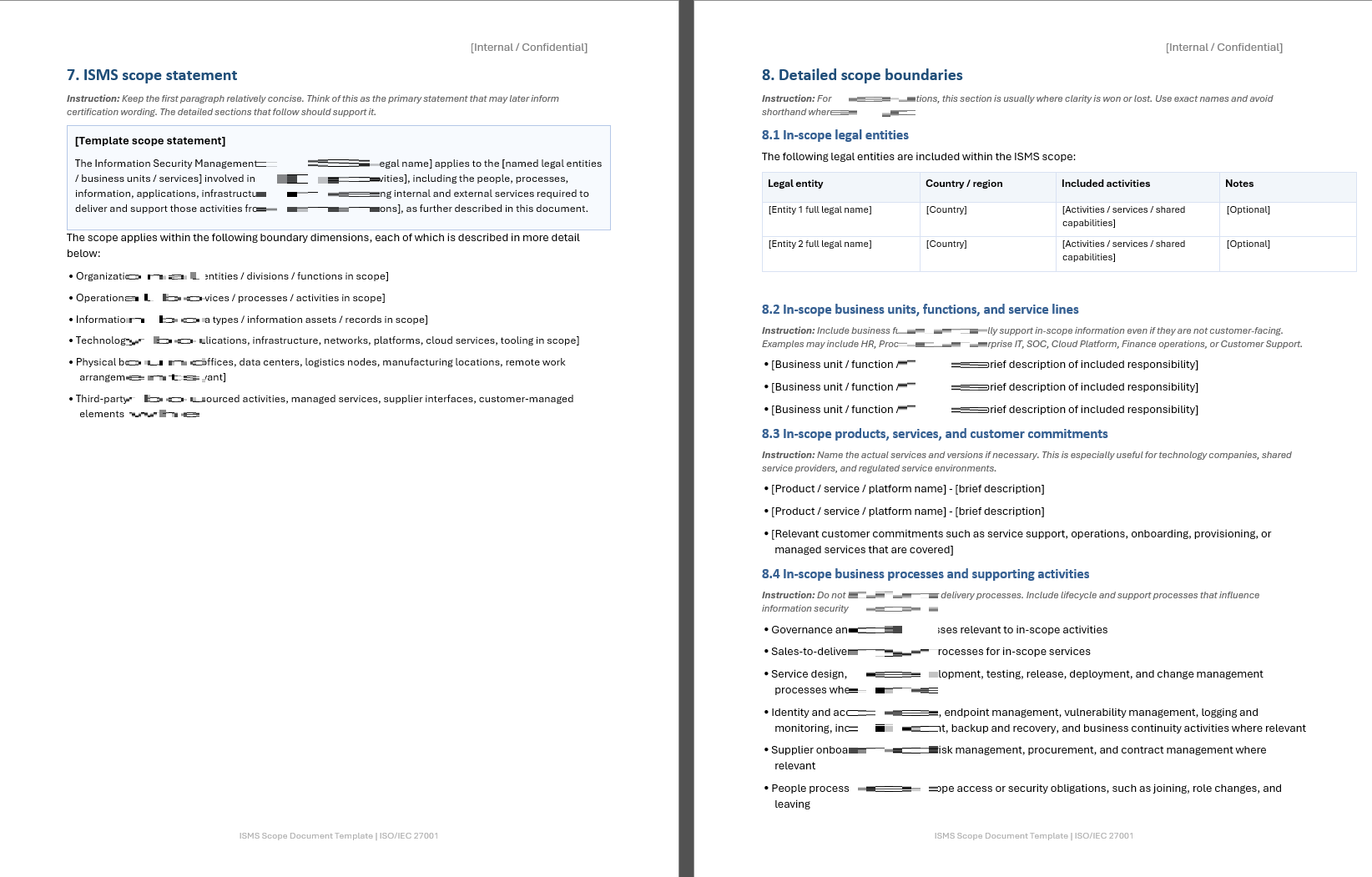
The structure is designed to support sections such as:
- Executive scope statement
- A concise statement of the ISMS scope that can be used for leadership review, certification readiness, and formal documentation.
- Organizational boundaries
- A section to describe the relevant legal entities, divisions, subsidiaries, business units, and group relationships that affect the scope.
- Operational scope
- Coverage for services, products, activities, customer-facing operations, and internal support functions that form part of the ISMS.
- Locations and environments
- Guidance for documenting headquarters, branch offices, data centers, cloud environments, remote workforce arrangements, and other relevant operational locations.
- Technology and information assets
- A framework for describing systems, applications, infrastructure, data types, and critical technology environments that support in-scope services and activities.
- Internal and external context
- Space to align the scope with business context, organizational realities, market pressures, regulatory obligations, and strategic priorities.
- Interested parties and requirements
- A section that helps link the scope to customer obligations, legal requirements, contractual expectations, board requirements, and other stakeholder needs.
- Interfaces and dependencies
- Support for describing shared services, third-party providers, outsourced activities, parent-company dependencies, and other connected environments that may affect the ISMS.
- Scope exclusions and justifications
- A clear place to document what is not included and why, which helps avoid vague or poorly defended exclusions.
- Governance and review
- A section to record ownership, review frequency, and change triggers so the scope remains current as the business evolves.
What this template helps you do
This template helps you define and document the boundaries and applicability of the ISMS in a way that is clear for management, useful for project teams, and defensible during internal reviews, external audits, and certification engagements.
It supports you in describing:
- which legal entities, business units, and functions are included
- which products, services, activities, and processes fall within scope
- which people, technologies, locations, and information assets are relevant
- which external providers, interfaces, and dependencies influence the ISMS
- which parts of the organization are outside scope and why
- how the scope relates to internal and external issues, stakeholder requirements, and operational realities
Why use a Scope Template for ISO 27001
Many ISO 27001 templates are too generic, too brief, or written for small organizations with simple environments. In practice, scoping often requires much more detail to be useful.
This template is different because it is built to handle real-world complexity. It gives you a fuller structure from the start so you can cut down where needed rather than having to rebuild missing sections later.
It also helps create more consistency across your documentation set. When you use a stronger scope template, it becomes easier to align the Statement of Applicability, risk assessment boundaries, asset inventories, supplier controls, and certification discussions with the same scoping logic.
Reviews
There are no reviews yet.