
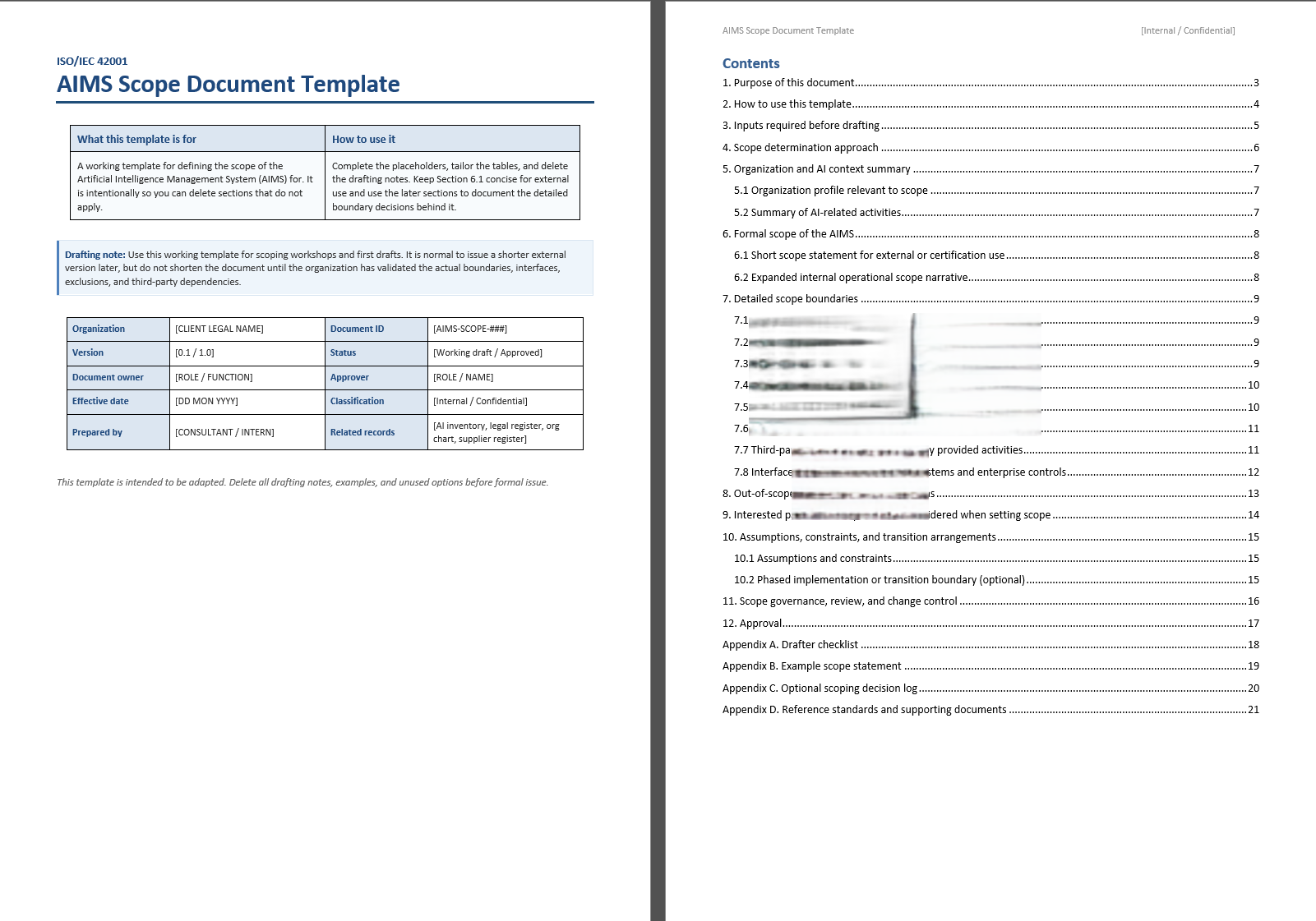
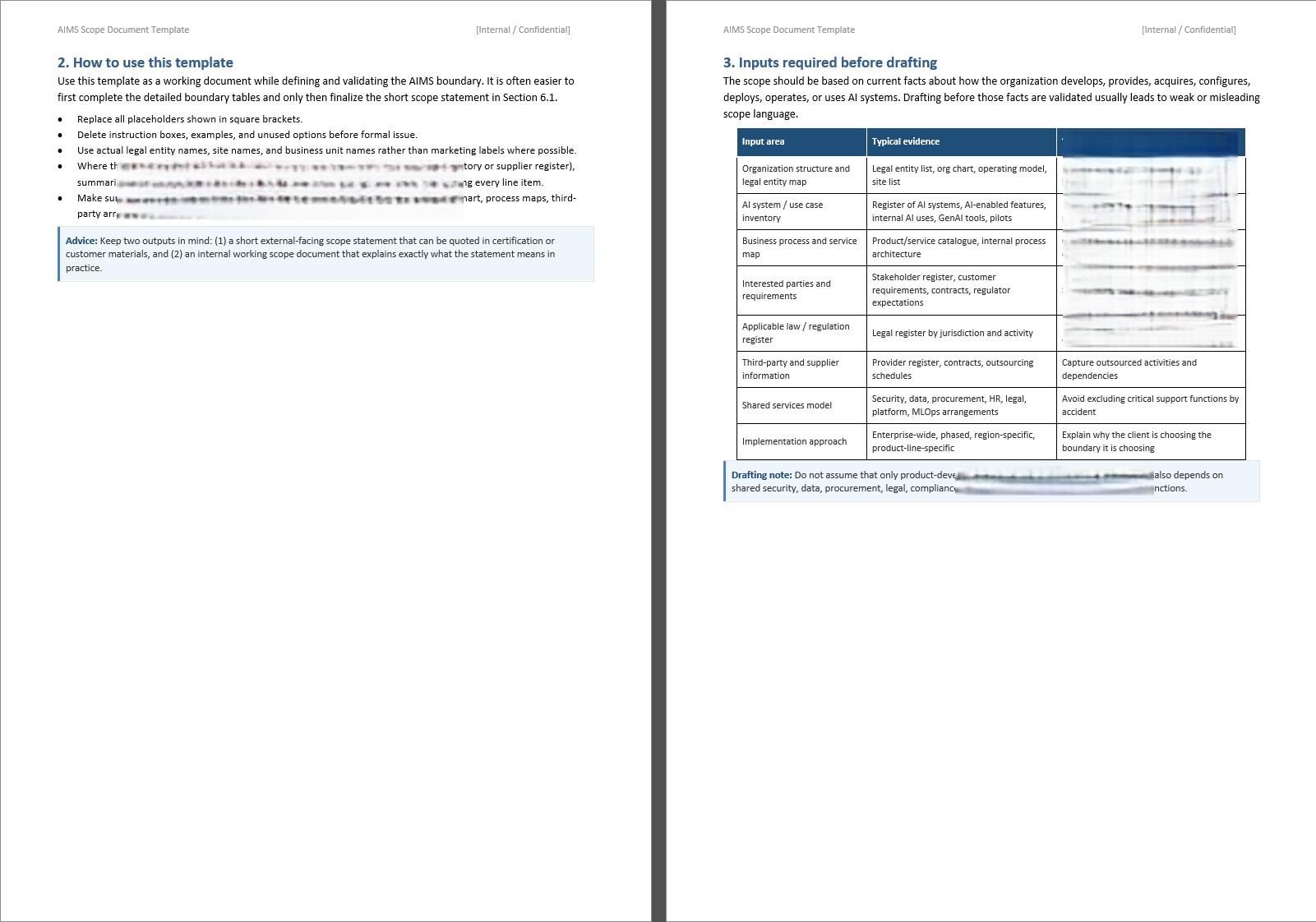
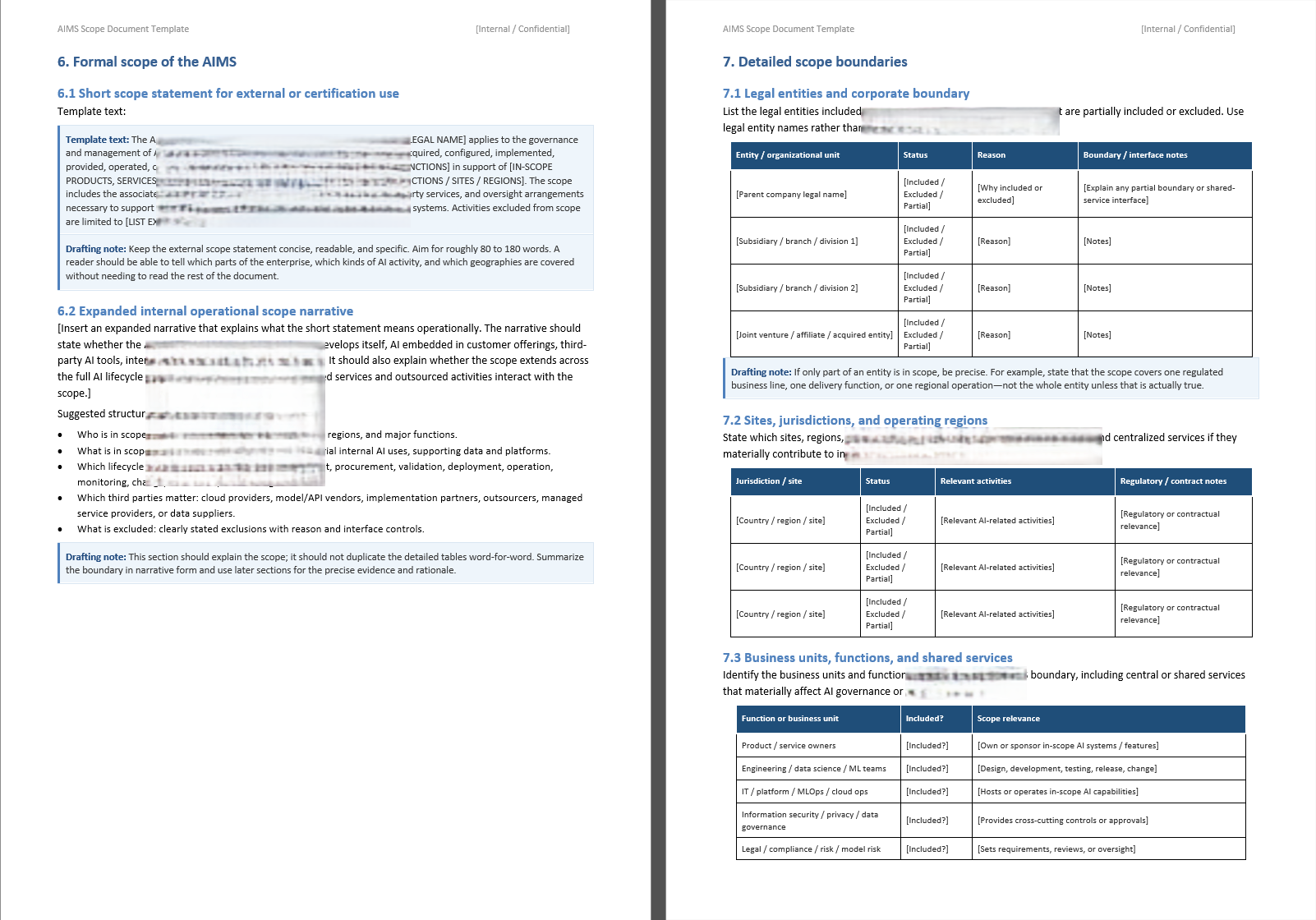
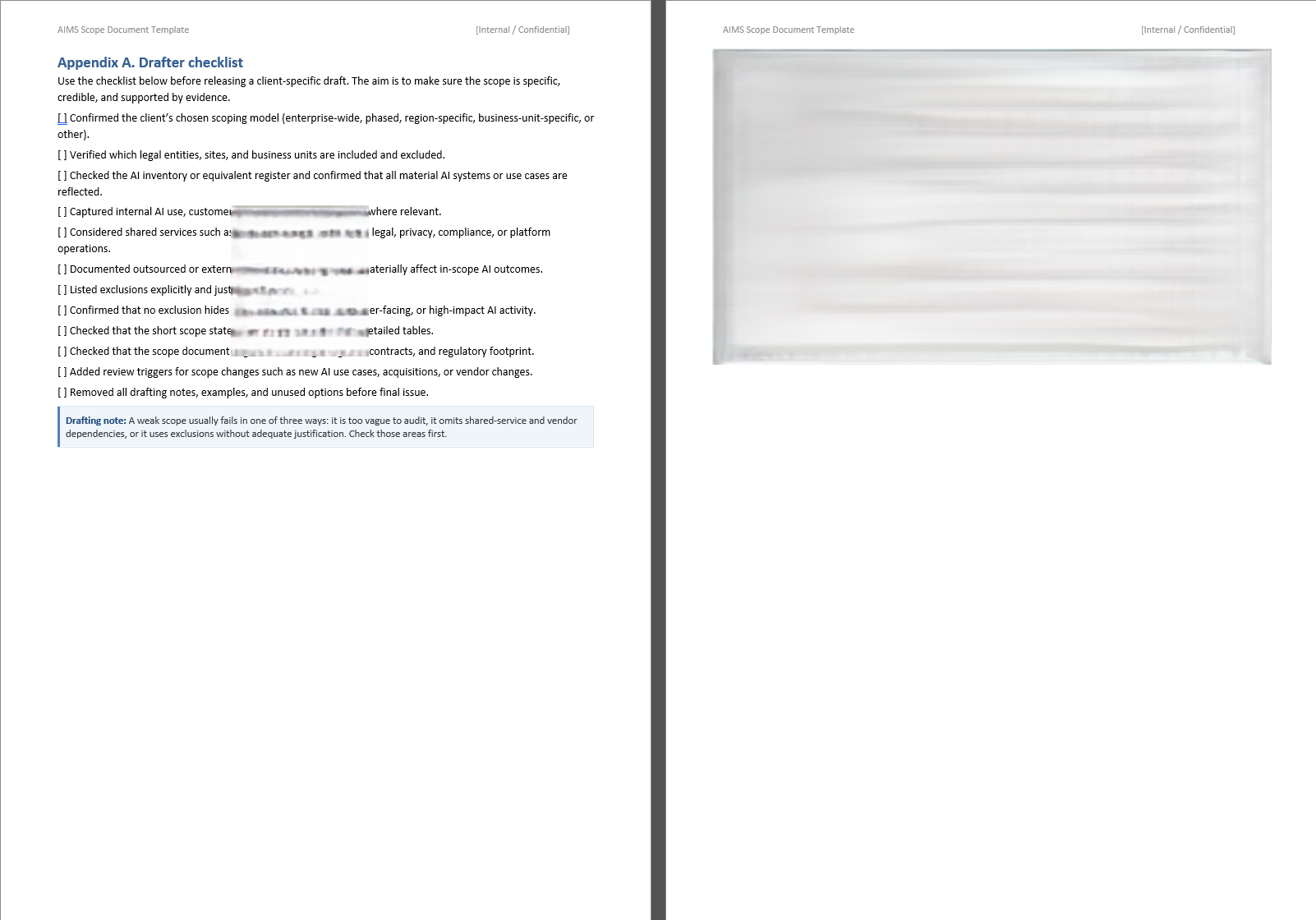
Overview of the AIMS Scope Document Template
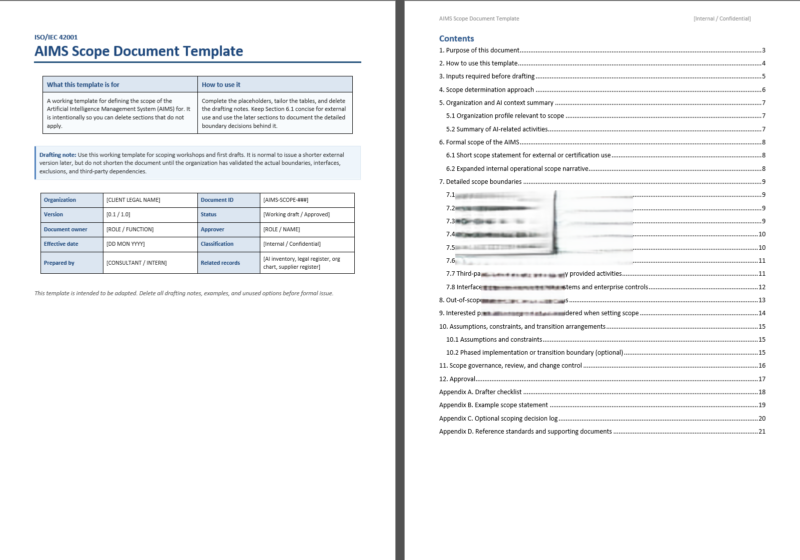
This template is a comprehensive expert-grade working document for defining and documenting the scope of an Artificial Intelligence Management System (AIMS) under ISO/IEC 42001:2023.
ISO/IEC 42001 requires an organization to determine the boundaries and applicability of its AIMS and to keep that scope available as documented information.
The standard applies to organizations that develop, provide, or use AI systems, so this template also supports companies that may operate across multiple legal entities, business units, geographies, platforms, and third-party relationships.
Purpose and Strategic Value of the AIMS Scope
The purpose of this template is to create a clear and defensible scoping baseline before the rest of the AI management system is written or audited.
A well-defined AIMS scope helps the organization apply AI governance consistently, manage risks and opportunities in a structured way, and support trust, accountability, traceability, transparency, and reliability in the development, provision, and use of AI systems.
Use of the Template Across the ISO/IEC 42001 Lifecycle
This template is typically used at the start of an ISO/IEC 42001 implementation, during gap assessments, when defining AI policy and objectives, before AI risk and impact assessments, when setting operational boundaries, and later during internal audit, management review, and certification preparation.
ISO/IEC 42001 includes requirements for AI risk assessment and treatment, AI system impact assessment, operational planning and control, internal audit, management review, continual improvement, and corrective action.
Scope Definition, Boundaries, and Applicability of the AIMS
This template is intentionally more detailed than a short certification scope statement. It is meant to capture the organization’s context and interested parties, the entities and sites in scope, the business units and shared services involved, the AI systems and use cases covered, the organization’s role in the AI system lifecycle, relevant data and technology dependencies, applicable third parties, exclusions and their justification, and the events that should trigger a scope review. This reflects the structure of ISO/IEC 42001, especially Clause 4.1 on organizational context, Clause 4.2 on interested parties, and Clause 4.3 on determining the scope of the AIMS. Clause 4.3 also makes clear that the defined scope drives the organization’s activities in relation to leadership, planning, support, operation, performance evaluation, improvement, controls, and objectives.
It is important to note that ISO/IEC 42001 does not require a document with the exact title “Scope Document.” What it requires is that the scope of the AIMS be determined and maintained as documented information. This template is therefore a practical way to meet that requirement in a structured, auditable, and reusable format for enterprise clients.
Alignment to ISO/IEC 42001 clauses
This template aligns directly with ‘Clause 4 Context of the Organization‘ which contains the following sub clauses:
- Clause 4.3 – Determining the scope of the AI management system
This is the primary clause supported by the template. - Clause 4.1 – Understanding the organization and its context
The template helps define internal and external issues relevant to the AIMS. - Clause 4.2 – Understanding the needs and expectations of interested parties
The template helps identify stakeholders and relevant requirements that shape the scope. - Clause 4.4 – AI management system
The scope provides the boundary within which the AIMS is established and maintained.
Reviews
There are no reviews yet.